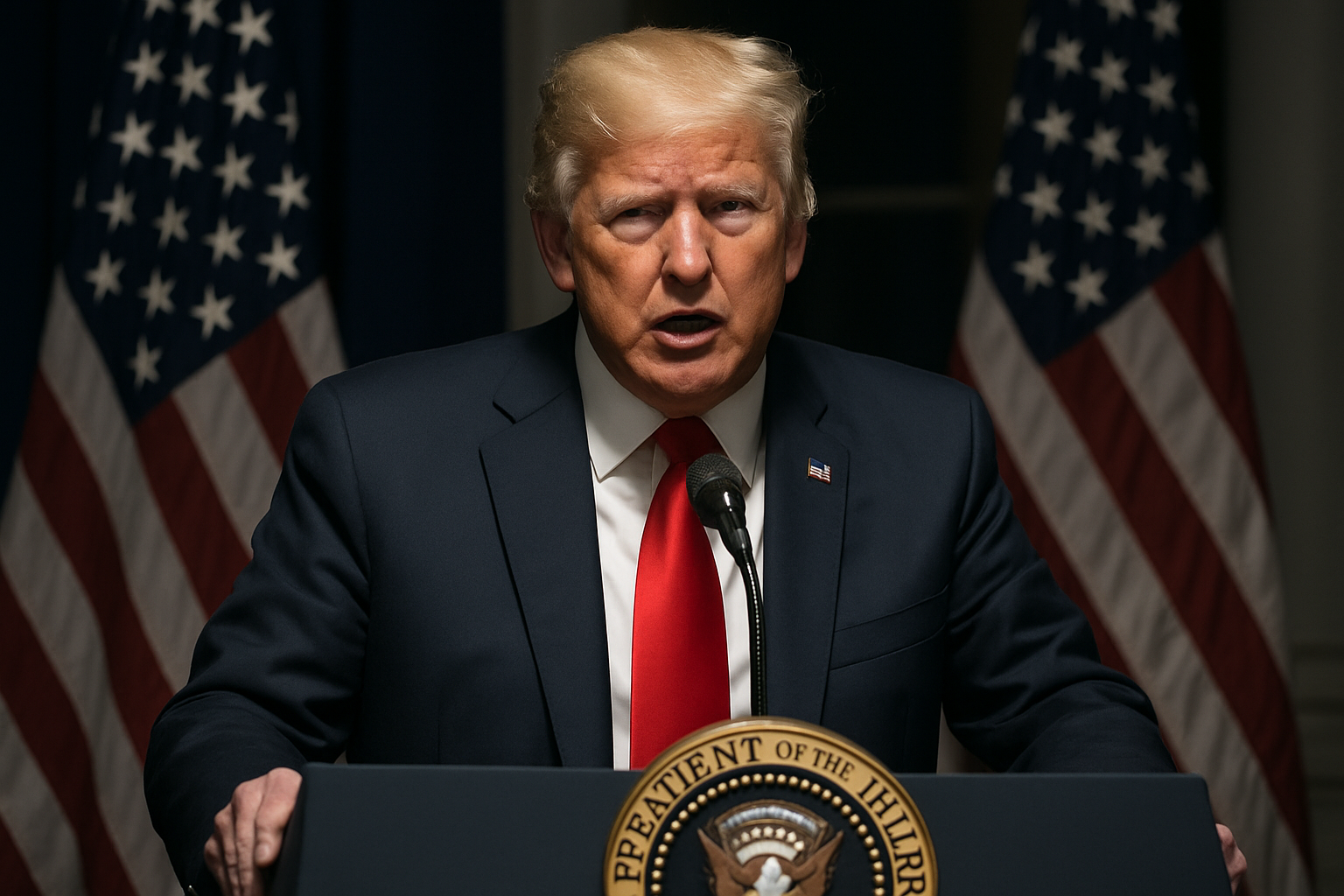
President Donald Trump issued his most explosive threat yet against Iran on Monday, warning that the United States has detailed plans to "destroy every bridge and power plant in Iran Tuesday night" if no ceasefire agreement is reached, escalating the most dangerous international crisis since the Cold War.
Speaking from the White House, Trump declared that "all of Iran can be taken out in one night... might be tomorrow night," calling Tehran's latest truce offer "significant" yet "insufficient" as the Tuesday deadline looms. The unprecedented ultimatum targets civilian infrastructure on a massive scale, prompting Iran to dismiss the threats as "baseless" from a "delusional US president."
Iran Categorically Rejects Negotiations
Iran's response has been swift and defiant. Foreign Minister Abbas Araghchi told his French counterpart that Trump's threats "normalize war crimes and genocide," while the Revolutionary Guard maintains that "no red lines remain" for systematic retaliation. Parliamentary Speaker Mohammad Bagher Ghalibaf warned that "the region will burn" if military action proceeds.
The Iranian government has categorically rejected the 45-day ceasefire proposal transmitted through Pakistan, instead demanding a permanent end to the conflict. Iran's 10-point response includes an end to all regional conflicts, establishment of a Strait of Hormuz safety protocol, complete lifting of sanctions, and full reconstruction assistance.
Crucially, Iran has refused to reopen the strategically vital Strait of Hormuz as part of any temporary ceasefire arrangement, maintaining this leverage as their primary negotiating tool. The waterway, which handles 40% of global oil transit, remains effectively closed due to Iranian naval mining operations.
Global Crisis Reaches Breaking Point
The escalating confrontation has pushed the global economy to the brink of crisis. Oil prices have surged to $119+ per barrel for Brent crude, heading toward potential $200 levels, while the International Energy Agency has authorized the largest strategic petroleum reserve release in 50-year history, deploying 400 million barrels from 32 countries to stabilize markets.
The aviation industry faces COVID-scale disruptions, with over 18,000 flights cancelled worldwide due to Middle Eastern airspace closures. Dubai International Airport, the world's busiest with 86 million passengers annually, remains shuttered following Iranian missile damage in what officials describe as an indefinite closure.
Iran has deployed between 2,000-6,000 naval mines in the Strait of Hormuz, effectively blocking the critical waterway and stranding more than 150 tankers carrying billions of dollars in cargo. Major shipping companies Maersk and MSC have suspended all Persian Gulf operations indefinitely.
Operation Epic Fury: Historic Military Campaign
The current conflict, dubbed "Operation Epic Fury," has become the largest U.S. Middle East military operation since the 2003 Iraq invasion, with costs reaching $11.3 billion in the first week alone. The operation has already claimed American lives, with Trump conducting a dignified transfer ceremony for six fallen U.S. soldiers killed in Iranian drone strikes in Kuwait.
The unprecedented military deployment includes a dual-carrier strike force featuring the USS Gerald R. Ford and USS Abraham Lincoln, representing approximately one-third of the active U.S. Navy fleet. Recent operations included a complex rescue mission extracting downed U.S. airmen from Iranian territory using over 170 aircraft, including 4 B-2 bombers, 64 fighters, 48 tankers, and 13 rescue aircraft.
In a historic naval engagement, the USS Charlotte submarine sank the Iranian frigate IRIS Dena near Sri Lanka, killing over 80 crew members in the first enemy vessel destroyed by a U.S. submarine since World War II.
European Territory Attacked for First Time Since WWII
The conflict has expanded beyond regional boundaries, with Iranian drones striking RAF Akrotiri in Cyprus—marking the first attack on European territory since World War II. This unprecedented escalation prompted the European Union to activate its ESTIA crisis mechanism for the first time in the bloc's history.
A multinational naval coalition featuring HMS Dragon and Spanish, Italian, French, Dutch, and Greek vessels has been deployed to protect European interests. However, European allies have largely rejected Trump's broader demands for Strait of Hormuz support, emphasizing diplomatic solutions over military escalation.
Congressional Opposition Intensifies
Domestic political pressure on the Trump administration has reached unprecedented levels, with only 25% of Americans supporting the military operations—described by analysts as "almost unprecedented" unpopularity for early-stage operations. Senator Chris Murphy declared that Trump has "lost control" and appears "unsettled and disorganized," while Senator Richard Blumenthal expressed being "more concerned than ever" about potential ground troop deployment.
Pentagon projections suggest operations could extend through September, far beyond the initial 4-6 week timeline. Congress is demanding comprehensive briefings on strategy, costs, and the possibility of ground troop involvement, with emergency military appropriations potentially exceeding $200 billion.
Iran's Leadership Transition Crisis
Adding complexity to the crisis, Iran is undergoing its first hereditary succession in the Islamic Republic's 47-year history. Following Supreme Leader Ali Khamenei's death on March 1, his son Mojtaba Khamenei has assumed power, marking a fundamental shift from clerical to military-influenced governance through Revolutionary Guard control.
Trump has explicitly rejected this succession, claiming the right to personally choose Iran's next leader—the most direct assertion of American control over Iranian affairs since the 1979 revolution. This stance eliminates virtually all diplomatic pathways to resolution.
Pakistan Mediation: Final Diplomatic Window
Pakistan has emerged as the sole remaining mediator, with Foreign Minister Ishaq Dar confirming "indirect talks" through a "message relay system." Prime Minister Shehbaz Sharif has formally offered Pakistan as a venue for "meaningful conclusive talks" for a comprehensive settlement, with China expressing "full support" for the initiative.
The proposed "Islamabad Accord" features a two-phase framework: an immediate 45-day ceasefire followed by comprehensive negotiations for long-term settlement. Germany has noted "positive signs" that direct talks may begin "very soon" with Pakistan as the venue, though Iranian conditions remain fundamentally incompatible with U.S. demands.
Nuclear Diplomacy Collapse
The current crisis emerged from the complete breakdown of nuclear negotiations that had shown unprecedented promise. Geneva talks in February achieved "broad agreement on guiding principles"—the most significant progress since the JCPOA collapse in 2018. However, fundamental scope disagreements proved insurmountable, with Iran demanding nuclear-only discussions while the U.S. insisted on comprehensive agreements addressing ballistic missiles, regional proxies, and human rights.
Iran continues uranium enrichment at 60% purity with over 400 kilograms of weapons-grade material, sufficient for multiple nuclear weapons if weaponized. The nuclear crisis unfolds against the broader backdrop of the New START treaty expiration in February 2026—the first time in over 50 years without U.S.-Russia nuclear constraints.
Humanitarian Crisis Mounting
The humanitarian toll continues to escalate, with the Iran Red Crescent reporting over 787 civilian casualties from U.S.-Israeli strikes, including a devastating elementary school attack that killed 165-185 students due to what Pentagon officials acknowledged as "outdated targeting data." International war crimes investigations have been initiated.
Evacuation operations are reaching Arab Spring-scale proportions, with Australia reporting 115,000 citizens trapped in the region and Germany evacuating 30,000 tourists. Multiple countries have issued "extremely uncertain security" warnings and ordered immediate evacuations.
Regional Coalition Under Severe Strain
The unprecedented regional coalition of Saudi Arabia, UAE, Qatar, and Egypt that initially supported diplomatic processes is now severely threatened by Iranian "Operation True Promise 4" attacks targeting coalition member territories. The UAE has confirmed one civilian killed in Abu Dhabi, Kuwait reported 32 injured in airport strikes, and Qatar suffered 8 wounded while intercepting 65 missiles and 12 drones.
Egyptian President Abdel Fattah el-Sisi condemned Iranian attacks on "sisterly countries," warning of "comprehensive chaos" if the conflict continues to spread regionally. This represents a fundamental fracture in Middle Eastern diplomatic consensus that had been unprecedented in its unity.
Tuesday Night Deadline: Point of No Return
As the Tuesday deadline approaches, Trump's ultimatum targeting Iranian civilian infrastructure represents a potential point of no return in the conflict. The threat to systematically destroy power plants and bridges would constitute an unprecedented escalation beyond conventional military targeting, potentially triggering massive civilian casualties and broader regional war.
UN Secretary-General António Guterres has called this "the greatest test of multilateral cooperation and crisis management in the modern era." The stakes encompass regional war prevention, global energy security, nuclear governance credibility, and the sustainability of post-World War II international order principles.
Historical Significance and Global Implications
The current crisis represents the most dangerous international moment since the Cold War's end, testing diplomatic solutions' viability versus military confrontation in the multipolar era. Success in preventing broader war could provide a 21st-century template for nuclear crisis resolution, while failure may accelerate military solutions that reshape Middle Eastern geopolitics for decades, encourage nuclear proliferation elsewhere, and undermine diplomatic credibility for international disputes worldwide.
As Tuesday night approaches, the world watches to see whether last-minute diplomacy through Pakistan mediation can prevent what many analysts describe as the most consequential international crisis of the modern era—one whose implications will extend far beyond the current administration and reshape global governance mechanisms for generations to come.