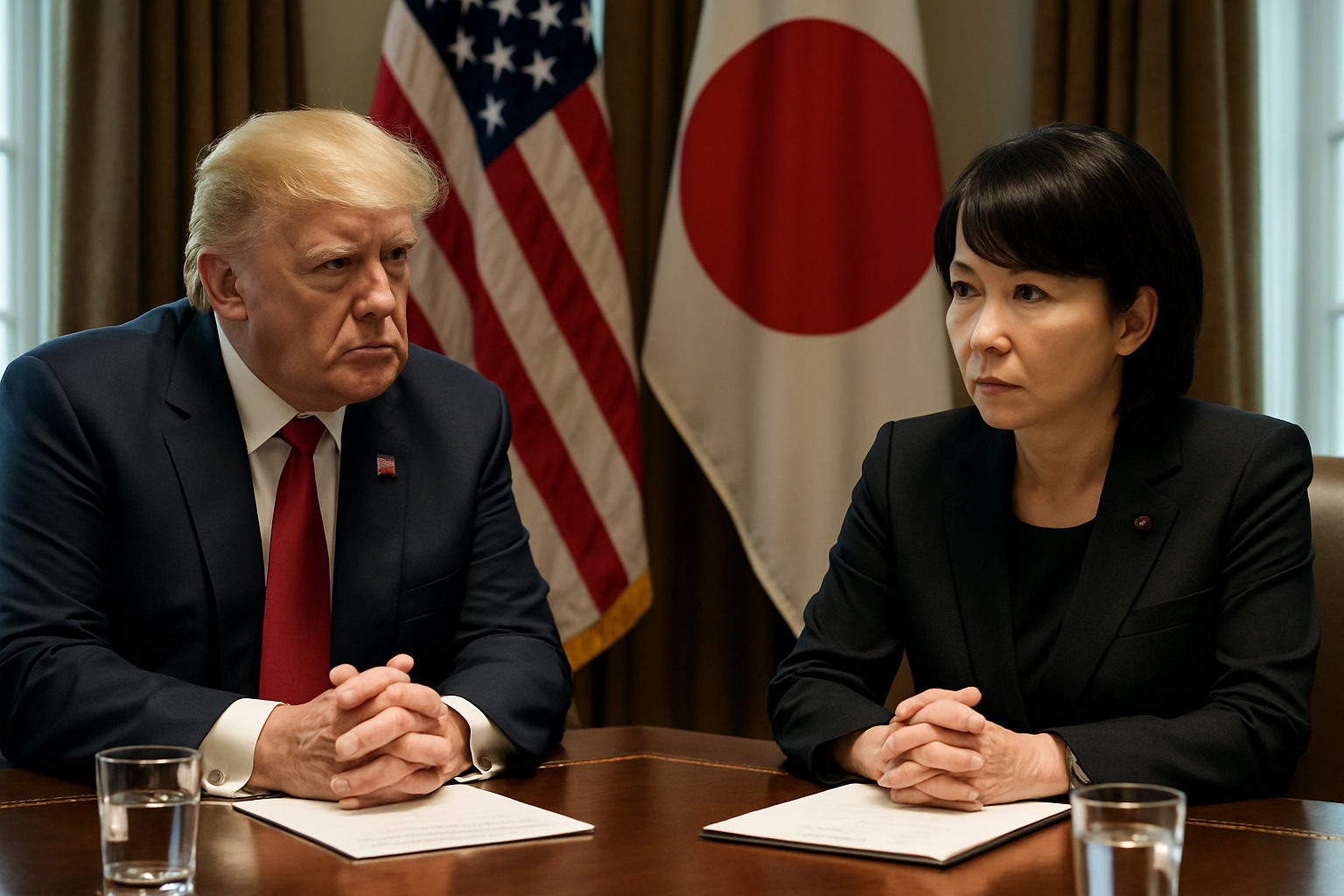
President Donald Trump stunned Japan's Prime Minister Sanae Takaichi during a White House meeting by comparing U.S. strikes on Iran to Japan's 1941 Pearl Harbor attack, defending his decision not to inform allies in advance of military operations against Tehran.
The controversial comparison came as Trump explained his administration's rationale for conducting Operation Epic Fury—the largest U.S.-Israeli coordinated military campaign since 2003—without prior consultation with key allies, including Japan. When asked by a Japanese reporter why the U.S. had not informed allies about the war in advance, Trump responded with a reference that evoked one of the most sensitive moments in U.S.-Japan relations.
"We wanted it to be a surprise," Trump said, according to multiple international news sources. "Why didn't you tell me about Pearl Harbor?" he reportedly asked Prime Minister Takaichi directly, drawing a parallel between American military surprise and Japan's historic attack.
Diplomatic Tensions Amid Global Crisis
The exchange occurred during a critical period in the ongoing Iran conflict, which has triggered the most severe global energy and security crisis since the Cold War. With oil prices surging past $100 per barrel for the first time since 2022 and the Strait of Hormuz effectively closed by Iranian mining operations, the meeting between Trump and Takaichi carried significant weight for international cooperation.
Prime Minister Takaichi's visit to Washington came as Tokyo joined several European countries in issuing a joint statement expressing readiness "to contribute to appropriate efforts" to secure the Strait of Hormuz. However, Japan notably declined Trump's direct requests to send naval vessels to the region, dealing a significant blow to U.S. coalition-building efforts.
The Pearl Harbor comparison reportedly left Takaichi visibly surprised, according to sources familiar with the meeting. The reference to the December 7, 1941 attack—which killed over 2,400 Americans and drew the United States into World War II—represents one of the most sensitive historical touchstones in U.S.-Japan relations, despite the countries' transformation into close allies in the post-war era.
Japan's Careful Balancing Act
Despite the awkward moment, Trump praised Takaichi publicly, saying Japan was "stepping up to the plate" on Iran issues. The Japanese Prime Minister had traveled to Washington in a delicate position—her country depends heavily on Middle Eastern oil imports, with 95% of Japan's oil coming from the region and 70% transiting through the now-blocked Strait of Hormuz.
Japan's cautious approach reflects broader international reluctance to fully support Trump's military campaign against Iran. Major allies including Germany, France, Australia, and the United Kingdom have either explicitly declined to send warships or refused base access for Iran operations, citing concerns about repeating "Iraq War mistakes."
During the meeting, Takaichi navigated between showing solidarity with the U.S. while avoiding full military commitment. Japan has agreed to contribute to diplomatic efforts and maritime security discussions but stopped short of the naval deployment Trump requested.
Historical Context of the Iran Crisis
The controversial exchange occurred against the backdrop of the most dangerous international crisis since the Cold War. The current conflict emerged from the complete collapse of U.S.-Iran nuclear negotiations, despite achieving what diplomats called "broad agreement on guiding principles" in Geneva—the most progress since the 2018 JCPOA collapse.
Iran maintains that ballistic missiles and proxy groups represent "red lines" that cannot be included in nuclear-only talks, while the U.S. demands comprehensive agreements covering missiles, armed groups, and human rights. This fundamental disagreement led to Operation Epic Fury, which has cost $11.3 billion in its first week alone.
The conflict has triggered unprecedented global disruptions: over 18,000 flights have been cancelled worldwide, eight Middle Eastern countries have closed their airspace simultaneously, and Dubai International Airport—the world's busiest—remains shuttered due to missile damage.
Energy Security Implications
Japan's energy vulnerability makes the current crisis particularly acute for Tokyo. The country relies on the Middle East for 95% of its oil supplies, with 70% transiting through the Strait of Hormuz—the 21-mile waterway that Iran has effectively blockaded with an estimated 2,000-6,000 naval mines.
In response to the crisis, Japan has announced its first strategic petroleum reserve deployment since the 2011 Fukushima disaster, releasing 80 million barrels as part of a coordinated international response. The International Energy Agency has orchestrated the largest strategic reserve release in its 50-year history, with 400 million barrels from 32 countries being deployed to stabilize markets.
The energy crisis has pushed natural gas prices up 24% in Europe and 78% in the United States, while major shipping companies Maersk and MSC have suspended Persian Gulf operations, leaving over 150 oil and LNG tankers stranded with billions of dollars in cargo.
Regional Coalition Under Strain
Trump's Pearl Harbor comment came as his administration struggles to build international support for the Iran campaign. A previously unprecedented coalition of Saudi Arabia, UAE, Qatar, and Egypt supporting diplomatic solutions has been severely strained as Iranian retaliation targets their territories directly.
The UAE has suffered one civilian death in Abu Dhabi, Kuwait has experienced 32 injuries from airport drone strikes, and Qatar intercepted 65 missiles and 12 drones, resulting in 8 injuries despite Patriot missile defenses. Egyptian President Abdel Fattah el-Sisi has warned of "comprehensive chaos" spreading across the region if attacks on "sisterly Arab countries" continue.
Congressional and Domestic Pressures
The diplomatic incident occurs as Trump faces mounting congressional scrutiny over the Iran conflict. Bipartisan lawmakers are demanding comprehensive answers about strategy, costs, and the potential for ground troop deployment. The conflict has achieved what one senator called "almost unprecedented" unpopularity, with only 25% American support in early polling.
Senator Richard Blumenthal has expressed being "more concerned than ever" about the possibility of boots on the ground, while the Pentagon has quietly prepared operations through September 2026—far beyond the initial 4-6 week timeline presented to Congress. With costs approaching $900 million daily, some analysts suggest financial markets may serve as the "ultimate constraint" on prolonged military action.
Nuclear Governance Crisis Context
The Trump-Takaichi meeting occurred during what UN Secretary-General António Guterres has described as the "greatest test of multilateral cooperation in the modern era." The crisis comes amid the February expiration of the New START Treaty—creating the first 50+ year gap without U.S.-Russia nuclear constraints—while Iran continues uranium enrichment at 60% purity with over 400 kilograms of weapons-grade material.
This broader nuclear governance breakdown provides additional context for the sensitivity around Trump's historical references and the urgent need for diplomatic coordination among allies.
Looking Forward
The Pearl Harbor controversy highlights the complex dynamics facing U.S.-Japan relations during this unprecedented crisis. While both nations maintain their fundamental alliance, the incident demonstrates how historical sensitivities can complicate modern diplomatic cooperation, particularly when dealing with military actions that echo past conflicts.
As the Iran crisis continues with no clear resolution in sight, Trump's ability to maintain allied support may prove crucial to achieving his stated objectives. The reaction to his Pearl Harbor comparison serves as a reminder that even close allies require careful diplomatic handling, especially when asking for support in controversial military campaigns.
Prime Minister Takaichi's restrained response—continuing with the planned meetings and joint statements despite the provocative comparison—reflects Japan's commitment to the alliance while managing domestic sensitivities about historical references to wartime conflicts. The incident may ultimately serve as a case study in how alliance relationships navigate both historical legacy and contemporary crisis management in an increasingly complex global environment.