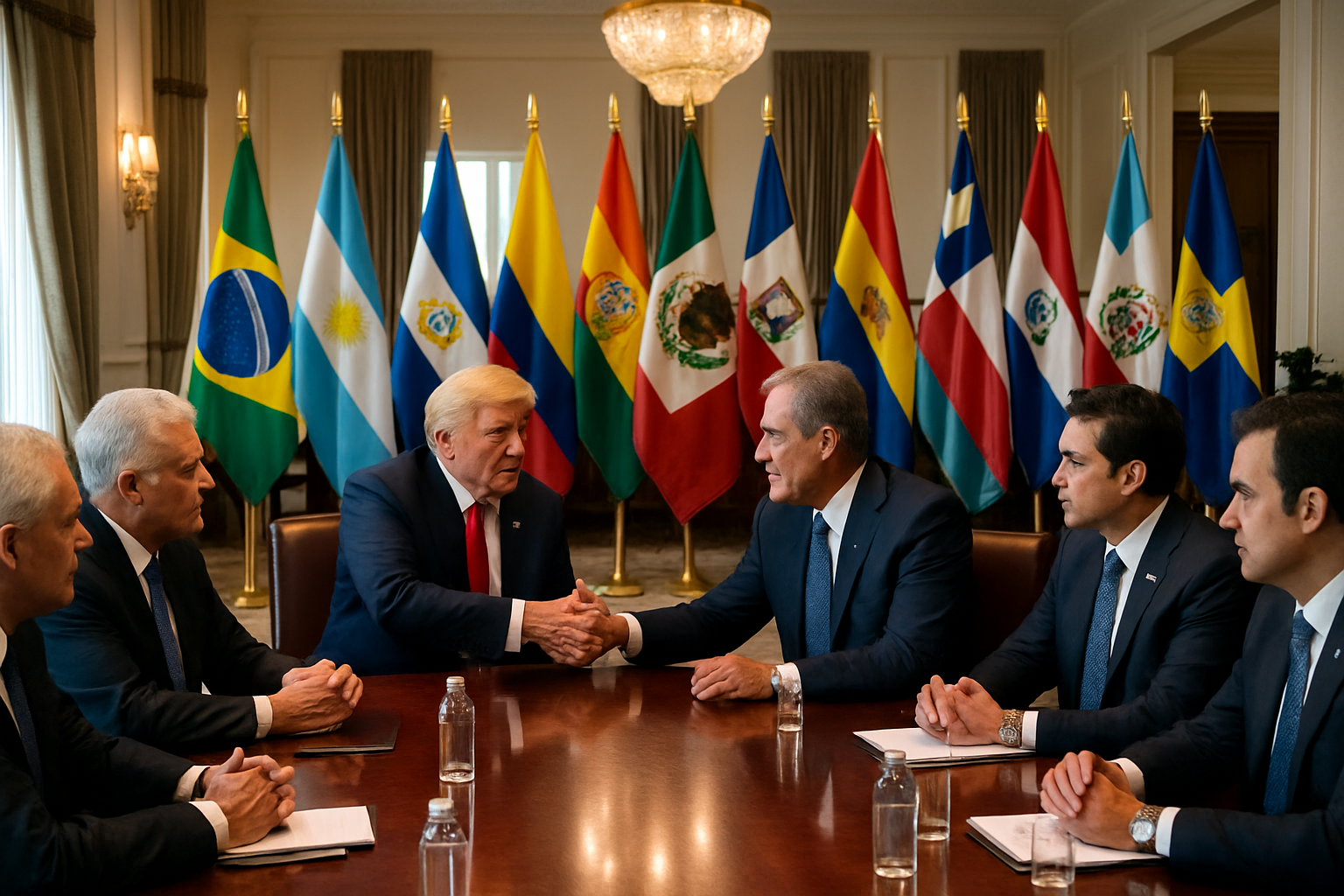
President Donald Trump hosted Latin American leaders at his Miami-area golf club on Saturday in what the White House termed the "Shield of the Americas" summit, marking his most significant hemispheric diplomatic initiative since taking office and representing a direct challenge to China's expanding influence across the region.
The gathering, held at Trump's luxury resort, brought together key regional allies including Guyana President Irfaan Ali and Trinidad and Tobago Prime Minister Kamla Persad-Bissessar, just days after U.S. strikes against Iranian positions drew international attention to America's global military posture.
Strategic Timing and Geopolitical Context
The summit occurs at a crucial moment for U.S. hemispheric relations, coming just two months after Trump ordered a dramatic military operation that captured former Venezuelan president Nicolás Maduro, fundamentally reshaping the regional balance of power. This action, combined with the subsequent energy cooperation agreements with Venezuela's interim government under Acting President Delcy Rodríguez, has demonstrated the Trump administration's willingness to use both military pressure and economic incentives to advance its hemispheric agenda.
The timing is particularly significant as it follows Venezuela's remarkable transformation from a sanctioned pariah state to America's newest energy partner, with oil exports surging 60% to 800,000 barrels daily since January 2026. This dramatic reversal has displaced China as Venezuela's top customer, marking a strategic victory for the "Corolario Trump" doctrine—the administration's 21st-century update to the Monroe Doctrine.
The Anti-China Focus
The summit's primary objective centers on countering China's extensive economic penetration of Latin America, where Beijing has invested hundreds of billions of dollars in infrastructure projects, mining operations, and trade partnerships over the past decade. China currently controls 60% of global critical minerals production and 90% of refining capacity, giving it significant leverage over countries dependent on these resources.
Trump's approach represents a comprehensive challenge to Chinese influence through what administration officials describe as "bilateral energy diplomacy." This strategy combines direct military pressure, economic partnerships, and selective engagement to create alternatives to Chinese investment and trade relationships.
"We're demonstrating that the United States offers better partnerships—partnerships based on mutual respect and shared democratic values, not debt-trap diplomacy,"
— Senior Administration Official
The Venezuelan case has become the template for this approach. Energy Secretary Chris Wright's historic February visit to Caracas, where he signed comprehensive cooperation agreements ending the 2019 oil embargo, demonstrates how rapidly U.S. policy can shift when strategic interests align. The result has been immediate: American companies including Chevron, BP, Shell, Eni, and Repsol have received authorization for expanded operations, while Venezuela has reoriented its entire energy export strategy toward U.S. markets.
Regional Security Cooperation
The "Shield of the Americas" initiative encompasses more than economic competition, extending into security cooperation that has already begun reshaping Caribbean and Central American dynamics. The appointment of former DHS Secretary Kristi Noem as Special Envoy for the initiative signals the administration's commitment to sustained engagement across traditional diplomatic, economic, and security domains.
Recent developments underscore the militarized nature of this approach. Operation Southern Spear, the Caribbean counter-narcotics campaign, has resulted in 145+ deaths since September 2025 through direct military strikes against suspected drug trafficking vessels. While controversial, these operations have been paired with diplomatic initiatives like the recent U.S.-Colombia cooperation reset following President Gustavo Petro's White House meeting with Trump in February.
The administration's dual-track strategy—combining kinetic operations with diplomatic engagement—reflects lessons learned from the Venezuelan experience, where military pressure preceded and enabled subsequent cooperation agreements.
Economic Partnerships and Energy Cooperation
Beyond security matters, the summit focused heavily on expanding economic ties through energy partnerships and critical minerals cooperation. The successful U.S.-Argentina trade agreement, which eliminated over 1,600 tariffs and quintupled beef imports, provides another model for rapid bilateral economic integration that offers alternatives to Chinese partnerships.
Trinidad's participation is particularly significant given discussions about restarting the Petrotrin refinery, which could process Venezuelan crude under U.S. technical assistance. This would create a integrated Caribbean energy hub under American influence, directly challenging Chinese infrastructure investments in the region.
The February Critical Minerals Ministerial, which included 11 bilateral agreements with countries like Bolivia, Ecuador, and Paraguay, established frameworks for challenging China's dominance in strategic materials essential for renewable energy and advanced manufacturing. These partnerships offer Latin American countries alternatives to Chinese financing while providing the U.S. with secure supply chains.
Democratic Transitions and Political Support
The summit also highlighted the administration's support for democratic transitions across the region, particularly Venezuela's ongoing political transformation. The recent release of over 750 political prisoners under the comprehensive 1999-2026 amnesty law demonstrates how American partnership can incentivize democratic reforms.
This approach contrasts sharply with Chinese engagement, which typically avoids conditional requirements for political reforms or human rights improvements. By linking economic partnerships to democratic progress, the administration aims to offer a values-based alternative to Chinese investment models.
Challenges and Skepticism
Despite these successes, the "Shield of the Americas" approach faces significant challenges. Congressional Democrats have demanded transparency regarding Venezuelan oil sales and raised concerns about the militarized aspects of counter-narcotics operations. The recent House vote ending Canada tariffs with Republican defections demonstrates growing congressional anxiety about the administration's trade approaches.
Regional sovereignty concerns have also emerged, particularly following incidents like the February 13 U.S. drone strike in Saint Vincent and the Grenadines territorial waters that seized $500 million in cocaine without diplomatic notification. Such operations, while successful operationally, have created anxiety among fishing communities and raised questions about respect for territorial sovereignty.
The effectiveness of the approach also depends on sustained commitment across electoral cycles and the ability to deliver concrete economic benefits that match Chinese investment levels. China's announcement of zero-tariff access for 53 African countries demonstrates Beijing's capacity for rapid, large-scale economic diplomacy that may be difficult to match through bilateral approaches.
International Reactions and Regional Dynamics
The summit has drawn mixed reactions from across Latin America and the international community. Brazil and the European Union have offered cautious support for Venezuelan democratic transitions while expressing concerns about the militarized aspects of U.S. regional policy. The Dominican Republic's decision to reopen relations with Venezuela reflects the gravitational pull of successful U.S. partnerships.
However, the approach has also exposed regional divisions, particularly evident during the recent CARICOM 50th anniversary summit in Saint Kitts and Nevis. Trinidad's strong support for U.S. operations contrasted with other Caribbean nations' emphasis on the "zone of peace" doctrine, highlighting the challenges of building regional consensus around American leadership.
Looking Ahead: Sustainability and Expansion
The success of the "Shield of the Americas" initiative will ultimately be measured by its ability to provide sustainable alternatives to Chinese partnerships while respecting regional sovereignty and democratic values. The Venezuelan model offers promise but also highlights the challenges of rapid transformation.
Oil production in Venezuela remains well below historical peaks, infrastructure decay continues, and questions persist about the sustainability of democratic reforms. Success requires sustained international investment, technical assistance, and political commitment that extends beyond immediate diplomatic victories.
The initiative's expansion to other countries will test whether the Venezuelan template can be replicated elsewhere or whether it represents a unique confluence of circumstances. The upcoming March 31-April 2 Trump-Xi summit in Beijing will provide another test of whether the bilateral approach can effectively compete with Chinese multilateral economic diplomacy.
Strategic Implications for the Hemisphere
The "Shield of the Americas" summit represents the most significant U.S. hemispheric initiative since the Cold War, combining elements of the original Monroe Doctrine with 21st-century tools of economic statecraft and targeted military intervention. Its success or failure will determine whether American influence can be successfully reconfigured for an era of great power competition.
For Latin American countries, the initiative offers both opportunities and challenges. Access to American markets, technology, and security cooperation provides alternatives to Chinese dependency, but acceptance may require political reforms and alignment with U.S. strategic objectives that some governments may find constraining.
The summit's immediate outcomes—strengthened bilateral relationships, expanded energy cooperation, and enhanced security partnerships—provide a foundation for sustained American engagement. However, the ultimate test will be whether these partnerships can deliver the economic development and political stability that regional populations demand while successfully competing with Chinese alternatives.
As President Trump concluded the summit, the message was clear: the Western Hemisphere would no longer be a secondary theater in American foreign policy. The "Shield of the Americas" represents a comprehensive strategy to reclaim regional leadership through a combination of partnership, pressure, and strategic investment that directly challenges China's expanding footprint across Latin America and the Caribbean.