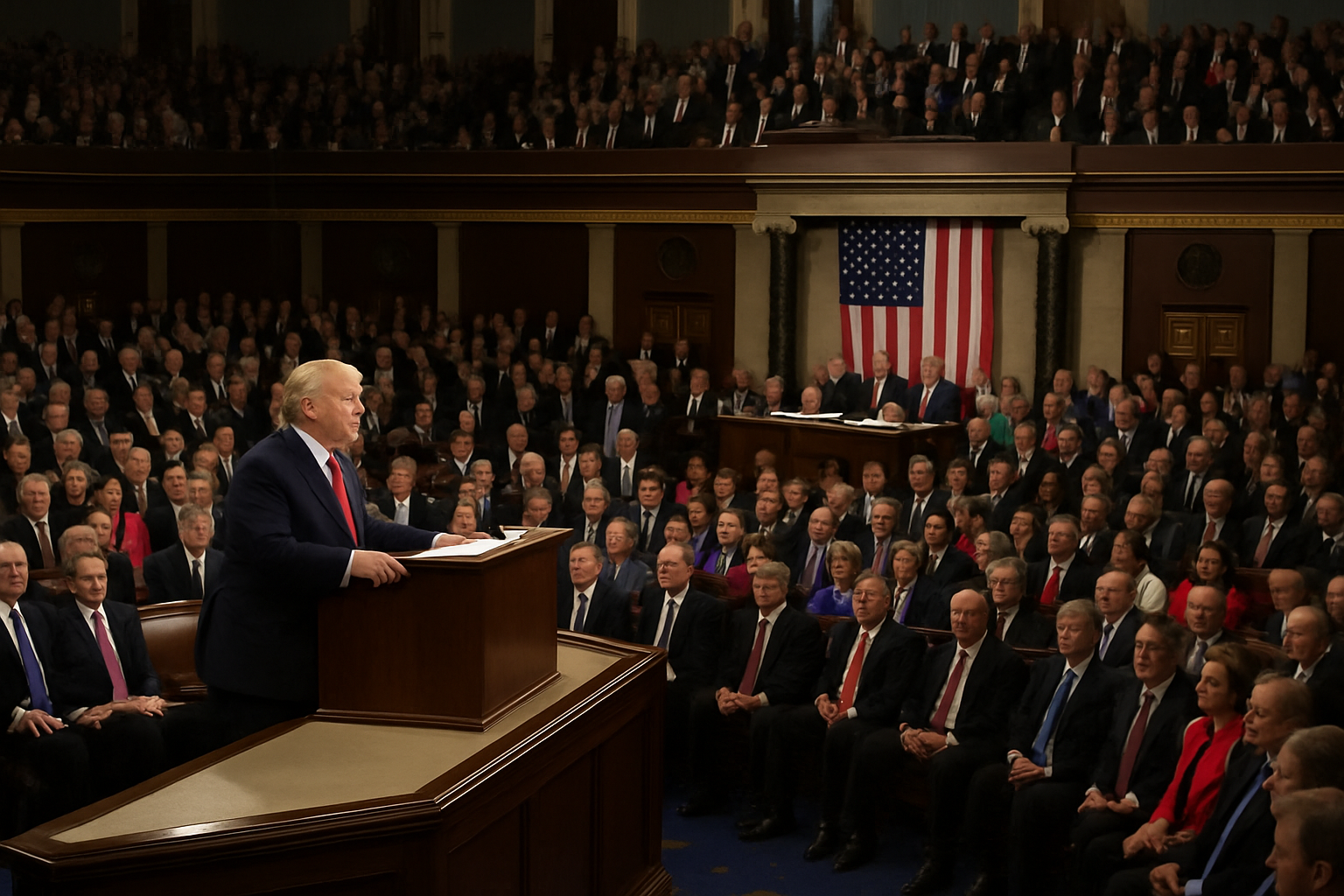
President Donald Trump delivered the longest State of the Union address in American history on February 25, 2026, speaking for a record-breaking 108 minutes amid explosive congressional confrontations that saw multiple ejections, vocal protests, and the deepest partisan divisions witnessed in modern political memory.
The historic speech surpassed Bill Clinton's previous record of 89 minutes set in 2000, as Trump declared a "golden age of America" and proclaimed the nation "bigger, better, richer and stronger than ever before." However, the address was overshadowed by unprecedented disruptions, fact-checking controversies, and direct attacks on Supreme Court justices that constitutional experts described as the most serious executive-judicial confrontation since Watergate.
Congressional Ejections and Racial Controversies
The evening's most shocking moment came when Representative Al Green was ejected from the House chamber after displaying a sign reading "Black People Aren't Apes" — a direct reference to Trump's controversial February 5 racist video that depicted Barack and Michelle Obama as monkeys. The video, posted on Trump's Truth Social platform, remained online for 18 hours before deletion and has drawn widespread condemnation from civil rights organizations.
"When racist imagery is used to attack the first Black president, silence becomes complicity."
— Source familiar with Obama's thinking
The confrontations escalated further when Representative Ilhan Omar shouted "You have killed Americans!" during Trump's immigration segment, leading to additional disruptions. Over 30 Democratic seats remained empty due to walkouts, with some members leaving the chamber entirely in protest.
False Claims and Fact-Checking Scrutiny
International media outlets documented numerous false and misleading claims throughout Trump's address, particularly regarding immigration statistics and economic data. France 24 described "classic Trump bullying and taunting," while fact-checkers noted Trump's approach to statistics as "extremely creative" with "numerous false claims," especially on economic indicators.
The speech's factual accuracy came under immediate scrutiny from 17 countries' media outlets, with Norwegian experts describing Trump's approach as a "political shitshow" and Swedish outlets emphasizing concerns about policy predictability during ongoing international negotiations.
Supreme Court Attack and Constitutional Crisis
In an unprecedented breach of constitutional norms, Trump directly attacked the Supreme Court, calling the justices' recent tariff ruling "totally wrong" and declaring them "disloyal to the Constitution." The attack referenced the Court's devastating 6-3 decision on February 20 that struck down Trump's global tariff program, with Chief Justice Roberts applying the "major questions doctrine" requiring congressional authorization for actions of "vast economic and political significance."
Constitutional historians noted this represented the most direct judicial attack by a sitting president in modern history, creating what experts described as the most serious executive-judicial confrontation since the Watergate era. The timing proved particularly significant as Trump faces declining approval ratings, with University of Virginia's Larry Sabato reporting Trump "underwater on all top ten issues except border security."
International Reactions and Iran Warnings
Trump delivered his most explicit anti-Iran rhetoric to date, calling Iran "the world's number one sponsor of terror" and vowing the US will "never allow" Iran to acquire nuclear weapons. The warning came amid ongoing Geneva nuclear negotiations and a massive dual-carrier deployment with the USS Gerald R. Ford and Abraham Lincoln representing the largest Middle East naval presence in years.
European officials expressed concerns about American institutional stability during the complex diplomatic period, particularly given ongoing Ukraine peace talks, Iran nuclear negotiations, and the New START treaty expiration crisis that left the world without US-Russia nuclear constraints for the first time in over 50 years.
Political Context and Electoral Implications
The address occurred during one of the most challenging periods of Trump's second presidency, coming just days after the Supreme Court defeat and amid growing congressional resistance. The House had voted 219-211 to end Canada tariffs with six GOP defections — the first bipartisan trade authority rebuke of his second term.
Political analysts noted the record length reflected the administration's determination to project strength during institutional challenges, with the speech serving as both a demonstration of institutional continuity and an illustration of contemporary governance difficulties.
International Coverage and Diplomatic Concerns
The address received extensive international coverage, with officials from multiple countries privately expressing concerns about its impact on U.S. credibility in leading democratic values initiatives. The timing during Ukraine peace negotiations and Iran nuclear talks raised questions about American moral authority during diplomatic initiatives advocating democratic norms globally.
"The post-war order no longer exists. We must repair and revive transatlantic trust together."
— German Chancellor Friedrich Merz at Munich Security Conference
Historical Significance and Democratic Implications
Beyond its record-breaking length, the 2026 State of the Union will likely be remembered for its extraordinary partisan tensions, institutional confrontations, and congressional ejections. The address highlighted fundamental questions about American democratic resilience during intense political division, serving as both a demonstration of institutional continuity and a stark illustration of contemporary governance challenges.
The evening's events represented a critical test of democratic institutions, with the combination of direct judicial attacks, congressional resistance, and declining approval ratings creating what experts described as a fundamental challenge to democratic institutional resilience during an era of expanded executive power.
As the administration faces midterm elections in nine months with increasingly unfavorable Republican prospects, the success or failure of translating the record-length address into political gains will determine the strategic position during the crucial months ahead, with implications extending far beyond domestic politics to America's role in international democratic leadership.