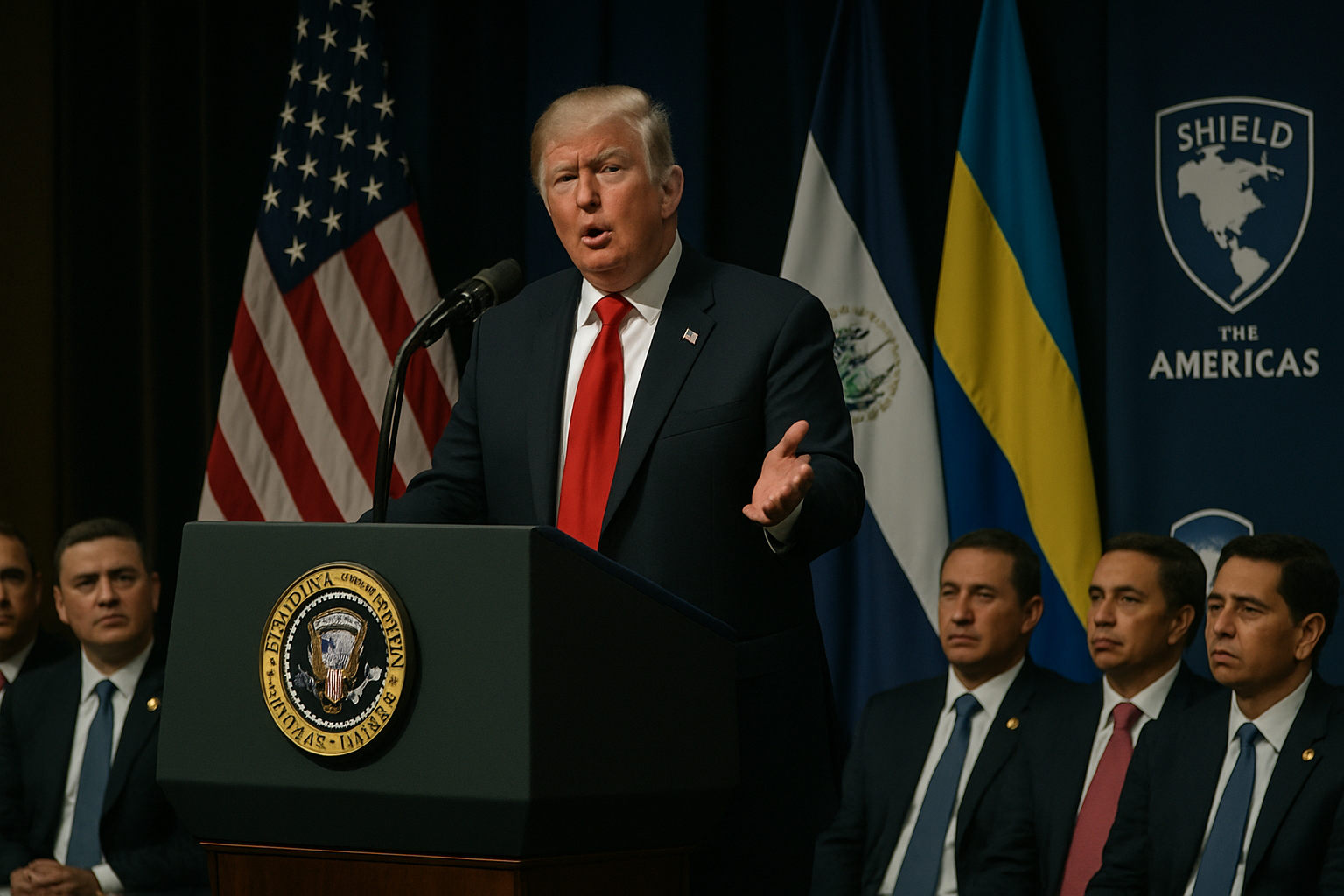
President Donald Trump launched the "Shield of the Americas" coalition on Saturday, announcing a 17-nation military alliance against drug cartels while simultaneously overseeing the dignified transfer of six fallen US soldiers killed in Iranian drone strikes during the ongoing Middle East conflict.
The President's ambitious dual-track strategy unfolded during a high-profile Florida summit, where he signed a decree formalizing the new anti-cartel coalition while also delivering stark warnings about the duration of the Iran war and dismissing British offers of military assistance.
Shield of the Americas: A New Hemispheric Military Alliance
Speaking to assembled Latin American leaders at the Miami summit, Trump declared the creation of "a new military coalition to eradicate the criminal cartels that plague our region." The initiative brings together 17 nations committed to using "lethal military force to destroy" drug trafficking organizations.
The coalition excludes countries with progressive governments, notably Mexico, Brazil, and Colombia. Trump criticized Mexico as the "epicenter of cartel violence" while confirming the nation's exclusion from the initial membership. US State Department spokesperson Natalia Molano later clarified that Mexico's exclusion was "not a closed door" and indicated opportunities for future expansion.
"On this historic day, we gather to announce a new military coalition to eradicate the criminal cartels that plague our region. The essence of the agreement is the commitment to use lethal military force to destroy the cartels."
— President Donald Trump
The President offered unprecedented US support to participating nations, including missile strikes targeting cartel leadership. "These missiles are extremely accurate," Trump assured the gathered leaders, demonstrating his administration's commitment to backing the coalition with advanced American military technology.
Iran War Duration and Kurdish Forces Strategy
Aboard Air Force One returning from the military ceremony, Trump provided new details about his Iran war strategy, telling Kurdish forces not to join the conflict. "The war is complicated enough without getting the Kurds involved," he explained to reporters, despite acknowledging the US maintains friendly relations with Kurdish forces.
The President's comments came after attending a somber "dignified transfer" ceremony for six US Army Reserve soldiers killed by Iranian drone strikes at a command center in Kuwait. This represents the first American casualties since the launch of "Operation Epic Fury," now the largest US-Israeli coordinated military operation since the 2003 Iraq invasion.
Trump pledged to keep American war deaths "to a minimum" while warning that military operations could continue for several more weeks. The conflict has already expanded beyond traditional Middle Eastern boundaries, with Iranian retaliation striking targets across the Gulf region and causing global aviation and energy crises.
Dismissal of British Military Support
In a pointed rebuke to British Prime Minister Keir Starmer, Trump rejected offers of UK military assistance via Truth Social. Learning that Britain was considering deploying two aircraft carriers, including HMS Prince of Wales, to the Middle East, Trump responded dismissively.
"That's OK, Prime Minister Starmer, we don't need them any longer — But we will remember. We don't need people that join Wars after we've already won!"
— President Trump via Truth Social
The rejection highlights growing tensions with European allies over the Iran conflict, particularly as Trump has demanded "unconditional surrender" from Iran while European leaders call for diplomatic solutions. The HMS Prince of Wales had been placed on advanced readiness for potential Middle East deployment.
Global Implications of Dual Strategy
Trump's simultaneous management of Middle Eastern warfare and hemispheric security cooperation demonstrates his administration's ambitious global agenda. The Iran conflict has already resulted in unprecedented consequences:
- Over 18,000 flights cancelled worldwide due to Middle Eastern airspace closures
- Oil prices surging past $80 per barrel with Iran closing the Strait of Hormuz
- First US casualties confirmed in largest Middle East operation since 2003
- Iran's Supreme Leader Ali Khamenei confirmed killed, creating succession crisis
The Shield of the Americas initiative represents Trump's effort to project American power beyond the Middle East while the Iran war continues. Dominican Republic President Luis Abinader met with US Energy Secretary Chris Wright to discuss energy cooperation, while El Salvador's Nayib Bukele held multiple meetings with senior Trump administration officials.
Regional Response and International Concerns
The coalition announcement received mixed international reactions. While participating Latin American nations praised the initiative, absent countries and European allies expressed concerns about militarizing anti-drug efforts without addressing root causes of the trafficking problem.
Iran has launched "Operation True Promise 4" in retaliation for US-Israeli strikes, targeting American allies across the region. The Iranian Revolutionary Guard declared "no red lines remain," resulting in casualties across the UAE, Kuwait, Qatar, and Cyprus – marking the first attack on European territory since World War II.
Congressional scrutiny of the Iran war is intensifying, with bipartisan lawmakers demanding answers about strategy, costs, and potential ground troop deployment. The conflict's unpopularity has reached "almost unprecedented" levels, according to political analysts, with only 25% of Americans supporting the military action.
Panama Canal Warning
During the summit, Trump also issued warnings about foreign influence in the Americas, specifically mentioning the Panama Canal as his "favorite canal." He warned that his government "will not allow hostile foreign influence to establish itself in this hemisphere," directing comments toward Panamanian President José Raúl Mulino.
This statement adds another dimension to Trump's hemispheric strategy, combining anti-cartel military cooperation with warnings about geopolitical competition in the region.
Looking Ahead: Uncertain Trajectories
Trump's dual-track approach – managing an expanding Middle East war while launching a new hemispheric military coalition – reflects his administration's ambitious but potentially overextended global strategy. The President's rejection of British support and criticism of European hesitancy suggests growing isolation from traditional allies.
As the Iran war enters its second week with no clear resolution in sight, and the Shield of the Americas coalition begins operations against drug cartels, Trump faces the challenge of managing multiple military commitments while maintaining domestic and international support.
The coming weeks will test whether his administration can successfully coordinate these complex, simultaneous security operations while managing the diplomatic fallout from his increasingly unilateral approach to international crises.