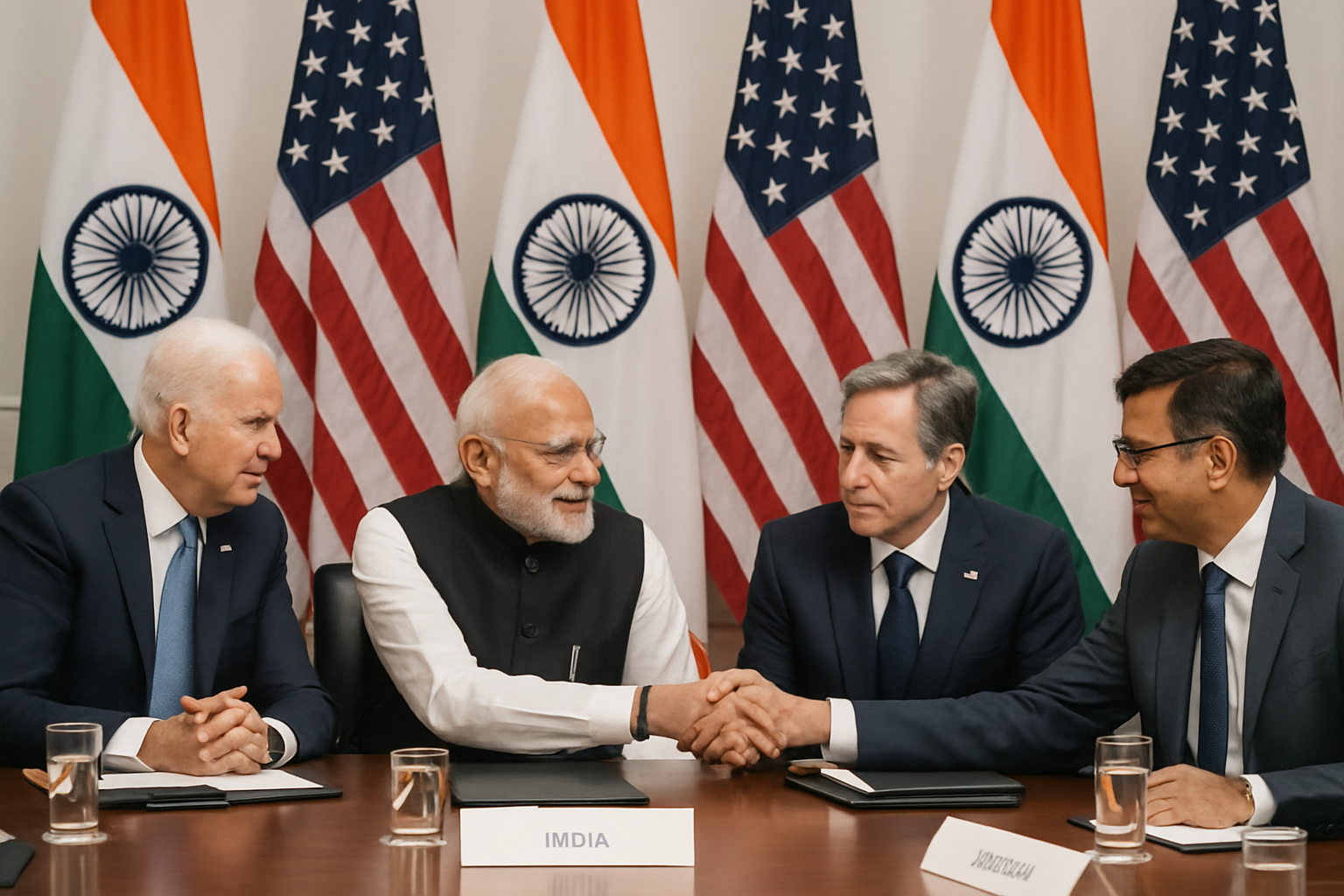
President Donald Trump announced a groundbreaking trade agreement with India on February 3, 2026, reducing US tariffs on Indian goods from 25% to 18% while securing Prime Minister Narendra Modi's commitment to halt Russian oil imports and purchase over $500 billion in American products.
The announcement, made via Trump's Truth Social platform following a phone conversation with Modi, represents the most significant shift in US-India economic relations in decades and a major geopolitical realignment away from Russia amid the ongoing Ukraine conflict.
Market Response and Economic Impact
Indian stock markets responded with unprecedented enthusiasm to the trade deal announcement. The BSE Sensex surged over 2,300 points, gaining more than 5% in opening trade, while the Nifty50 jumped over 2%, nearing all-time highs. The dramatic market rally reflected investor confidence in the deal's potential to transform bilateral trade relations.
External Affairs Minister S. Jaishankar emphasized the deal's economic benefits, stating it would boost job creation, spur economic growth, and promote innovation across both nations. The agreement gives India a significant competitive advantage over regional rivals, with tariffs now lower than those imposed on China (34%) and Pakistan (19%).
"This landmark agreement will take our economic ties to new heights,"
— Rajnath Singh, India's Defence Minister
Key Terms of the Agreement
The deal encompasses several critical components that mark a fundamental shift in trade relations between the world's largest and oldest democracies:
- Reduction of US tariffs on Indian goods from 25% to 18%
- India's commitment to zero tariffs on US goods
- Complete cessation of Russian oil purchases by India
- Indian commitment to purchase over $500 billion in American products
- Transition to purchasing American and potentially Venezuelan oil
Trump described Modi as "one of his greatest friends and a powerful and respected leader" in his Truth Social announcement, emphasizing the personal diplomatic relationship that facilitated the breakthrough.
Geopolitical Implications
The agreement represents a significant departure from India's traditional non-aligned foreign policy and its energy dependence on Russia. India's decision to end Russian oil imports comes as a major blow to Moscow's energy revenues amid the ongoing Ukraine conflict.
The timing of the announcement appears strategically linked to broader US efforts to isolate Russia economically. Trump stated the deal would "help end the war in Ukraine" by cutting off a crucial revenue stream for Russian military operations.
Congressional and Political Response
While the deal has received praise from Indian officials and market analysts, it has also sparked political scrutiny. The Congress party has demanded full disclosure of the agreement's details, questioning its impact on Indian farmers, industry, and the "Make in India" initiative.
Congress leaders raised concerns about India agreeing to zero tariffs on US goods and the feasibility of completely eliminating Russian oil imports given India's massive energy needs and existing contracts.
"Just like the ceasefire announcement, we demand complete transparency about this trade deal's implications for Indian sovereignty and economic policy,"
— Congress Party Statement
Energy Security Challenges
The commitment to halt Russian oil imports presents significant logistical challenges for India, the world's third-largest oil consumer. Energy experts express skepticism about India's ability to completely eliminate Russian oil imports while maintaining energy security and price stability.
The transition to American oil suppliers will require substantial infrastructure adjustments and could impact India's energy costs in the short term. However, the deal opens opportunities for long-term energy partnerships with the United States and potentially other Western allies.
Historical Context
This agreement builds on years of strengthening US-India relations but represents an unprecedented level of economic and strategic cooperation. Current bilateral trade stands at approximately $50 billion annually, making the $500 billion commitment a ten-fold increase that would reshape global trade patterns.
The deal also comes against the backdrop of recent India-EU Free Trade Agreement talks, which had put pressure on the Trump administration to secure its own comprehensive trade arrangement with New Delhi.
Implementation Challenges
Despite the announced agreement, significant technical and policy challenges remain. The transition away from Russian energy supplies will require careful coordination to avoid supply disruptions, while the massive increase in bilateral trade will necessitate substantial infrastructure and policy adjustments on both sides.
Trade experts note that implementing such a comprehensive agreement will require detailed negotiations on specific sectors, timelines, and mechanisms for ensuring compliance with the various commitments.
Regional Impact
The deal positions India as a key strategic partner for the United States in the Indo-Pacific region, potentially influencing regional trade dynamics and security arrangements. The agreement may prompt other countries to reassess their own trade relationships with both India and the United States.
China, in particular, faces increased competition from India in US markets, while Russia loses a crucial energy customer as it grapples with international sanctions.
Looking Forward
The India-US trade deal represents more than an economic arrangement; it signals a fundamental realignment of global partnerships in an era of increasing geopolitical competition. As both nations work to implement the agreement's ambitious targets, the success of this partnership could serve as a model for other strategic trade relationships.
The agreement's impact on global trade patterns, energy markets, and geopolitical alignments will likely unfold over the coming months as implementation details are negotiated and executed. For now, it stands as a testament to the evolving nature of international commerce in an increasingly multipolar world.