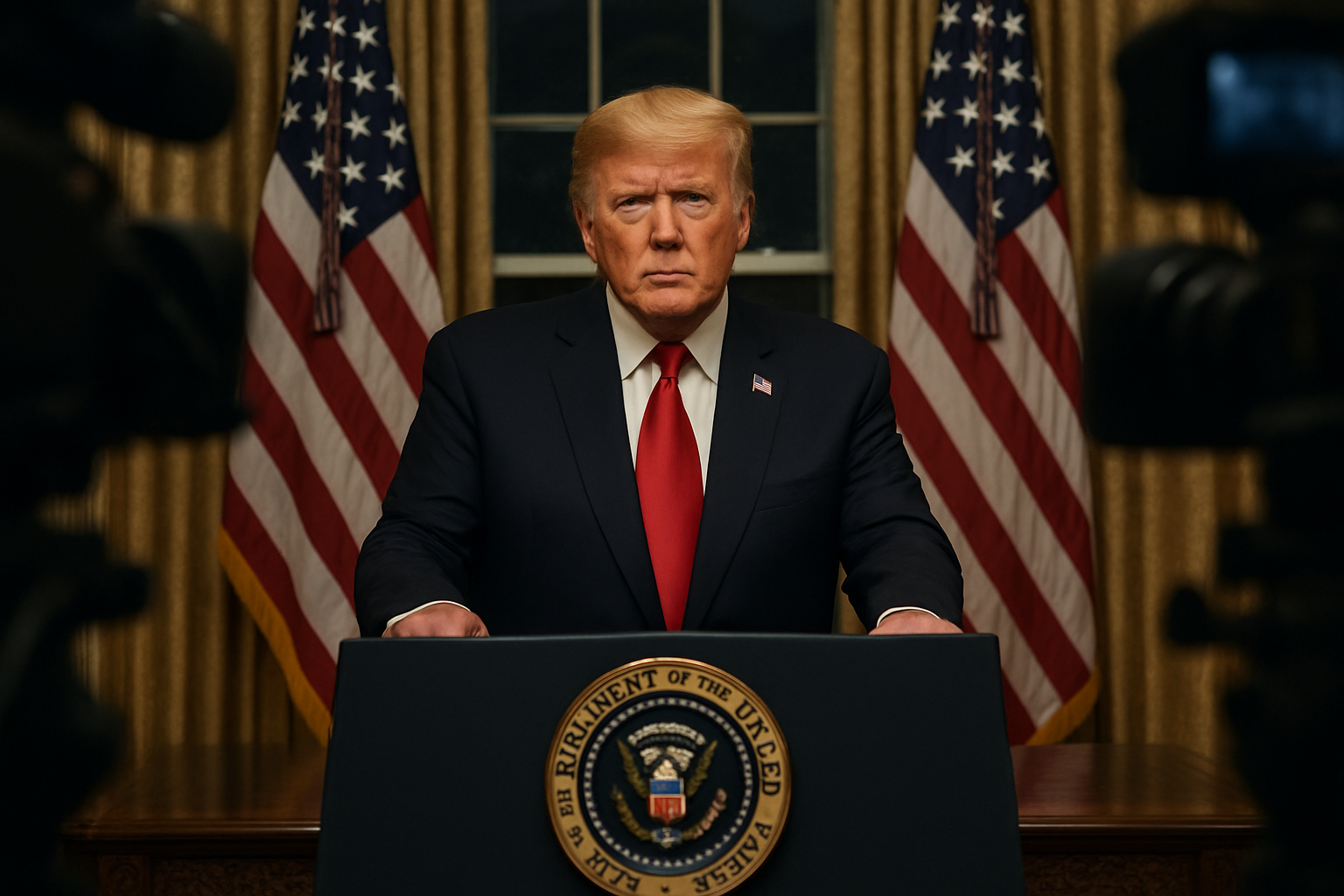
President Donald Trump delivered a prime-time national address on the Iran war Wednesday evening, hours after claiming Iran was seeking a ceasefire—a statement immediately denied by Tehran as "false and baseless"—amid the most dangerous international crisis since the Cold War.
The address, scheduled for 9 PM ET, comes as Operation Epic Fury enters its second month with unprecedented global implications. The U.S.-Israeli campaign, launched March 1 following the death of Iranian Supreme Leader Ali Khamenei, has evolved into the largest Middle East military operation since 2003 with costs exceeding $11.3 billion in the first week alone.
Conflicting Ceasefire Claims
In a dramatic pre-speech development, Trump claimed via Truth Social that Iran was requesting a ceasefire, conditioning any agreement on reopening the Strait of Hormuz currently closed by Iranian mining operations affecting 40% of global oil transit. However, Iranian Foreign Ministry spokesman Esmaeil Baghaei categorically rejected Trump's claims as "false and baseless," stating that Iran would not negotiate under current circumstances.
"Iran derides Trump ceasefire claim as psychological warfare while maintaining that the Islamic Republic will never surrender to the United States and Israel."
— Iranian President Masoud Pezeshkian
The contradiction highlights the information warfare dynamics surrounding the conflict, as both sides seek to control the narrative amid unprecedented military escalation.
Global Crisis Reaches Peak Levels
The Iran war has created cascading global disruptions affecting multiple sectors. Aviation has been particularly hard hit, with over 18,000 flights cancelled worldwide—the most severe disruption since COVID-19. Eight Middle Eastern countries have simultaneously closed their airspace, severing critical Europe-Asia corridors and leaving hundreds of thousands of passengers stranded globally.
Dubai International Airport, the world's busiest with 86 million passengers annually, remains completely shut down due to missile damage. Major carriers including Emirates, Air France-KLM, and Wizz Air have suspended operations indefinitely.
Energy Markets in Turmoil
Oil prices have surged past $100 per barrel, heading toward $200 according to analysts' warnings. Iran's Revolutionary Guard has effectively closed the Strait of Hormuz through the deployment of 2,000-6,000 naval mines, forcing the International Energy Agency to authorize its largest strategic petroleum reserve release in its 50-year history—400 million barrels from 32 countries.
Natural gas prices have spiked 24% in Europe and 78% in the United States, while Qatar has halted LNG production, threatening European energy supplies. Major shipping companies Maersk and MSC have suspended Persian Gulf operations, leaving over 150 tankers stranded with billions in cargo.
Constitutional Crisis in Iran
Following Supreme Leader Ali Khamenei's confirmed death on March 1, Iran has undergone its first hereditary succession in the Islamic Republic's 47-year history. Mojtaba Khamenei, the former leader's son, has consolidated power with unprecedented Revolutionary Guard control, representing a fundamental shift from clerical to military governance during active warfare.
Trump has explicitly rejected this succession, claiming the right to personally choose Iran's next leader and calling Mojtaba "lightweight"—the most direct assertion of American control over Iranian affairs since 1979.
NATO Solidarity Under Strain
The conflict has exposed cracks in the Atlantic alliance, with Trump launching an unprecedented diplomatic attack on NATO allies, calling them "cowards" for refusing to support the U.S.-Israel war effort. The President demanded major allies send warships to help secure the Strait of Hormuz, warning of "very bad consequences" if NATO fails to assist.
The situation became more complex when Italy denied U.S. bomber access to Sicily air bases, forcing strategic aircraft to operate from more distant locations and potentially limiting strike frequency and scope. Meanwhile, Iran has directly threatened Romania, warning that use of U.S. bases would constitute "military aggression"—the first direct threat to a NATO member during the crisis.
European Territory Under Attack
In a historic escalation, Iranian drones struck RAF Akrotiri in Cyprus—the first attack on European territory since World War II. This prompted an unprecedented naval coalition response, with HMS Dragon, Spanish frigates, and vessels from Italy, France, the Netherlands, and Greece deploying to protect European interests. The European Union activated its ESTIA evacuation protocol for the first time in the bloc's history.
Regional Coalition Fracturing
The unprecedented diplomatic coalition of Saudi Arabia, UAE, Qatar, and Egypt that had backed negotiations is now severely strained as Iranian retaliation has directly targeted member territories. Egyptian President Abdel Fattah el-Sisi condemned attacks on "sisterly Arab countries," warning of "comprehensive chaos spreading across the region."
UAE reported one civilian killed in Abu Dhabi, Kuwait suffered 32 injuries from airport drone strikes, and Qatar intercepted 65 missiles and 12 drones with eight people wounded by debris fragments.
Congressional Opposition Mounting
Domestic pressure on the Trump administration has intensified, with bipartisan lawmakers demanding answers about strategy, costs, and potential ground troop deployment. Senator Richard Blumenthal expressed being "more concerned than ever" about boots on the ground, while the conflict's unpopularity reaches "almost unprecedented" levels with only 25% public support.
Pentagon officials have prepared operations through September, far beyond Trump's initial 4-6 week timeline, raising questions about the administration's strategy and endgame. The financial markets have become what analysts call the "ultimate constraint" on escalation, with Pakistan's KSE-100 suffering its largest single-day decline in history at -8.97%.
Humanitarian Crisis Deepens
The human cost continues mounting, with Iran's Red Crescent reporting over 787 civilian casualties from U.S.-Israeli strikes. The Pentagon has confirmed U.S. responsibility for an elementary school strike that killed 165-185 students, which officials attributed to "outdated targeting data"—a incident that has drawn international condemnation and Geneva Conventions investigations.
International evacuations have reached the largest scale since the Arab Spring in 2011, with Australia reporting 115,000 nationals trapped and Germany evacuating 30,000 stranded tourists.
Nuclear Diplomacy Collapse
The current military confrontation emerged from the complete collapse of nuclear negotiations, despite Geneva talks achieving a "broad agreement on guiding principles"—the most significant progress since the JCPOA breakdown in 2018. Fundamental scope disagreements proved insurmountable, with Iran maintaining that ballistic missiles and regional proxies were "red lines" excluded from nuclear-only talks, while the U.S. demanded comprehensive agreements including missiles, armed groups, and human rights.
Iran continues 60% uranium enrichment with over 400kg of weapons-grade material, sufficient for multiple weapons if weaponized. The crisis occurs amid a broader nuclear governance breakdown, with the New START treaty having expired in February—the first time in over 50 years without U.S.-Russia nuclear constraints.
Global Implications
UN Secretary-General António Guterres has called this "the greatest test of multilateral cooperation and crisis management in the modern era." The rapid transition from diplomatic breakthrough to military confrontation demonstrates the fragility of crisis management in the multipolar era.
The stakes extend far beyond the immediate conflict, affecting regional war prevention, global energy security, nuclear governance credibility, and international law enforcement. Success in containing the escalation could provide a framework for future nuclear crisis resolution, while failure may accelerate military solutions globally, encouraging proliferation and undermining diplomatic credibility worldwide.
Looking Forward
As Trump prepares to address the nation, the international community faces a watershed moment that will determine whether diplomatic or military solutions become the preferred approach to 21st-century territorial and nuclear disputes. The coming phase will be decisive in determining whether this remains a contained regional confrontation or expands into a broader Middle Eastern war with implications extending decades beyond current events.
The President's address is expected to outline U.S. objectives and potentially announce a timeline for military operations, amid growing pressure from Congress, allies, and domestic opposition to the conflict's trajectory and costs. With global energy markets, aviation networks, and international alliances all under severe strain, Trump's words tonight may determine the path forward for one of the most consequential international crises in modern history.