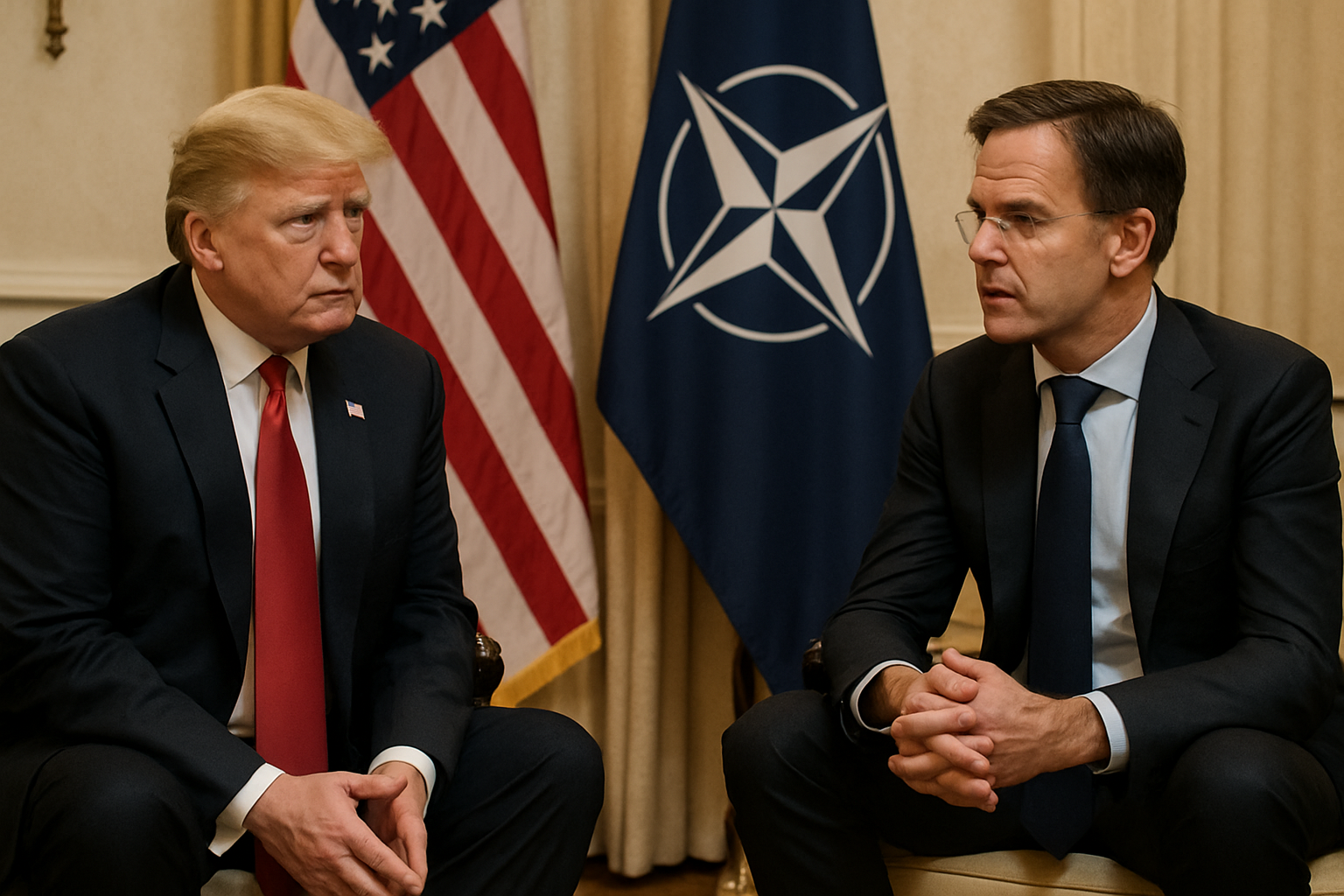
President Donald Trump intensified threats to withdraw the United States from NATO following a White House meeting with Secretary-General Mark Rutte, as European allies delivered an unprecedented rejection of American demands for military support in the Iran conflict.
The April 9 meeting, described by Rutte as a "frank and open discussion between two good friends," failed to ease the deepest crisis in the 75-year alliance's history. Trump renewed his characterization of NATO as a "paper tiger" while expressing disappointment with European allies' refusal to support Operation Epic Fury against Iran.
Alliance Fracture Reaches Breaking Point
The current crisis stems from European allies' comprehensive rejection of Trump's demands for naval coalition support in the Strait of Hormuz, where Iranian mining operations have blocked 40% of global oil transit. German Defense Minister Boris Pistorius led the resistance, asking "What does Donald Trump expect handful European frigates to do that powerful US Navy cannot?"
France explicitly rejected warship deployment, while Japan and Australia declined naval vessel requests despite their critical dependence on Middle Eastern oil routes. The coordinated European response represents the most comprehensive rejection of American military leadership since the 2003 Iraq War.
"NATO wasn't there when we needed them"
— President Donald Trump
Spain escalated its opposition beyond the initial denial of military base access, closing its airspace entirely to US military aircraft involved in Iran operations. Prime Minister Pedro Sánchez justified the move as defending international law compliance, stating Spanish bases could only support activities "consistent with the UN Charter."
Operation Epic Fury Costs Mount
The Iran conflict has become a massive financial drain, with costs exceeding $27 billion in the first month alone and running approximately $1 billion daily. Operations have extended far beyond Trump's initial 4-6 week projection, with Pentagon planning through September 2026.
Congressional opposition has reached unprecedented levels, with only 25% American public support for the military action. Senator Richard Blumenthal expressed being "more concerned than ever" about potential ground troop deployment. The conflict's unpopularity has created significant political constraints for the administration.
In a significant development, Joseph Kent, the administration's counterterrorism chief, resigned in protest, citing "no imminent threat" from Iran and criticizing what he called "disinformation campaigns" pressuring the administration into military action.
European Strategic Autonomy Demonstrated
European allies have demonstrated what experts call "selective cooperation" – rejecting American military adventures while rapidly defending European territory. When Iranian drones struck RAF Akrotiri in Cyprus, marking the first attack on European soil since World War II, Europeans mobilized an unprecedented naval coalition within hours.
British HMS Dragon led Spanish, Italian, French, Dutch, and Greek vessels in protecting Cyprus, while the EU activated its ESTIA crisis mechanism for the first time in history. This response highlighted the distinction European leaders draw between territorial defense and discretionary interventions.
Trump's Regime Change Demands
Trump has escalated his Iran policy from nuclear concerns to explicit regime change demands, claiming the right to "personally choose" Iran's next Supreme Leader. He rejected the succession of Mojtaba Khamenei, son of the deceased Ali Khamenei, calling him a "lightweight."
This represents the most direct assertion of American control over Iranian affairs since 1979, marking a complete departure from nuclear-focused diplomacy to comprehensive political transformation. The policy evolution has effectively eliminated diplomatic solutions to the crisis.
Nuclear Governance Crisis
The alliance tensions occur against the backdrop of a broader nuclear governance crisis. The New START treaty's expiration in February 2026 marked the first time in over 50 years without US-Russia nuclear constraints. Iran continues uranium enrichment at 60% purity, possessing over 400 kilograms of weapons-grade material sufficient for multiple nuclear weapons.
European leaders have begun serious nuclear deterrence discussions for the first time since the Cold War's end. German Chancellor Friedrich Merz confirmed negotiations with French President Emmanuel Macron about expanding France's nuclear deterrent beyond national scope, with preliminary conversations including Germany, Poland, and Finland.
Global Economic Disruption
The crisis has created unprecedented global disruption, with over 18,000 flights cancelled worldwide – comparable to COVID-19-scale aviation disruption. Oil prices have surged past $100 per barrel, while natural gas prices increased 24% in Europe and 78% in the United States.
The International Energy Agency authorized its largest strategic petroleum reserve release in 50 years – 400 million barrels from 32 countries. Eight Middle Eastern countries have closed their airspace simultaneously, creating what aviation experts call an "aviation black hole" severing Europe-Asia corridors.
Wall Street Journal Reports Troop Withdrawal Plans
According to Wall Street Journal reporting, the Trump administration is examining potential sanctions against NATO allies deemed insufficiently supportive during the Iran crisis. The plan would reportedly include withdrawing US troops from countries that haven't provided adequate backing for Middle East operations.
Greece is positioned among nations to be "rewarded" for their cooperation, while other allies face potential consequences for their refusal to participate in military operations. This would represent an unprecedented departure from traditional alliance management approaches.
Historical Significance
UN Secretary-General António Guterres characterized the current period as the "greatest test of multilateral cooperation in the modern era." The crisis represents a watershed moment for 21st-century international relations, determining whether diplomatic or military solutions will predominate in future conflicts.
Polish Prime Minister Donald Tusk warned that NATO's potential breakup represents "Putin's dream plan," highlighting how alliance divisions serve adversarial interests. Lithuanian President Gitanas Nausėda acknowledged that "tensions within the Alliance are rising recently" while maintaining confidence in collective defense mechanisms.
Congressional Bipartisan Concerns
Despite Trump's threats, US Senators from both parties have issued statements supporting continued NATO membership, providing some European reassurance about long-term American commitment to alliance obligations. However, the unprecedented nature of presidential threats has created uncertainty about the alliance's future.
The current crisis tests whether NATO's institutional resilience can accommodate fundamental restructuring while maintaining democratic principles, or whether it faces the most serious existential challenge since the 1956 Suez Crisis.
Template-Setting Implications
The outcome of this crisis will establish precedents for alliance management, burden-sharing models, and collective defense mechanisms for decades to come. Success in institutional innovation could strengthen frameworks for addressing contemporary challenges, while failure might accelerate Western fragmentation during a critical period of great power competition.
European strategic autonomy has evolved from aspiration to operational reality, with implications extending far beyond the current crisis. The selective cooperation paradigm – defending European territory while rejecting discretionary interventions – may become a template for 21st-century alliance relationships.
As the crisis continues to unfold, the fundamental question remains whether the NATO alliance can adapt to accommodate divergent views on military intervention while maintaining the unity necessary for collective defense in an increasingly complex global security environment.