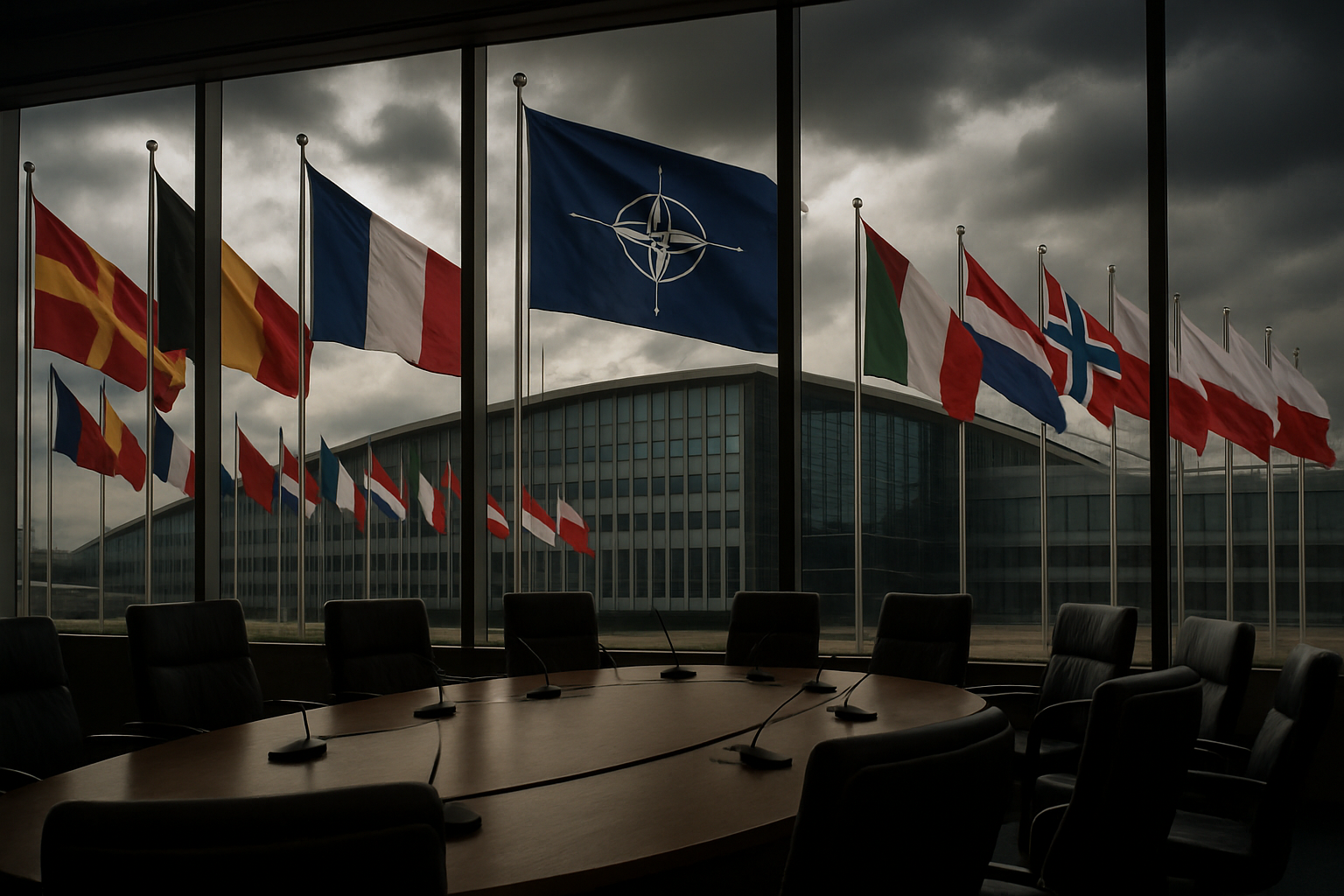
President Donald Trump escalated his threats against NATO allies Wednesday following a tense White House meeting with Secretary General Mark Rutte, declaring the alliance "clearly disappointed" him over insufficient support for U.S. operations against Iran and threatening American withdrawal from the 75-year-old transatlantic partnership.
The high-stakes diplomatic encounter, described by Rutte as a "frank and open discussion between two good friends," failed to resolve mounting tensions as Trump expressed fury over European reluctance to provide military assistance for Operation Epic Fury, the ongoing U.S.-Israeli campaign against Iran that has consumed over $27 billion in its first month.
Historic Alliance Fracture Deepens
Speaking after the meeting, Rutte acknowledged Trump's disappointment with NATO members' response to American requests for naval vessels and military support in the Persian Gulf. The Secretary General's diplomatic language could not mask the severity of the crisis facing the alliance, which experts describe as the deepest strain since NATO's formation in 1949.
European allies have delivered comprehensive rejection of Trump's demands for international naval coalitions to secure the Strait of Hormuz, with German Defense Minister Boris Pistorius leading resistance by asking, "What does Donald Trump expect a handful of European frigates to do that the powerful U.S. Navy cannot?" France explicitly rejected warship deployment, while Japan and Australia declined naval vessel requests despite their critical dependence on Middle Eastern oil routes.
"We no longer 'need' or want assistance from NATO countries—IN FACT, WE NEVER NEEDED IT!"
— Donald Trump, Truth Social
Trump's social media declaration following his meeting with Rutte represents a complete policy reversal from traditional coalition-building approaches to a deliberately unilateral strategy. The President has already threatened Spain with trade cutoffs after Madrid denied U.S. base access for Iran operations, while criticizing Britain as "not Winston Churchill's Britain" for reluctance to fully support the strikes.
European Strategic Autonomy in Action
The crisis has paradoxically demonstrated European unity in defending their own territory while rejecting what they characterize as "optional wars." When Iranian forces struck RAF Akrotiri in Cyprus—the first attack on European soil since World War II—allied nations rapidly assembled an unprecedented naval coalition featuring HMS Dragon and vessels from Spain, Italy, France, the Netherlands, and Greece.
This selective cooperation highlights a fundamental shift in European strategic thinking, as outlined in my previous analysis. EU nations are now distinguishing between territorial defense obligations and discretionary military interventions, particularly those lacking clear international legal authorization.
Spain has escalated its opposition beyond base denial, closing its airspace to U.S. military aircraft involved in Iran operations. Defense Minister Margarita Robles justified the action as refusing to "participate in or contribute to a war which was initiated unilaterally and against international law."
Congressional and Public Opposition Mounts
Trump faces unprecedented domestic pressure over the Iran conflict, with only 25% of Americans supporting the military action according to recent polling—historically low support for operations in their early stages. Senator Richard Blumenthal expressed being "more concerned than ever" about potential ground troop deployment, while the Pentagon has extended operations through September 2026, far beyond the initial 4-6 week timeline.
The resignation of counterterrorism chief Joseph Kent in protest of the war represents the first senior administration official to break publicly over the Iran campaign. Kent objected to claims of an "imminent threat" from Iran and accused Israeli officials and American media of conducting "disinformation campaigns" to pressure for military action.
Global Crisis Scope Unprecedented
The Iran conflict has triggered what UN Secretary-General António Guterres called "the greatest test of multilateral cooperation in the modern era." Global aviation has suffered COVID-scale disruption with over 18,000 flights cancelled worldwide, while oil prices have surged past $100 per barrel as Iran's mining of the Strait of Hormuz effectively closed 40% of global oil transit.
The International Energy Agency has released a record 400 million barrels from strategic reserves—the largest intervention in the agency's 50-year history—while natural gas prices have jumped 24% in Europe and 78% in the United States. Major shipping companies Maersk and MSC have suspended Persian Gulf operations, with over 150 tankers stranded carrying billions of dollars in cargo.
Nuclear Diplomacy Breakdown
The military escalation emerged from the complete collapse of nuclear negotiations despite February's Geneva talks achieving "broad agreement on guiding principles"—the most progress since the 2018 JCPOA withdrawal. Fundamental disagreements over scope proved insurmountable, with Iran insisting on nuclear-only discussions while the U.S. demanded comprehensive talks including missiles, proxy groups, and human rights.
The crisis unfolds against the backdrop of unprecedented nuclear governance uncertainty. The New START treaty between the U.S. and Russia expired in February 2026, marking the first time in over 50 years without bilateral nuclear constraints between the superpowers. Iran continues uranium enrichment to 60% purity—approaching weapons-grade levels—with over 400 kilograms of material sufficient for multiple nuclear weapons.
Trump's Regime Change Demands
Trump has explicitly escalated beyond nuclear concerns to demand Iran's "unconditional surrender" and claimed the right to "personally choose" Iran's next Supreme Leader, rejecting the recent succession of Mojtaba Khamenei following his father Ali's death in March. This represents the most direct assertion of American control over Iranian affairs since the 1979 revolution and effectively eliminates diplomatic solutions.
The Iranian leadership transition—the first hereditary succession in the Islamic Republic's 47-year history—has shifted power toward the Revolutionary Guards, creating unprecedented military control over governance. Defense officials suggest the new Supreme Leader may have been "wounded or disfigured" in ongoing Israeli strikes, further complicating any potential negotiations.
Alliance Obligations Versus Sovereignty
The Trump-Rutte meeting represents a watershed moment for 21st-century alliance relationships, testing the balance between collective security obligations and national sovereignty principles. European allies have demonstrated they will rapidly coordinate to defend member territory while asserting independence on controversial military interventions lacking broad international support.
Polish Prime Minister Donald Tusk has warned that NATO's potential breakup represents "Putin's dream plan," while Lithuanian President Gitanas Nausėda acknowledges "tensions within the alliance are rising." However, the alliance has shown remarkable coordination when defending European territory, suggesting institutional frameworks remain robust for core defensive purposes.
Economic Consequences and Strategic Implications
Financial markets have become what analysts describe as the "ultimate constraint" on further escalation. Pakistan's stock exchange suffered its largest decline in history (-8.97%), while global supply chains dependent on Persian Gulf logistics face severe disruption in automotive, electronics, and textile manufacturing.
The crisis has exposed fundamental vulnerabilities in global energy architecture, with the 21-mile Strait of Hormuz representing a single-point failure for modern logistics systems. Qatar has halted LNG production affecting 20% of global exports, while airlines have implemented emergency fuel surcharges as jet fuel prices surge from $85-90 to $150-200 per barrel.
Historical Precedent and Future Implications
The current crisis carries template-setting significance for international relations, determining whether 21st-century disputes will be resolved through diplomatic or military means. The rapid transition from promising nuclear negotiations to military confrontation demonstrates the fragility of crisis management in an increasingly multipolar world.
European strategic autonomy has evolved from aspiration to operational reality, with implications extending far beyond the current conflict. Success in managing the crisis through institutional cooperation could strengthen frameworks for future challenges, while failure might accelerate Western fragmentation at a critical moment for international stability.
The stakes extend beyond immediate conflict resolution to fundamental questions about alliance obligations, international law enforcement, and nuclear governance credibility. As Guterres noted, the outcome will influence territorial sovereignty enforcement, energy security architecture, and diplomatic vs. military solution precedents for decades to come.
Coming Phase Critical
The aftermath of Wednesday's Trump-Rutte meeting will likely determine whether NATO can adapt to 21st-century challenges through institutional innovation or faces its most serious existential crisis since the 1956 Suez Crisis. European nations must balance maintaining alliance solidarity with asserting sovereignty over controversial military interventions.
With congressional midterm elections approaching in November 2026, Trump faces mounting pressure to demonstrate results from the costly Iran campaign while managing unprecedented alliance tensions. The President's threats to reconsider U.S. troop deployments in Germany and implement "pay-to-play" decision-making models based on defense spending could fundamentally reshape NATO's governance structure.
The resolution of this crisis will establish precedents for how democratic nations coordinate defense in an era of great power competition, determine the future of Western security architecture, and influence international cooperation frameworks for generations. As the most consequential test of multilateral cooperation in the modern era, the stakes could not be higher for both immediate conflict resolution and long-term global stability.