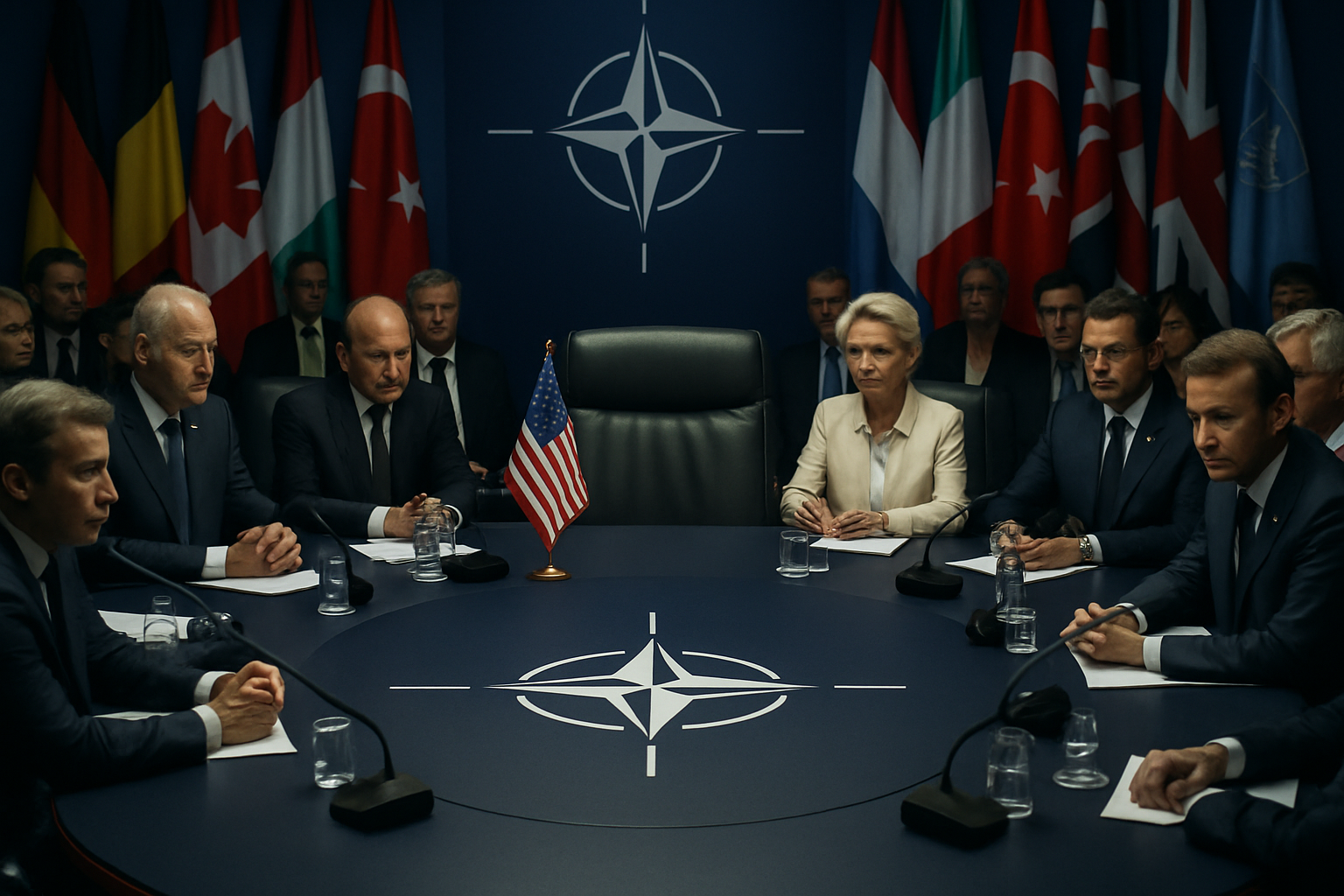
President Donald Trump has escalated his threats to withdraw the United States from NATO to unprecedented levels, with White House Press Secretary Karoline Leavitt confirming he will discuss potential withdrawal with NATO Secretary-General Mark Rutte during critical meetings scheduled for this week. The confirmation represents the most serious threat to the transatlantic alliance since its 1949 founding.
The crisis stems from a comprehensive rejection by European allies of Trump's demands for military support in Operation Epic Fury, the ongoing U.S.-Israeli campaign against Iran that has cost over $27 billion in its first month. German Defense Minister Boris Pistorius led the European resistance, asking pointedly: "What does Donald Trump expect a handful of European frigates to do that the powerful U.S. Navy cannot?"
Historic Alliance Fracture Deepens
Trump's fury at NATO allies reached a boiling point when he declared on Truth Social that "We no longer 'need' or want assistance from NATO countries—IN FACT, WE NEVER NEEDED IT!" This represents a complete policy reversal from traditional coalition-building to a unilateral American approach that has left European leaders stunned.
The President has called the alliance a "paper tiger" and suggested that "Without the USA, NATO IS A PAPER TIGER!" His unprecedented public rebuke of allies has exposed the deepest fractures in the Western alliance since World War II, with implications extending far beyond the current Iran crisis.
"We are witnessing the greatest test of multilateral cooperation in the modern era. The stakes could not be higher for the future of international security cooperation."
— António Guterres, UN Secretary-General
European allies have delivered what analysts describe as the most comprehensive rejection of American military leadership since the 2003 Iraq War. France explicitly rejected warship deployment to the Strait of Hormuz, while Japan and Australia declined to send naval vessels despite their critical dependence on Middle Eastern oil supplies.
European Strategic Autonomy in Action
The crisis has produced a paradoxical response from European allies, who have rejected participation in what they view as America's "optional war" while simultaneously demonstrating unprecedented unity in defending European territory. When Iranian drones struck RAF Akrotiri in Cyprus—the first attack on European soil since World War II—a rapid naval coalition emerged within hours.
The European response included HMS Dragon from Britain, Spanish frigates, and vessels from Italy, France, Netherlands, and Greece. The EU activated its ESTIA crisis mechanism for the first time in the bloc's history, demonstrating a capacity for independent action that has caught Washington off-guard.
Spain has taken the most dramatic stance, not only denying the U.S. access to military bases at Rota and Morón but also closing its airspace to American military aircraft involved in Iran operations. Prime Minister Pedro Sánchez condemned the Iran operations as a "breach of international law," prompting Trump to threaten to "cut off all trade" with Madrid.
Congressional and Domestic Pressures Mount
The President faces unprecedented domestic opposition to his Iran policy, with only 25% of Americans supporting the military strikes according to recent polls. Senator Richard Blumenthal has expressed being "more concerned than ever" about potential ground troop deployment, while bipartisan lawmakers demand comprehensive briefings on strategy, costs, and exit plans.
Operation Epic Fury has already cost $11.3 billion in its first week alone, with Pentagon operations now extending through September 2026—far beyond Trump's initial 4-6 week timeline. The financial markets have emerged as what officials privately describe as the "ultimate constraint" on further escalation.
Joseph Kent, the former director of the National Counterterrorism Center, became the first senior Trump administration official to resign in protest over the Iran war, stating that "Iran posed no imminent threat to our nation" and warning that the same tactics used to justify the Iraq War were being repeated.
Global Economic Consequences Escalate
The Iran crisis has triggered the worst aviation disruption since COVID-19, with over 18,000 flights cancelled worldwide. Eight Middle Eastern countries have simultaneously closed their airspace, severing critical Europe-Asia corridors and stranding hundreds of thousands of passengers.
Oil prices have surged past $100 per barrel for the first time since 2022, with warnings that they could reach $200 as Iran continues to mine the Strait of Hormuz—a critical chokepoint that handles 40% of global oil transit. The International Energy Agency has authorized the largest strategic petroleum reserve release in its 50-year history, deploying 400 million barrels from 32 countries.

Nuclear Diplomacy Collapse
The military escalation came despite Geneva nuclear talks achieving what negotiators described as "broad agreement on guiding principles"—the most progress since the 2018 JCPOA collapse. However, fundamental scope disagreements proved insurmountable, with Iran seeking nuclear-only negotiations while the U.S. demanded comprehensive talks including missiles, proxies, and human rights issues.
The crisis unfolds against the backdrop of a broader nuclear governance breakdown. The New START treaty expired in February 2026, marking the first time in over 50 years that the United States and Russia operate without bilateral nuclear constraints. Iran continues uranium enrichment at 60% levels with over 400 kilograms of material—sufficient for multiple nuclear weapons if weaponized.
Leadership Transitions Amid Crisis
Iran's leadership structure has undergone dramatic changes since the confirmed death of Supreme Leader Ali Khamenei on March 1. His son, Mojtaba Khamenei, has consolidated power as the first hereditary Supreme Leader in the Islamic Republic's 47-year history, representing a shift from clerical to military governance under Revolutionary Guards control.
Trump has explicitly rejected this succession, claiming the right to "personally choose" Iran's next leader and demanding "unconditional surrender"—the most direct assertion of American control over Iranian affairs since 1979. This regime change advocacy has eliminated remaining diplomatic options and hardened Iranian resistance.
Alliance Adaptation or Fragmentation?
The coming meetings between Trump and NATO Secretary-General Rutte represent a pivotal moment for the Western alliance. European leaders are grappling with what Estonian analyst Marek Kohv describes as Trump's ability to "paralyze alliance activities and reduce U.S. military presence in Europe," even if he cannot unilaterally withdraw from NATO.
Polish Prime Minister Donald Tusk has warned that NATO's potential breakup serves as Putin's "dream plan," while Lithuanian President Gitanas Nausėda acknowledges that "tensions within the Alliance have been rising recently" despite maintaining trust in collective defense principles.
"The Alliance faces its most serious test since formation. Whether NATO institutional resilience can accommodate fundamental restructuring while maintaining democratic principles will determine the future of Western security cooperation."
— Senior NATO Official (speaking anonymously)
European Nuclear Renaissance
Concerns about American security guarantee reliability have accelerated European discussions about independent nuclear deterrence capabilities. German Chancellor Olaf Scholz has confirmed direct talks with French President Emmanuel Macron about expanding France's nuclear deterrent beyond national scope, while Germany, Poland, and Finland have engaged in preliminary conversations about extended deterrence arrangements.
Sweden and Finland have both expressed willingness to host nuclear weapons under wartime conditions, breaking an 80-year Nordic nuclear-free tradition. This European nuclear renaissance reflects broader questions about American alliance commitments in an era of great power competition.
Defense Spending and Burden Sharing
Trump has proposed raising NATO's defense spending target from 2% to 5% of GDP—a requirement that would necessitate massive European fiscal adjustments. All 32 NATO members achieved the historic 2% GDP target for the first time in the alliance's 75-year history, representing combined spending of $1.4 trillion with a 6% increase from previous years.
Poland leads alliance spending at 4.3% of GDP, while European allies have initiated their own burden-sharing initiatives. The NATO Arctic Sentry mission operates under European leadership, with the UK doubling its Norway troop presence to 2,000 and Sweden deploying Gripen jets for Greenland exercises, addressing a 23% increase in Russian Arctic activity.
Template for 21st Century Relations
The current crisis extends far beyond immediate policy disagreements to establish precedents for 21st-century alliance relations. European allies have demonstrated a new paradigm of selective cooperation—rejecting what they view as American "military adventures" while rapidly coordinating to defend European territory when directly threatened.
This approach reflects a fundamental shift toward what analysts term "conditional solidarity," where alliance obligations are balanced against national sovereignty principles and international law compliance. The resolution of this crisis will influence how democratic nations coordinate defense challenges for decades to come.
Stakes Beyond NATO
The implications extend well beyond the Atlantic alliance to affect global governance mechanisms. The crisis occurs amid multiple simultaneous challenges: the Ukraine conflict, Chinese expansion in the Pacific, nuclear proliferation concerns, climate security threats, and energy infrastructure vulnerabilities.
Success in managing the current institutional crisis could strengthen frameworks for addressing contemporary challenges, while failure might accelerate Western fragmentation during a critical period of great power competition. The stakes include not only NATO's survival but the broader sustainability of post-World War II international order principles.
Looking Ahead
The coming weeks will prove decisive for the future of transatlantic relations. Trump's meeting with Secretary-General Rutte represents either an opportunity for institutional innovation or a potential inflection point toward fundamental alliance restructuring.
European allies face the challenge of maintaining collective defense coordination while asserting greater strategic autonomy. American policymakers must weigh the benefits of alliance cooperation against the domestic political pressures driving unilateral approaches.
As the Iran crisis continues to unfold with global economic and security implications, the Western alliance confronts its greatest test since the Cold War. Whether NATO emerges strengthened through adaptation or weakened by fragmentation will shape international security architecture for generations.
The world watches as two of history's most successful security partnerships—the U.S.-European alliance and the NATO framework—navigate uncharted waters in an increasingly multipolar and dangerous global environment. The outcome will determine whether multilateral cooperation or unilateral power projection defines the 21st century approach to international security challenges.