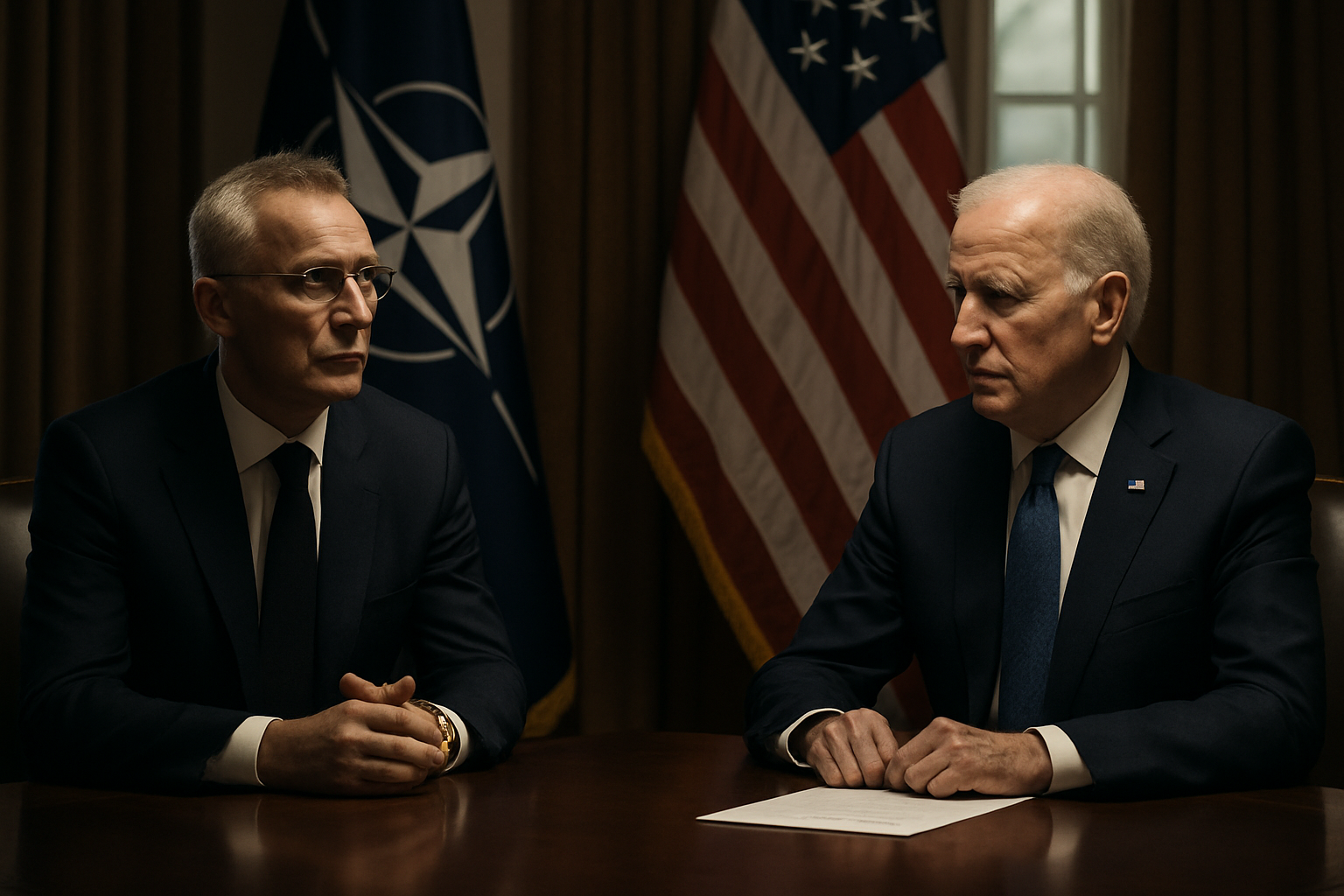
President Donald Trump has escalated his threats against NATO to an unprecedented level, calling the alliance a "paper tiger" and confirming discussions about potential U.S. withdrawal following European allies' comprehensive rejection of American military support requests in the ongoing Iran crisis.
The confrontation represents the gravest challenge to the 75-year-old alliance since its founding in 1949, with Trump administration officials confirming that potential NATO withdrawal remains "on the table" despite Secretary-General Mark Rutte's emergency consultations in Washington.
European Allies Deliver Historic Rejection
The current crisis stems from European allies' coordinated refusal to provide military support for Operation Epic Fury, the U.S.-Israeli campaign against Iran that has cost over $27 billion in its first month. German Defense Minister Boris Pistorius led the resistance, asking pointedly: "What does Donald Trump expect a handful of European frigates to do that the powerful U.S. Navy cannot?"
France, Japan, and Australia explicitly declined to deploy naval vessels to secure the Strait of Hormuz, despite the waterway's critical importance for global oil transit. Spain escalated its opposition beyond base access denial to closing its airspace to U.S. military aircraft conducting Iran operations, marking the first such denial since the 1950s defense agreements.
"We are prouder than ever to be Spanish, and we will not be accomplices in something that is bad for the world simply out of fear of retaliation."
— Pedro Sánchez, Spanish Prime Minister
The European stance reflects a fundamental shift toward what analysts term "strategic autonomy" – the willingness to defend European territory while rejecting what they view as American military adventures in the Middle East.
Trump's Unprecedented Retaliation
Trump's response has shattered diplomatic norms governing alliance relationships. His Truth Social declaration that the United States "no longer 'needs' or wants assistance from NATO countries—IN FACT, WE NEVER NEEDED IT!" represents the most direct threat to alliance unity in NATO's history.
The president has moved beyond rhetoric to concrete retaliation, ordering Treasury Secretary Scott Bessent to "cut off all dealings" with Spain and threatening to end "all trade" with Madrid. He has also criticized British Prime Minister Keir Starmer for insufficient support, declaring "This is not Winston Churchill's Britain."
Most significantly, White House Press Secretary Karoline Leavitt officially confirmed that Trump will discuss potential U.S. withdrawal from NATO during his critical meetings with Secretary-General Rutte, marking the first formal acknowledgment that alliance exit remains under active consideration.
The Iran Crisis Context
The NATO rift has emerged against the backdrop of the most dangerous international crisis since the Cold War. Iran's closure of the Strait of Hormuz through naval mining has disrupted 40% of global oil transit, sending energy prices soaring above $100 per barrel and forcing the International Energy Agency to authorize its largest strategic petroleum reserve release in 50 years.
The conflict has created a global aviation crisis, with over 18,000 flights cancelled worldwide and eight Middle Eastern countries closing their airspace simultaneously. Dubai International Airport, the world's busiest, remains shuttered due to missile damage.
Perhaps most significantly, Iranian forces have attacked European territory for the first time since World War II, striking British sovereign bases in Cyprus. This prompted an unprecedented European naval coalition response, demonstrating that allies will coordinate rapidly to defend European soil while refusing to support operations they view as discretionary wars.
Congressional and Public Opposition Mounts
Trump faces mounting domestic pressure over the Iran campaign, with only 25% of Americans supporting the military action according to recent polls. Senator Richard Blumenthal, a key voice on foreign policy, expressed being "more concerned than ever" about potential ground troop deployment.
The resignation of counterterrorism chief Joseph Kent in protest of the Iran war marked the first time a senior administration official has broken publicly over foreign military interventions. Kent cited the lack of "imminent threat" from Iran and accused Israeli officials and American media of conducting "disinformation campaigns" to pressure the administration into war.
Congressional opposition has been notably bipartisan, with lawmakers demanding detailed briefings on strategy, costs, and exit timelines as the Pentagon confirms operations will extend through September 2026, far beyond the initial 4-6 week projection.
Nuclear Governance in Crisis
The alliance crisis unfolds amid a broader breakdown in global nuclear governance. The New START treaty between the United States and Russia expired in February 2026, marking the first time in over 50 years that the two nuclear superpowers operate without bilateral arms control constraints.
Simultaneously, Iran continues uranium enrichment at 60% purity with over 400 kilograms of enriched material – approaching weapons-grade levels. The Geneva talks achieved "broad agreement on guiding principles" in what negotiators called the most progress since the 2018 JCPOA collapse, but fundamental disagreements over scope proved insurmountable.
Iran maintained that ballistic missiles and regional proxy relationships were "red lines" to be excluded from nuclear-only talks, while the United States demanded comprehensive agreements covering missiles, armed groups, and human rights concerns.
European Strategic Autonomy Accelerates
The crisis has accelerated European discussions about strategic autonomy and nuclear deterrence. German Chancellor Friedrich Merz and French President Emmanuel Macron have confirmed negotiations about expanding French nuclear deterrence beyond national scope for the first time since the Cold War's end.
Finland announced it will lift its comprehensive nuclear weapons ban "as soon as possible," stating current legislation is inadequate for NATO membership requirements. Sweden's Defense Minister indicated willingness to host nuclear weapons during wartime conditions, breaking an 80-year Nordic tradition of nuclear-free policies.
The NATO Arctic Sentry mission represents another manifestation of European strategic autonomy, with the UK doubling its troop presence in Norway to 2,000 personnel and Sweden deploying Gripen jets for Greenland exercises – all coordinated through European leadership rather than traditional U.S. command structures.
Alliance Obligations vs. Sovereignty
The crisis has exposed fundamental tensions between alliance solidarity and national sovereignty within NATO's framework. European leaders increasingly invoke "Iraq lessons" from 2003, emphasizing they cannot repeat what they view as the same mistakes in supporting questionable American interventions.
Spanish officials have been particularly explicit, with Prime Minister Sánchez positioning Spain as defending international law and the UN Charter against unlawful military intervention. The Spanish stance has broad European support, with EU Council President António Costa declaring "full solidarity with Spain" and guaranteeing that "the interests of member states are fully protected."
This represents a template-setting moment for 21st-century alliance relationships, testing whether NATO can accommodate fundamental disagreements over military intervention while maintaining collective defense commitments for territorial security.
Global Economic Consequences
The Strait of Hormuz closure has created the most significant energy crisis since the 1970s oil shocks. Natural gas prices have surged 24% in Europe and 78% in the United States, while Qatar has halted LNG production representing 20% of global exports.
Major shipping companies including Maersk and MSC have suspended operations in the Persian Gulf, leaving over 150 tankers stranded with billions of dollars in cargo. Airlines have imposed emergency fuel surcharges as prices approach $150-200 per barrel.
Financial markets have registered the global scope of the crisis, with Pakistan's KSE-100 recording its largest decline in history and South Korea's KOSPI triggering circuit breakers. The economic disruption extends beyond energy to manufacturing supply chains dependent on Gulf logistics for automotive, electronics, and textile sectors.
Regional Coalition Under Strain
An unprecedented regional coalition of Saudi Arabia, UAE, Qatar, and Egypt had initially supported diplomatic solutions to prevent military confrontation. However, Iranian retaliation has directly targeted these territories, with one civilian killed in the UAE, 32 injured in Kuwait, and eight wounded in Qatar.
Egyptian President Abdel Fattah al-Sisi condemned attacks on "sisterly countries" and warned of "comprehensive chaos spreading to the region." The Gulf states now face an impossible choice between their alliance with the United States and protecting their populations from Iranian retaliation.
Historical Significance and Implications
UN Secretary-General António Guterres has characterized the current period as the "greatest test of multilateral cooperation in the modern era." The rapid transition from diplomatic breakthrough to military confrontation demonstrates the fragility of crisis management mechanisms in the multipolar era.
The NATO crisis represents more than a policy disagreement – it's a fundamental test of whether the Western alliance can adapt to 21st-century challenges while preserving democratic principles and international law. European allies have demonstrated they will coordinate rapidly for territorial defense while refusing to support what they characterize as American military adventurism.
"NATO means security, stability and trust for Romania. The alliance must remain united and strong during these multiple security challenges."
— Ilie Bolojan, Romanian Prime Minister
Success in managing this crisis through institutional innovation could strengthen frameworks for addressing contemporary challenges. Failure might accelerate Western fragmentation at a critical moment for international stability, with implications extending far beyond current events to reshape global security architecture for decades.
Looking Ahead: Critical Decisions
The coming weeks will prove decisive for the future of the transatlantic alliance. Trump's meetings with Secretary-General Rutte represent a pivotal moment that could determine whether NATO can accommodate fundamental restructuring while maintaining its core collective defense mission.
European strategic autonomy has evolved from aspiration to operational reality, with concrete expressions in nuclear deterrence discussions, independent defense cooperation, and selective engagement with American military operations. This represents a potential paradigm shift in alliance relationships that could influence international cooperation mechanisms for the 21st century.
The stakes extend beyond NATO to fundamental questions about American leadership credibility, Western coordination capabilities, and the sustainability of post-World War II international order principles. Whether through institutional adaptation or fundamental fragmentation, the current crisis will establish precedents for alliance management, burden-sharing models, and collective defense mechanisms with implications lasting decades.
As Polish Prime Minister Donald Tusk warned, NATO's potential breakup would fulfill "Putin's dream plan." The alliance faces its most consequential test since formation, with outcomes that will determine not only transatlantic relations but the broader architecture of democratic nations' coordination in an era of intensifying great power competition.