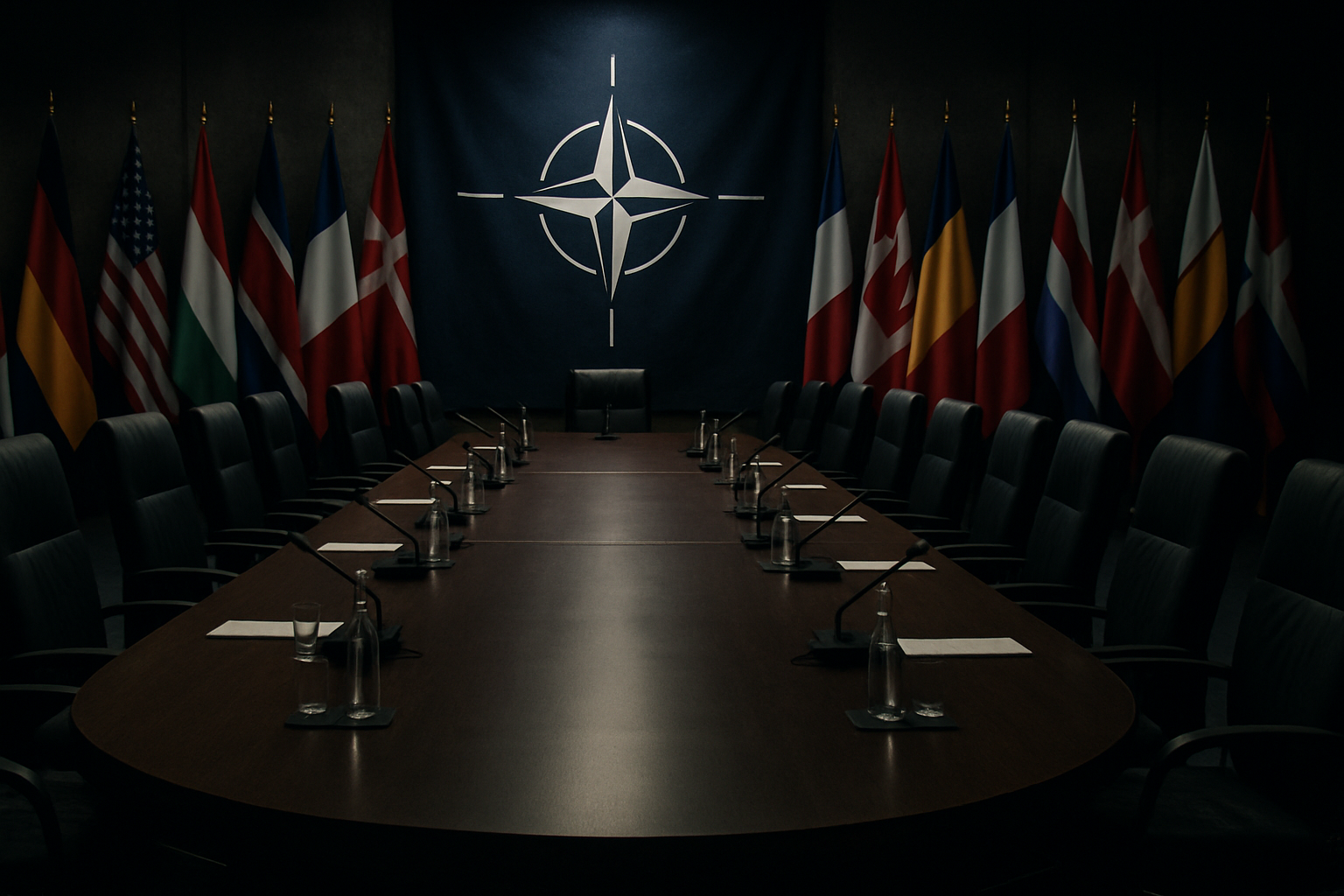
President Donald Trump launched his most scathing attack yet on NATO allies Tuesday, angrily rejecting their assistance and declaring "We don't need anyone's help!" after European leaders delivered a crushing refusal to send warships to secure the Strait of Hormuz during the escalating Iran crisis.
The unprecedented public rebuke came as Trump's demands for an international naval coalition to reopen the critical waterway—which carries 40% of global oil transit—met with resounding rejection from Germany, France, Japan, and Australia. The crisis has exposed the deepest fractures in the Atlantic alliance since World War II, with experts calling it a watershed moment for NATO unity.
European Allies Deliver Crushing Rejection
Germany's Defense Minister Boris Pistorius led the resistance with a pointed question that encapsulated European skepticism: "What does Donald Trump expect a handful European frigates to do that the powerful US Navy cannot?" France explicitly rejected warship deployment requests, while Japan and Australia declined sending naval vessels despite their critical dependence on Middle East oil routes.
The rejections came as Iran has effectively closed the Strait of Hormuz by deploying an estimated 2,000-6,000 naval mines throughout the 21-mile waterway. Oil prices have surged past $100 per barrel for the first time since 2022, with Brent crude hitting $119.50 and West Texas Intermediate reaching $108.15—an unprecedented 18.98% single-day jump.
Swedish Prime Minister Ulf Kristersson refused assistance outright, while European leaders invoked the "Iraq lessons," emphasizing they "cannot repeat the same mistakes made in Iraq." The coordinated European response reflects a fundamental shift in how allies view American military interventions in the multipolar era.
Trump's Furious Response
In a series of incendiary Truth Social posts, Trump declared: "The United States has been informed by most of our NATO 'allies' that they do not want to participate in our military operation against Iran. We no longer 'need' or want the assistance of NATO countries—IN FACT, WE NEVER NEEDED IT!"
"I am not surprised by their reaction. Having decimated the Iranian army, the United States no longer needs or wants the help from NATO countries."
— Donald Trump, President
The president's fury extends beyond the immediate Hormuz crisis to broader alliance tensions. Trump has already threatened to "cut off all trade" with Spain after Prime Minister Pedro Sánchez refused US military base access for Iran operations, calling Spain a "terrible ally." The UK faced criticism for what Trump characterized as lukewarm support, with the president declaring he didn't recognize this as "Winston Churchill's Britain."
The Iran War Context
Trump's NATO ultimatum comes during the third week of Operation Epic Fury, the largest US-Middle East military operation since the 2003 Iraq invasion. The conflict began after the complete breakdown of nuclear diplomacy despite Geneva talks achieving a "broad agreement on guiding principles"—the most progress since the 2018 JCPOA collapse.
The war has cost $11.3 billion in its first week alone, with 150 US troops wounded and three confirmed killed. Iran's retaliatory "Operation True Promise 4" has targeted US allies across the Gulf region, marking the first attack on European territory since World War II when Iranian drones struck RAF Akrotiri in Cyprus.
Global Crisis Escalates
The Hormuz closure has triggered the most severe global crisis since the COVID-19 pandemic. Over 18,000 flights have been cancelled worldwide as eight Middle Eastern countries simultaneously closed their airspace. Dubai International Airport, the world's busiest with 86 million passengers annually, remains completely shut down due to missile damage.
Emirates, Air France-KLM, and Wizz Air have suspended operations indefinitely, affecting hundreds of thousands of passengers globally. The aviation disruption has severed critical Asia-Europe corridors, forcing fundamental reconsiderations of flight routing and logistics.

Energy Architecture Under Threat
The International Energy Agency has released a record 400 million barrels from strategic petroleum reserves—the largest intervention in the agency's 50-year history. Japan is releasing 80 million barrels for the first time since the 2011 Fukushima disaster. Qatar has halted LNG production, threatening European gas supplies and driving natural gas prices up 24% in Europe and 78% in the United States.
Maersk and MSC have suspended Persian Gulf operations, with over 150 tankers stranded carrying billions of dollars worth of cargo. Qatar Energy Minister Saad Al Kaabi warned that Gulf states may declare force majeure "within weeks," potentially driving oil prices toward $150-200 per barrel and threatening to "bring down world economies."
Congressional Opposition Mounts
The alliance crisis comes as Trump faces unprecedented bipartisan congressional pressure over the Iran war. Senator Richard Blumenthal expressed being "more concerned than ever" about potential ground troop deployment, while the Pentagon has quietly prepared operations extending through September—far beyond the administration's initial 4-6 week timeline.
The conflict's unpopularity is "almost unprecedented" for early-stage military operations, with only 25% of Americans supporting the strikes according to recent polling. Financial markets have become what analysts describe as the "ultimate constraint" on escalation, with Pakistan's stock exchange suffering its largest single-day decline in history.
Regional Consequences
The NATO crisis has severely strained the unprecedented coalition of Saudi Arabia, UAE, Qatar, and Egypt that had supported diplomatic solutions. Egyptian President Abdel Fattah el-Sisi condemned Iranian attacks on "sisterly Arab countries," warning of "comprehensive chaos spreading across the region."
Iran's systematic targeting under its "no red lines remain" policy has caused casualties across the Gulf: one civilian killed in the UAE, 32 injured in Kuwait airport strikes, and eight injured in Qatar despite Patriot missile systems intercepting 65 missiles and 12 drones.
Nuclear Diplomacy's Complete Collapse
The current crisis emerged from the complete breakdown of nuclear negotiations despite February's Geneva breakthrough. The fundamental scope disagreement proved insurmountable: Iran excluded ballistic missiles and regional proxies as "red lines" while demanding nuclear-only talks, whereas the US insisted on comprehensive agreements addressing missiles, armed groups, and human rights.
Iran continues enriching uranium to 60% purity—approaching the 90% weapons-grade threshold—with an estimated 400+ kilograms of enriched uranium sufficient for multiple weapons. The crisis unfolds against the backdrop of the New START treaty's expiration in February 2026, leaving the world without US-Russia nuclear constraints for the first time in over 50 years.
European Strategic Autonomy in Action
Paradoxically, while rejecting Trump's Gulf coalition demands, Europeans have demonstrated unprecedented unity in defending their own territory. The first Iranian attack on European soil since World War II prompted an immediate naval coalition featuring HMS Dragon, Spanish frigates, and vessels from Italy, France, the Netherlands, and Greece.
The EU activated its ESTIA evacuation plan for Cyprus for the first time in the bloc's history, while European leaders have begun accelerating strategic autonomy discussions. The Merz-Macron nuclear deterrence talks have gained new urgency amid questions about American reliability.
Historical Watershed Moment
UN Secretary-General António Guterres has called the crisis the "greatest test of multilateral cooperation in the modern era." The rapid transition from diplomatic breakthrough to military confrontation demonstrates what experts describe as the fragility of crisis management in the multipolar era.
Trump's explicit demands for Iran's "unconditional surrender" and his claim to personally choose Iran's next Supreme Leader represent the most direct assertion of American control over Iranian affairs since the 1979 revolution. This policy evolution from nuclear-focused negotiations to comprehensive regime change has eliminated near-term diplomatic solutions.
Global Economic Disruption
The crisis has exposed fundamental vulnerabilities in global supply chains dependent on Gulf logistics networks. Manufacturing in automotive, electronics, and textiles sectors faces severe disruptions, while airlines have implemented emergency fuel surcharges as jet fuel costs jumped from $85-90 per barrel to $150-200.
The Persian Gulf's role as a critical Asia-Europe trade hub extends far beyond energy, affecting consumer goods and industrial materials worldwide. The single-point failure of the 21-mile Strait of Hormuz has highlighted the need for fundamental restructuring of global energy architecture, though such transitions require years or decades to implement.
Template-Setting Implications
March 17, 2026, may be remembered as a watershed moment in international relations, determining whether 21st-century disputes are resolved through diplomacy or military confrontation. The European allies' rejection of American military adventurism while defending their own territory represents a new paradigm for alliance relationships in the multipolar era.
The success or failure of containing this crisis will establish precedents affecting nuclear proliferation prevention, territorial sovereignty enforcement, and energy security architecture for decades. Most critically, it will determine whether institutional cooperation frameworks can adapt to modern challenges or whether Western unity will fragment at this critical moment for international stability.
As Trump continues his angry rejection of allied assistance while demanding their support, the Atlantic alliance faces its most severe test since formation. The coming days will determine whether NATO can weather this unprecedented challenge to its unity or whether the president's fury marks the beginning of a fundamental realignment in global security relationships.