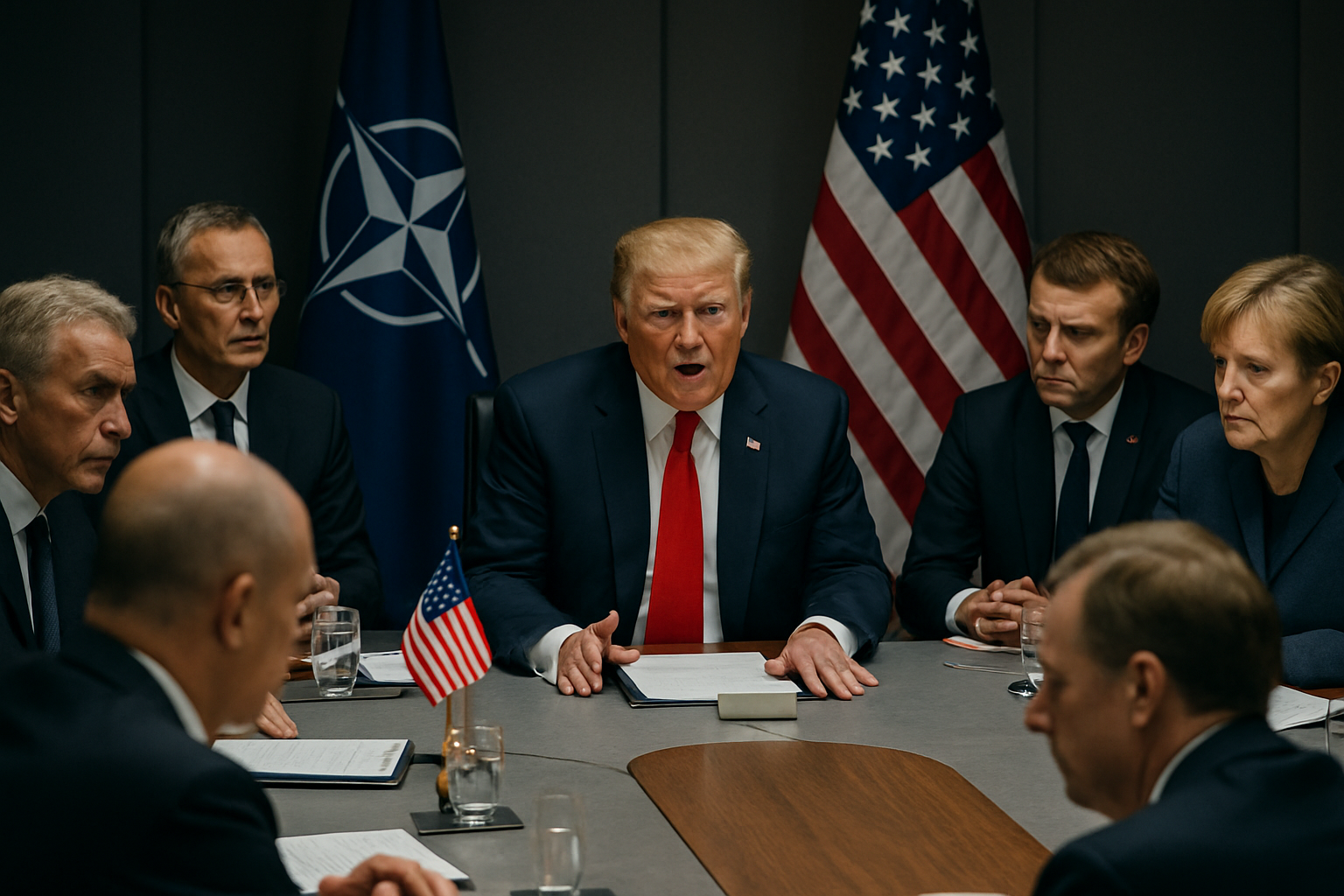
President Donald Trump issued an unprecedented ultimatum to NATO allies on Sunday, warning they face a "very bad future" if they refuse to help the United States secure the Strait of Hormuz amid the ongoing conflict with Iran.
In an explosive interview with the Financial Times, Trump escalated pressure on European partners and other allies to provide naval support for the strategic waterway, which carries 40% of the world's seaborne oil trade. The president's stark language represents the most direct threat to alliance cohesion since the Iran crisis began.
"I'm demanding that these countries come in and protect their own territory because it is their territory," Trump told reporters aboard Air Force One, referencing nations that rely heavily on Middle Eastern oil. The president specifically mentioned China's dependence on Persian Gulf oil, stating that Beijing "gets 90% of its oil from the strait."
Global Response Remains Lukewarm
Despite Trump's calls for international naval assistance, the global response has been decidedly cool. Japan and Australia explicitly stated they have no plans to send naval vessels to the Middle East, dealing a significant blow to Trump's coalition-building efforts.
Japanese officials indicated their forces would only deploy once "significant thresholds" are met in the region, while Australian government sources confirmed the country will not participate in Middle East missions. China has remained largely silent, with Beijing stating it aims to maintain "constructive engagement" among relevant parties.
The lukewarm international response highlights the diplomatic challenges Trump faces in building support for U.S. operations in the Persian Gulf, even among traditional allies concerned about energy security.
Energy Markets React to Escalating Tensions
Oil markets responded nervously to Trump's demands and the deteriorating security situation in the Gulf. Brent crude prices rose more than 1% above $104.50 per barrel, while regional stock markets showed weakness amid concerns about potential disruptions to Middle Eastern oil facilities.
The Strait of Hormuz crisis has created significant volatility in global energy markets, with natural gas prices surging 24% in Europe and 78% in the United States. The narrow 21-mile chokepoint has become a critical vulnerability for the global economy, demonstrating the world's continued dependence on Middle Eastern energy supplies.
"The spike in oil and gas prices that we're seeing is caused by the closure of the Strait," British Energy Secretary Ed Miliband told British media, adding that Britain views diplomatic solutions as the most effective path forward.
— Ed Miliband, British Energy Secretary
Aviation Industry Faces Unprecedented Crisis
The Iran conflict has triggered the most extensive global aviation disruption since COVID-19, with over 18,000 flights cancelled worldwide. Eight Middle Eastern countries have simultaneously closed their airspace, effectively severing critical Europe-Asia air corridors.
Dubai International Airport, the world's busiest with 86 million passengers annually, remains completely shut down due to missile damage. Major carriers including Emirates, Air France-KLM, and Wizz Air have suspended Middle Eastern operations indefinitely, affecting hundreds of thousands of passengers globally.
The aviation crisis demonstrates how quickly regional conflicts can cascade into global disruptions, highlighting the interconnected nature of modern transportation networks and their vulnerability to geopolitical shocks.
NATO Under Unprecedented Strain
Trump's ultimatum to NATO represents one of the most serious challenges to alliance unity in recent memory. Several European leaders have publicly expressed reservations about military involvement in the Middle East, with Spanish Prime Minister Pedro Sánchez previously condemning U.S.-Israeli operations as a "breach of international law."
The president has already threatened to "cut off all trade" with Spain after Madrid refused to allow U.S. military bases on Spanish territory to be used for Iran operations. This unprecedented diplomatic rupture highlights the growing strain between Washington and key European allies over Middle East policy.
Iran's Strategic Calculations
Iran's closure of the Strait of Hormuz appears designed to inflict maximum economic pain while drawing international attention to the conflict. The Islamic Revolutionary Guard Corps has declared "no red lines remain" in their response to U.S.-Israeli operations, indicating Tehran's willingness to escalate further.
The Iranian strategy of targeting economic infrastructure reflects a broader shift toward asymmetric warfare designed to impose costs on the global economy and potentially fracture the international coalition supporting U.S. operations.
Congressional Opposition Intensifies
On Capitol Hill, bipartisan opposition to the Iran conflict continues to grow, with lawmakers demanding answers about strategy, costs, and the potential for ground troop deployment. Senator Richard Blumenthal has expressed being "more concerned than ever" about the possibility of boots on the ground.
The conflict's unpopularity among the American public, with support at just 25%, creates additional political pressure on the Trump administration to either secure international backing or find an exit strategy.
Global Economic Implications
The Strait of Hormuz crisis has exposed critical vulnerabilities in global supply chains and energy infrastructure. Stock markets worldwide have shown significant volatility, with Pakistan's KSE-100 experiencing its largest single-day decline in history at -8.97%.
Manufacturing sectors dependent on Gulf logistics networks, including automotive, electronics, and textiles, face severe disruption. The crisis has forced a fundamental reconsideration of global supply chain resilience and the risks of over-dependence on single strategic chokepoints.
Diplomatic Efforts Continue Despite Tensions
Despite the military escalation, diplomatic channels remain open. Recent nuclear talks in Geneva achieved what Iranian Foreign Minister Abbas Araghchi called "broad agreement on guiding principles" - the most significant diplomatic progress since the JCPOA collapse in 2018.
However, fundamental disagreements persist, with Iran maintaining that ballistic missiles and regional proxy activities are "red lines" excluded from nuclear negotiations, while the U.S. demands a comprehensive agreement addressing all aspects of Iranian behavior.
Looking Ahead
Trump's ultimatum to NATO allies represents a critical juncture in the Iran crisis, with implications extending far beyond the immediate conflict. The president's ability to build an international coalition could determine both the trajectory of the current crisis and the broader credibility of American leadership in future international crises.
As energy markets continue to gyrate and global aviation networks remain disrupted, the international community faces a stark choice between supporting U.S. demands for naval assistance or risking further deterioration in alliance relationships at a time when unity is most needed.
The coming days will likely prove decisive in determining whether Trump can rally international support for securing one of the world's most critical shipping lanes, or whether the United States will find itself increasingly isolated in its confrontation with Iran.