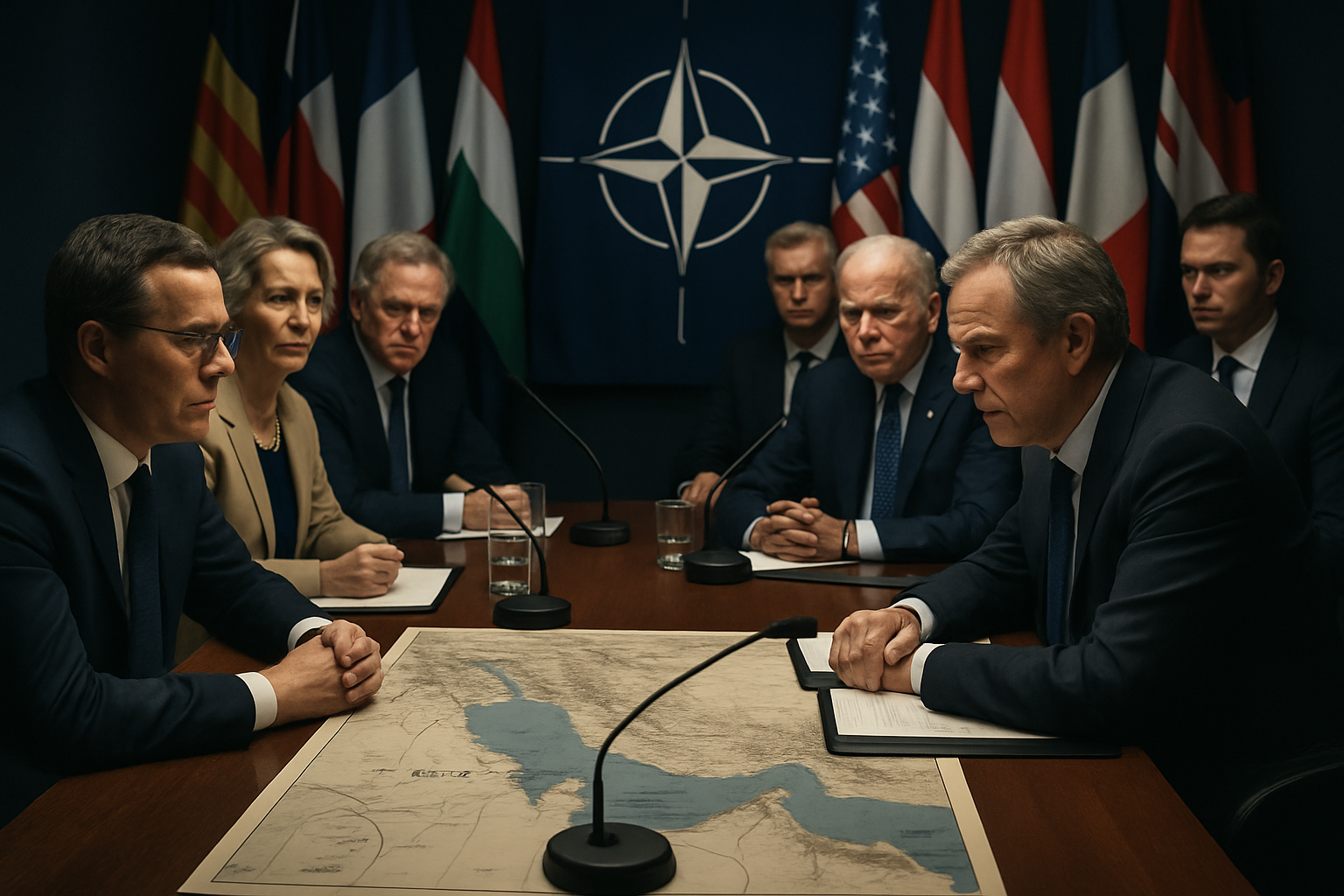
President Donald Trump delivered an unprecedented warning to NATO allies Monday, threatening a "very bad future" for the alliance if member nations refuse to provide military support to secure the Strait of Hormuz amid the ongoing conflict with Iran.
Speaking to the Financial Times, Trump demanded that countries "come in and protect their own territory," specifically targeting China, which he noted gets "90% of its oil from the strait." The ultimatum represents the most direct threat to NATO cohesion since the Iran crisis began 18 days ago, with Trump already having threatened to "cut off all trade" with Spain after Prime Minister Pedro Sánchez refused to allow U.S. military base access for Iran operations.
Energy Crisis Reaches Critical Point
The Strait of Hormuz, a narrow waterway carrying 40% of global seaborne oil transit, remains effectively closed as Iran continues mining operations using an estimated 2,000-6,000 naval mines. Oil prices surged above $104.50 per barrel Monday, while natural gas jumped 24% in Europe and 78% in the United States.
British Energy Secretary Ed Miliband blamed the oil and gas price spike directly on the strait closure, emphasizing that diplomatic solutions remain preferred over military intervention. Airlines worldwide have implemented emergency fuel surcharges as jet fuel costs skyrocketed from the normal $85-90 per barrel to $150-200 per barrel.
"What does Donald Trump expect a handful or two handfuls of European frigates to do in the Strait of Hormuz that the powerful U.S. navy cannot do?"
— Boris Pistorius, German Defence Minister
The global aviation industry continues to suffer unprecedented disruption, with over 18,000 flights cancelled worldwide—the most since COVID-19. Eight Middle Eastern countries maintain simultaneous airspace closures, completely severing Europe-Asia flight corridors. Dubai International Airport, the world's busiest with 86 million passengers annually, remains shut down due to missile damage.
European Allies Push Back
German Defence Minister Boris Pistorius rejected Trump's demands outright, questioning what European naval forces could accomplish that the powerful U.S. Navy cannot. "This is not our war, we have not started it," Pistorius declared in Berlin, downplaying Trump's threats about NATO's future.
Sweden's Prime Minister Ulf Kristersson similarly stated that Sweden would not assist the U.S. in the Strait of Hormuz operations. Swedish shipping company Stena Bulk, which has vessels stranded in the region, expressed concern about the risks of military escort operations. "It is clear that should one begin to escort ships, the risk is very high that something will happen," said CEO Erik Hånell.
The resistance from European allies reflects broader concerns about the Iraq War precedent, with many nations emphasizing they "cannot repeat the same mistakes made in Iraq." This philosophical divide has already led to the most serious transatlantic crisis in decades.
Coalition Building Challenges
Trump's coalition-building efforts have faced significant setbacks, with Japan and Australia explicitly refusing to send naval vessels despite direct U.S. requests. This represents a substantial blow to American efforts to internationalize the military response to Iran's closure of the strategic waterway.
The president's approach has strained relationships across the Atlantic, with European leaders expressing reservations about military involvement in what they view as an American-led intervention. Trump's criticism of British Prime Minister Keir Starmer as "not Winston Churchill" for his reluctance to fully support Iran strikes exemplifies the growing tensions.
Congressional Opposition Mounts
On the domestic front, Trump faces mounting bipartisan congressional opposition to the expanding conflict. Senator Richard Blumenthal expressed being "more concerned than ever" about the potential deployment of ground troops, while the conflict maintains historically low public support at just 25% among Americans.
The Pentagon's Operation Epic Fury has already cost $11.3 billion in its first week, with operations now extending through September—far beyond the initial 4-6 week timeline promised by the White House. The financial markets have emerged as what analysts call the "ultimate constraint" on further escalation, with Pakistan's stock exchange recording its largest single-day decline in history.
Iran's Strategic Response
Iran's Revolutionary Guard has maintained its position of "no red lines remain" in response to U.S.-Israeli operations. The systematic targeting of economic infrastructure through asymmetric warfare appears designed to impose global costs and fracture the international coalition supporting the United States.
The Iranian approach has proven effective in disrupting global supply chains dependent on Gulf logistics, particularly affecting manufacturing in automotive, electronics, and textiles sectors. This strategy forces a fundamental reconsideration of supply chain resilience and the over-dependence on single strategic chokepoints in modern logistics.
Historical Context and Precedent
The current crisis emerged from the complete breakdown of nuclear diplomacy, despite Geneva talks in February achieving "broad agreement on guiding principles"—the most significant progress since the 2018 JCPOA collapse. However, fundamental disagreements persisted, with Iran excluding ballistic missiles and regional proxies as "red lines" while the U.S. demanded comprehensive agreements addressing these issues.
Trump's demand for NATO support represents an evolution from the alliance's traditional Article 5 collective defense principle, instead asking allies to assist in what many view as an offensive operation initiated by the United States and Israel.
Global Economic Implications
The crisis has exposed fundamental vulnerabilities in the global economic system, with manufacturing sectors severely disrupted due to their dependence on Gulf logistics networks. The 21-mile-wide Strait of Hormuz has effectively become a single point of failure for modern global trade.
Major shipping companies Maersk and MSC have suspended Persian Gulf operations indefinitely, leaving over 150 oil and LNG tankers stranded with billions of dollars in cargo. Qatar has halted LNG production, representing approximately 20% of global exports, directly threatening European energy security.
Template-Setting Moment for Alliances
Foreign policy analysts describe Trump's NATO ultimatum as a critical juncture with implications extending far beyond the immediate conflict. The president's coalition-building ability could determine not only the crisis trajectory but also the broader credibility of American leadership in future international crises.
UN Secretary-General António Guterres has called the situation "the greatest test of multilateral cooperation and crisis management in the modern era." The rapid transition from diplomatic breakthrough to military escalation demonstrates what experts term the "fragility of crisis management in the multipolar era."
The stakes are maximum for alliance unity, global energy security, and international cooperation frameworks during what has become the most dangerous Middle East crisis in decades, with global implications extending far beyond regional boundaries.