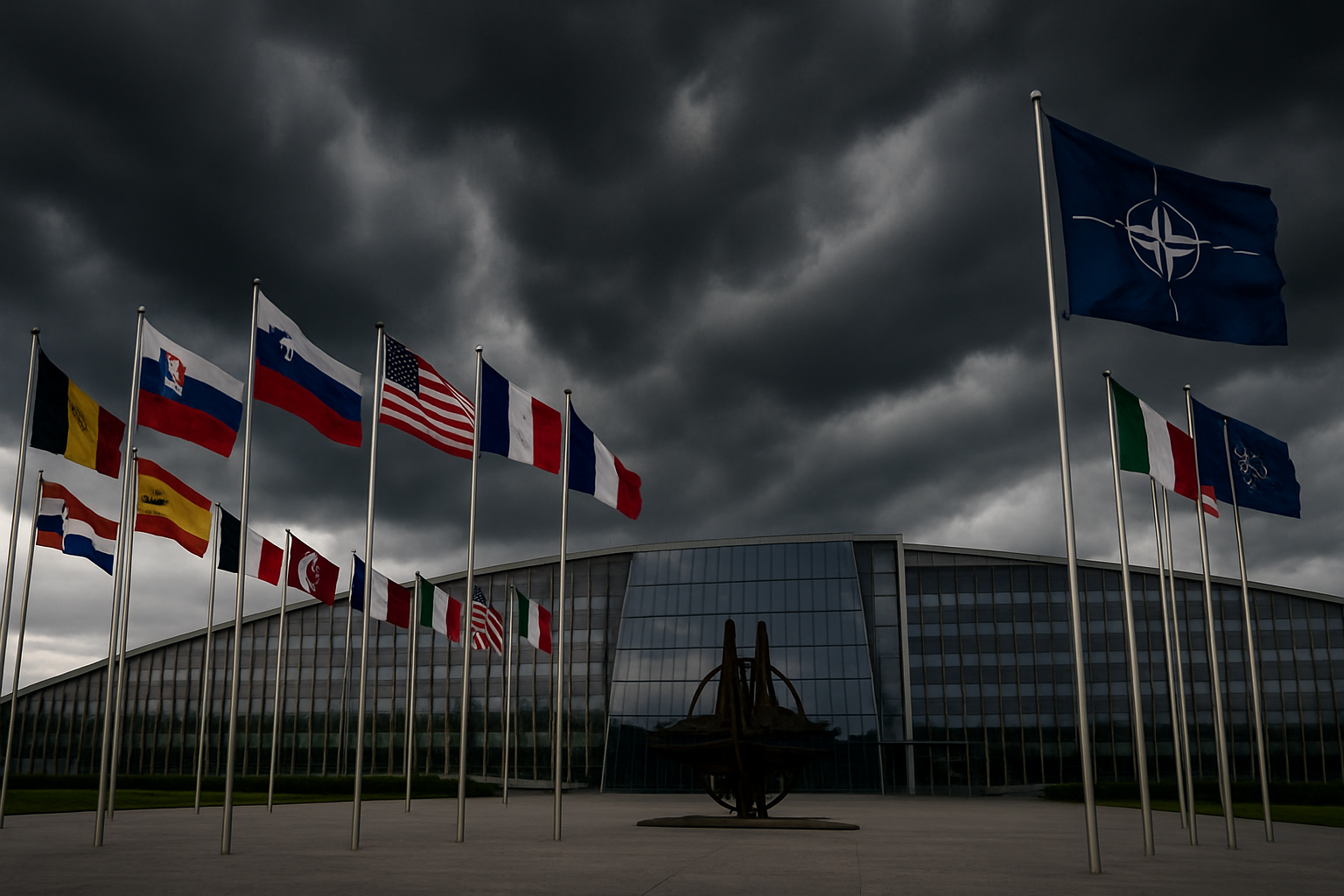
President Donald Trump's escalating pressure campaign on NATO allies has reached a critical breaking point, with Secretary-General Mark Rutte traveling to Washington for emergency consultations as the alliance faces its gravest existential crisis in 75 years.
The crisis has reached unprecedented levels following Trump's explosive Truth Social declaration that NATO is a "paper tiger" without American support, delivered after European allies delivered a crushing rejection of U.S. military demands during the Iran crisis. Austrian media reports suggest Trump may now target the alliance with economic sanctions, while Norwegian sources indicate NATO leadership is desperately attempting to prevent a complete rupture of transatlantic relations.
European Rejection Triggers Alliance Fracture
The current crisis stems from European allies' comprehensive refusal to support U.S. naval operations in the Strait of Hormuz during Operation Epic Fury. German Defense Minister Boris Pistorius led the resistance, asking publicly: "What does Donald Trump expect a handful of European frigates to do that the powerful U.S. Navy cannot?" France, Japan, and Australia explicitly declined to deploy naval vessels despite their dependence on Middle Eastern oil supplies.
Trump's response was immediate and unprecedented. "Without the United States, NATO IS A PAPER TIGER!" he declared on Truth Social, adding that America "no longer 'need' or want assistance from NATO countries—IN FACT, WE NEVER NEEDED IT!" The statement represents the most direct threat to alliance unity since NATO's formation in 1949.
Spanish Defense Minister Margarita Robles escalated the confrontation by closing Spanish airspace to U.S. military aircraft involved in Iran operations, going beyond the previous denial of base access at Rota Naval Station and Morón Air Base. This move forces American aircraft to bypass Spain entirely for Middle East missions, creating significant operational complications for ongoing military operations.
Strategic Autonomy Versus Alliance Solidarity
Despite rejecting U.S. military requests in the Persian Gulf, European nations demonstrated unprecedented coordination when defending their own territory. The Iranian drone attack on Cyprus's RAF Akrotiri—the first strike on European soil since World War II—prompted an immediate four-nation naval coalition featuring HMS Dragon, Spanish frigates, and Italian, French, Dutch, and Greek vessels.
This selective cooperation has created a new paradigm in alliance relations. European officials privately describe it as balancing "alliance obligations with sovereign decision-making" when controversial military operations are involved. The EU activated its ESTIA crisis mechanism for the first time in history to manage the Cyprus evacuation, demonstrating European capacity for independent action.
"No to war in Iran, but solidarity with Cyprus, EU country victim of this war."
— Spanish Government Statement
Nuclear Deterrence and Defense Spending
The alliance crisis has accelerated discussions about European strategic autonomy that began during Trump's previous term. German Chancellor Friedrich Merz and French President Emmanuel Macron have confirmed direct negotiations about expanding France's nuclear deterrent beyond national boundaries—the first such talks since the Cold War's end.
The timing is particularly significant given the February 2026 expiration of the New START treaty, leaving the world without bilateral U.S.-Russia nuclear constraints for the first time in over 50 years. Finland has announced plans to lift its comprehensive nuclear weapons ban "as soon as possible," while Sweden declared willingness to host nuclear weapons during wartime, breaking an 80-year Nordic tradition.
Paradoxically, these developments come as NATO achieved a historic milestone: all 32 member nations reached the 2% GDP defense spending target for the first time in the alliance's history. Combined spending reached $1.4 trillion, representing a 6% increase from the previous year. Poland leads at 4.3% of GDP, while the final five nations—Spain, Portugal, Albania, Belgium, and Canada—recently achieved the minimum requirement.
Arctic and Regional Security Initiatives
European leadership has been particularly evident in the NATO Arctic Sentry mission, launched in response to a 23% increase in Russian Arctic activity since Finland and Sweden joined the alliance. The UK is doubling its troop presence in Norway from 1,000 to 2,000 over three years, while Sweden has deployed Gripen jets for Greenland exercises and Finland contributes operational planning.
These initiatives operate largely independent of U.S. leadership, reflecting growing European confidence in managing regional security challenges. The Arctic mission addresses multiple pressures: Russian base reopening, Chinese research expansion, and climate change creating new shipping routes and resource extraction opportunities.
Congressional and Domestic Pressures
Trump's NATO threats face significant resistance from the U.S. Congress, where bipartisan support for the alliance remains strong despite presidential criticism. Senators from both parties have issued statements supporting continued NATO membership, providing some European reassurance about long-term American commitment.
Estonian politicians remain divided on Trump's NATO remarks, with some viewing them as serious signals while others dismiss them as negotiating tactics. Estonian researcher Marek Kohv from the International Centre for Defence and Security notes that while Trump cannot unilaterally withdraw from NATO, he can "paralyze alliance activities and reduce U.S. military presence in Europe."
Lithuanian President Gitanas Nausėda acknowledges that "tensions within the Alliance have been rising recently" but maintains trust in collective defense mechanisms. However, Polish Prime Minister Donald Tusk has warned that NATO's potential breakup represents Putin's "dream plan," emphasizing how alliance divisions serve Russian strategic interests.
Economic and Strategic Implications
The crisis extends beyond military cooperation to fundamental questions about Western economic integration. Trump has threatened to "cut off all trade" with Spain following its refusal to support Iran operations, while Treasury Secretary Scott Bessent was ordered to "cut off all dealings" with Madrid. Such unilateral trade embargos would likely violate World Trade Organization rules and existing EU-U.S. agreements.
European officials express confidence in their ability to manage potential American economic retaliation through EU collective solidarity and supply chain diversification. Spain's Economy Minister Carlos Cuerpo justified the country's position as refusing to "participate in or contribute to a war which was initiated unilaterally and against international law."
The French government has been particularly supportive of allied resistance to U.S. pressure, with President Macron telephoning Spanish Prime Minister Pedro Sánchez to express solidarity. These developments have accelerated European strategic autonomy discussions, with Brussels defending the principle that alliance obligations must be balanced against international law compliance.
Historical Precedents and Future Implications
The current crisis draws inevitable comparisons to the 2003 Iraq War, when European opposition to U.S. military intervention created significant alliance strains. Spanish officials explicitly reference "Iraq lessons," emphasizing their determination not to "repeat the same mistakes made in Iraq." The 2003 Spanish opposition to the Iraq War contributed to the Popular Party's electoral defeat in 2004, providing a domestic precedent for resistance to American military pressure.
However, the current situation differs significantly in both scope and potential consequences. Unlike 2003, when disagreements remained largely diplomatic, Trump's threats now target the fundamental structure of the alliance itself. His consideration of economic sanctions against NATO members represents a unprecedented departure from traditional alliance management principles.
"We are prouder than ever to be Spanish, and we will not be accomplices in something that is bad for the world."
— Spanish Prime Minister Pedro Sánchez
The Path Forward
UN Secretary-General António Guterres has characterized the current period as "the greatest test of multilateral cooperation in the modern era." The outcome will determine whether NATO's institutional resilience can accommodate fundamental restructuring while maintaining democratic principles, or whether the alliance faces its most serious existential crisis since the 1956 Suez Crisis.
Success in managing the crisis could strengthen institutional frameworks for addressing contemporary security challenges. However, failure might accelerate Western fragmentation at a critical moment for international stability, with implications extending far beyond Europe to affect global governance mechanisms and conflict resolution approaches.
The stakes are particularly high given simultaneous challenges including the ongoing Ukraine conflict, Russian activities in the Arctic, tensions over Greenland sovereignty, and the broader context of great power competition with China. European leaders increasingly view their choice as one between strategic autonomy and traditional alliance solidarity, with potential to reshape international relations for decades.
As NATO Secretary-General Mark Rutte prepares for his critical Washington meetings, the alliance stands at perhaps its most consequential crossroads since formation. Whether these discussions can bridge the growing divide between American unilateralism and European multilateralism may determine not only NATO's future, but the broader trajectory of Western cooperation in addressing 21st-century global challenges.