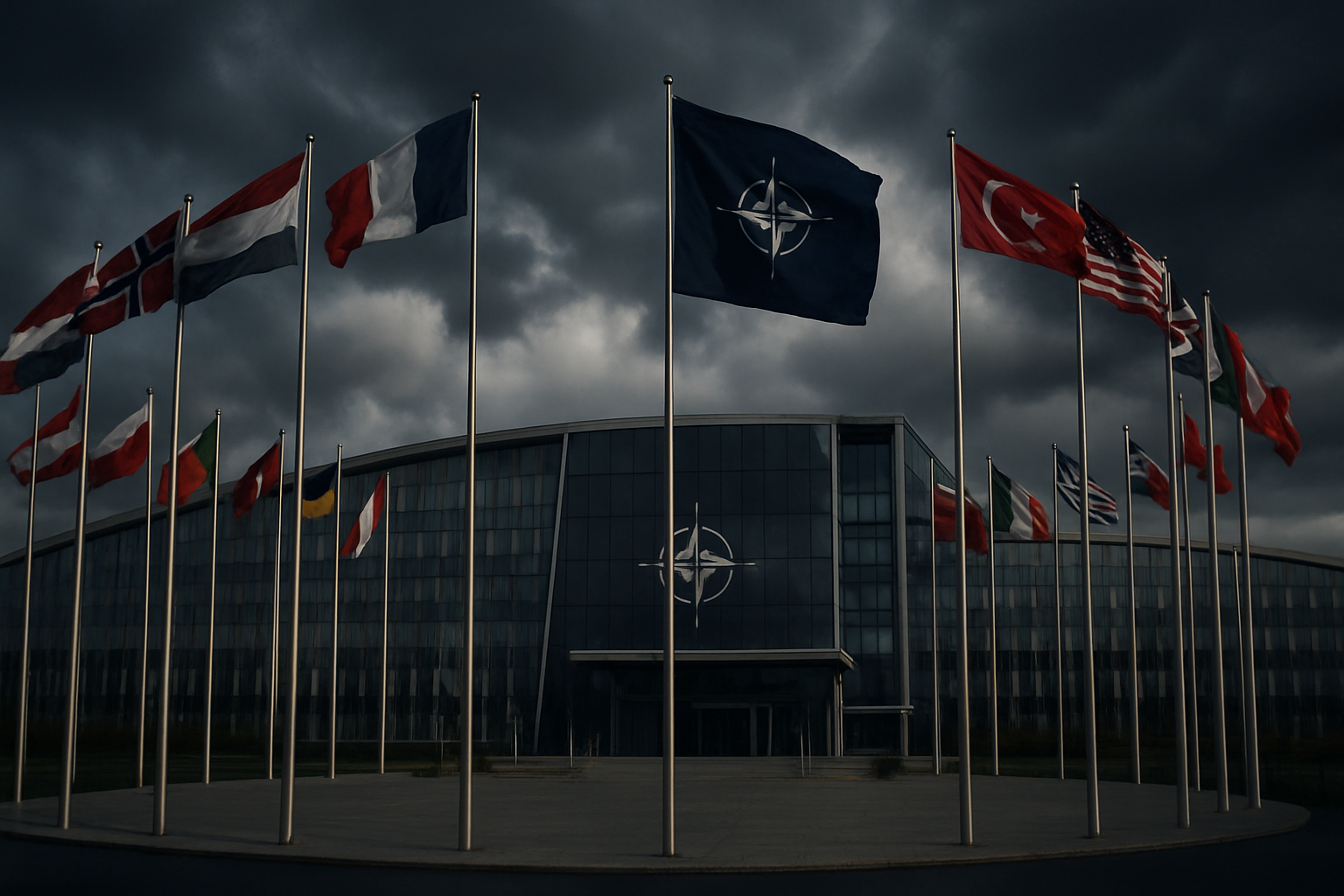
President Donald Trump has escalated his threats to withdraw the United States from NATO, calling the alliance a "paper tiger" after European allies delivered a crushing rejection of his demands for naval coalition support in the Iran crisis, marking the most serious threat to the transatlantic alliance since its 1949 founding.
In interviews with The Daily Telegraph and statements across multiple platforms, Trump declared he is "seriously considering" US withdrawal from NATO, marking his most direct challenge to the Western military alliance as the Iran crisis enters its fourth week with mounting costs and unprecedented European resistance to American military leadership.
European Allies Deliver Historic Rejection
The alliance fracture reached its peak when European leaders delivered a comprehensive rebuke to Trump's demands for international naval coalition support in the Strait of Hormuz. German Defense Minister Boris Pistorius led the resistance, asking "What does Donald Trump expect a handful of European frigates to do that the powerful US Navy cannot?"
France explicitly rejected warship deployment to the Persian Gulf, while Japan and Australia declined to send naval vessels despite their critical dependence on Middle Eastern oil trade routes. Sweden's Prime Minister Ulf Kristersson refused assistance entirely, citing "Iraq lessons" and emphasizing that European nations "cannot repeat the same mistakes."
The coordinated European response represents the most comprehensive rejection of American military leadership since the 2003 Iraq War, with allies invoking historical precedents while maintaining their commitment to defending European territory when directly threatened.
Trump's Unprecedented Retaliation
Trump's response marked a dramatic policy reversal from traditional coalition-building to a unilateral approach. In a Truth Social post, he declared: "The United States has been informed by most NATO 'allies' that they do not want to participate in our military operation in Iran. We no longer 'need' or want assistance from NATO countries—IN FACT, WE NEVER NEEDED IT!"
The president had already threatened to "cut off all trade" with Spain after Prime Minister Pedro Sánchez refused US military base access for Iran operations, and criticized UK Prime Minister Keir Starmer as "not Winston Churchill's Britain" for lukewarm support of the military campaign.
"Without the United States, NATO is a paper tiger. They didn't want to go to war to stop nuclear-armed Iran."
— Donald Trump, US President
Operation Epic Fury Costs Mount
The Iran military campaign, dubbed "Operation Epic Fury," has become the largest US-Israeli coordinated operation since 2003, with costs exceeding $11.3 billion in the first week alone. Pentagon operations are now planned through September 2026, far beyond Trump's initial 4-6 week timeline.
The human cost includes the first US casualties, with 3 confirmed deaths and over 150 wounded troops. The USS Charlotte submarine's sinking of an Iranian frigate marked the first enemy vessel destroyed by a US submarine since World War II, highlighting the conflict's escalating intensity.
Congressional opposition has reached unprecedented levels, with only 25% of Americans supporting the Iran strikes—historically low for a major military operation. Senator Richard Blumenthal expressed being "more concerned than ever" about potential ground troop deployment, while bipartisan lawmakers demand comprehensive briefings on strategy and costs.
European Strategic Autonomy Demonstrated
The crisis has revealed a paradoxical European approach: rejecting American military adventures while rapidly coordinating to defend European territory. When Iranian drones struck RAF Akrotiri in Cyprus—the first attack on European soil since World War II—European nations immediately deployed an unprecedented naval coalition.
The HMS Dragon, Spanish frigates, and vessels from Italy, France, the Netherlands, and Greece formed a protective screen around Cyprus within hours. The EU activated its ESTIA crisis mechanism for the first time in history, demonstrating Europe's capacity for rapid territorial defense coordination outside traditional NATO frameworks.
This selective cooperation model challenges traditional alliance structures, with European leaders distinguishing between defensive obligations to fellow Europeans and participation in discretionary American interventions.
Global Crisis Reaches Peak Intensity
The Iran conflict has triggered the most severe global disruptions since the COVID-19 pandemic. Oil prices have surged past $119.50 per barrel for Brent crude, with Iran's Revolutionary Guard deploying between 2,000-6,000 naval mines in the Strait of Hormuz, effectively closing 40% of global oil transit.
Aviation networks have collapsed with over 18,000 flights cancelled worldwide—the most extensive disruption since the pandemic. Dubai International Airport, the world's busiest with 86 million passengers annually, remains completely shut due to missile damage. Major carriers including Emirates, Air France-KLM, and Wizz Air have suspended operations indefinitely.
The International Energy Agency has authorized the largest strategic petroleum reserve release in its 50-year history, releasing 400 million barrels from 32 countries. Japan has begun releasing 80 million barrels, its first emergency release since the 2011 Fukushima disaster.
Nuclear Diplomacy Breakdown
The military escalation followed the complete breakdown of nuclear diplomacy despite achieving "broad agreement on guiding principles" in Geneva talks—the most progress since the 2018 JCPOA withdrawal. The fundamental disagreement proved insurmountable: Iran insisted on nuclear-only negotiations excluding ballistic missiles and proxy groups as "red lines," while the US demanded comprehensive talks covering missiles, proxies, and human rights.
Iran continues uranium enrichment to 60% purity with over 400 kilograms of weapons-grade material, approaching the capability for multiple nuclear weapons. The crisis occurs amid the first nuclear governance vacuum in over 50 years, following the February expiration of the New START treaty between the US and Russia.
Alliance at Historic Crossroads
NATO faces its most severe test since formation, with fundamental questions about the balance between alliance obligations and national sovereignty. Trump's explicit demands for regime change in Iran—claiming the right to "personally choose" the next Supreme Leader and rejecting the hereditary succession of Mojtaba Khamenei as "lightweight"—have eliminated diplomatic solutions and isolated the US from traditional partners.
UN Secretary-General António Guterres has characterized the crisis as the "greatest test of multilateral cooperation in the modern era." The rapid transition from diplomacy to military confrontation demonstrates the fragility of crisis management in an increasingly multipolar world.
Regional coalition partners including Saudi Arabia, the UAE, Qatar, and Egypt have seen their consensus threatened by Iranian retaliation targeting their territories directly. The UAE has reported 1 civilian killed in Abu Dhabi, Kuwait 32 injured in airport strikes, and Qatar 8 wounded while intercepting Iranian missiles and drones.
Template for 21st Century Alliance Relations
The April 2026 crisis represents a watershed moment in international relations with implications extending decades beyond the current events. European strategic autonomy has evolved from aspiration to concrete reality, with allies demonstrating their capacity for independent action while maintaining selective cooperation with the United States.
The success or failure of managing this crisis will establish precedents for nuclear proliferation prevention, territorial sovereignty enforcement, and energy security architecture for the remainder of the century. Most critically, it will determine whether the post-World War II international order can adapt to contemporary challenges or will fragment under the pressure of competing national interests.
As Trump continues to threaten NATO withdrawal while demanding unconditional European support for military operations, the alliance faces a fundamental choice between preserving traditional frameworks and accepting a new paradigm of selective cooperation based on shared interests rather than automatic solidarity.