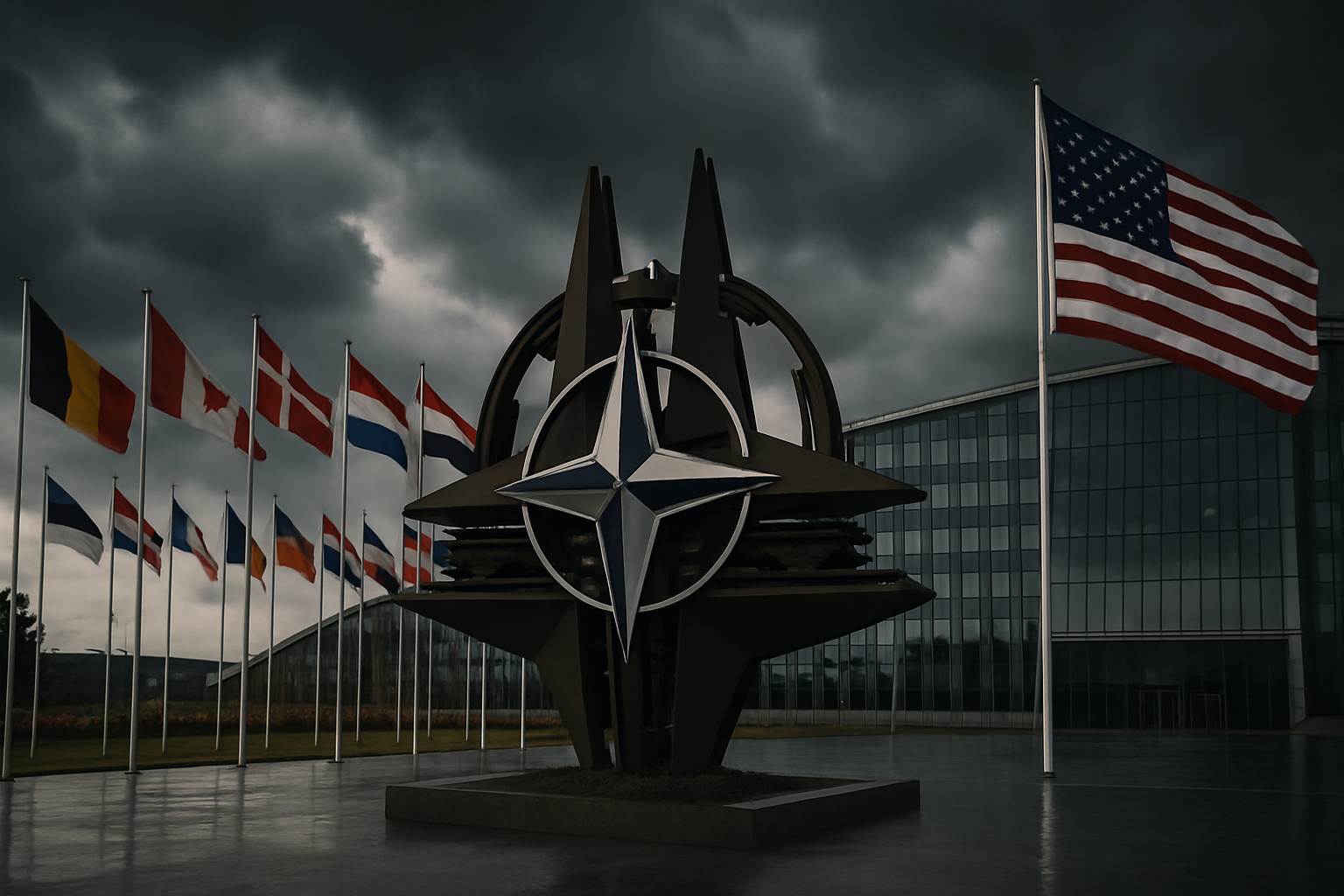
President Donald Trump has delivered the most serious threat to NATO's existence since the alliance's 1949 formation, calling it a "paper tiger" and declaring he is "seriously considering" withdrawing the United States from the Atlantic partnership after European allies delivered a comprehensive rejection of American military demands.
In an explosive interview with The Daily Telegraph, Trump unleashed unprecedented fury at NATO partners who refused to provide naval support for U.S. operations in the Strait of Hormuz, marking what analysts describe as the deepest transatlantic crisis since the Cold War.
European Allies Deliver Historic Rejection
The crisis erupted when European allies mounted coordinated resistance to Trump's demands for naval coalition support in the Persian Gulf. German Defense Minister Boris Pistorius led the opposition, pointedly asking: "What does Donald Trump expect a handful of European frigates to do that the powerful US Navy cannot?"
France explicitly rejected warship deployment, while Japan and Australia declined to provide naval vessels despite their heavy dependence on Middle Eastern oil. Swedish Prime Minister Ulf Kristersson refused assistance entirely, citing "Iraq lessons" - a reference to the controversial 2003 invasion that deeply divided the alliance.
"We no longer 'need' or want assistance from NATO countries—IN FACT, WE NEVER NEEDED IT!"
— President Donald Trump, Truth Social
The rejection represents the most comprehensive rebuke of American military leadership since the Iraq War, signaling a fundamental shift in how European allies view their obligations to support U.S. military interventions.
European Strategic Autonomy in Action
Despite refusing to support American operations in the Gulf, European nations demonstrated remarkable unity in defending their own territory. When Iranian drones struck RAF Akrotiri in Cyprus - the first attack on European soil since World War II - four NATO members immediately coordinated a naval response.
Within hours, Britain deployed HMS Dragon with Sea Viper missile systems, Spain provided air defense frigates, while France and Italy contributed naval assets to protect Eastern Mediterranean waters. The European Union activated its ESTIA crisis mechanism for the first time in the bloc's history.
This paradoxical pattern - rejecting American "optional wars" while defending European territory - illustrates what experts call a new paradigm of selective cooperation that challenges traditional NATO frameworks.
Mounting Financial and Human Costs
Trump's Iran campaign, dubbed Operation Epic Fury, has already cost $11.3 billion in its first week, making it one of the most expensive military operations in recent decades. Pentagon sources confirm the mission will extend through September 2026, far beyond the administration's initial 4-6 week timeline.
The human toll continues mounting, with 150+ U.S. troops wounded and three confirmed deaths. The USS Charlotte submarine sank an Iranian frigate - the first enemy vessel destroyed by an American submarine since World War II.
Congressional opposition has reached unprecedented levels, with only 25% of Americans supporting the military action according to recent polls. Senator Richard Blumenthal stated he is "more concerned than ever" about the potential deployment of ground troops.
Global Economic Chaos
The crisis has triggered worldwide economic disruption on a scale not seen since the COVID-19 pandemic. Oil prices have surged to $119.50 per barrel for Brent crude, representing an 18.98% single-day jump. Iran's mining of the Strait of Hormuz has effectively closed 40% of global oil transit through the deployment of 2,000-6,000 naval mines.
The International Energy Agency authorized the largest strategic petroleum reserve release in 50 years, totaling 400 million barrels from 32 countries. Aviation networks have collapsed with over 18,000 flights cancelled worldwide, while eight Middle Eastern countries have simultaneously closed their airspace.
Nuclear Diplomacy Collapse
The military escalation comes after the complete breakdown of nuclear diplomacy, despite February talks in Geneva that achieved what negotiators called "broad agreement on guiding principles" - the most progress since the 2018 JCPOA withdrawal.
The fundamental disagreement proved insurmountable: Iran insisted on nuclear-only discussions, excluding ballistic missiles and proxy forces as "red lines," while the United States demanded comprehensive negotiations covering missiles, proxies, and human rights.
The crisis unfolds against a backdrop of unprecedented nuclear governance challenges. The New START Treaty expired in February 2026, marking the first time in over 50 years without bilateral nuclear constraints between the superpowers. UN Secretary-General António Guterres has warned of nuclear risks being at their "highest in decades."
Trump's Regime Change Demands
Trump has escalated beyond nuclear concerns to explicit regime change advocacy, demanding Iran's "unconditional surrender" and claiming the right to "personally choose" the next Supreme Leader. He dismissed Mojtaba Khamenei, who succeeded his father following the March 1 killing, as a "lightweight."
This represents the most direct assertion of American control over Iranian affairs since the 1979 revolution, effectively eliminating any remaining diplomatic solutions.
Alliance Under Maximum Strain
The NATO crisis extends beyond the immediate Iran conflict to fundamental questions about alliance solidarity. Trump has already threatened to cut off all trade with Spain after Madrid denied access to U.S. military bases, calling Prime Minister Pedro Sánchez a "terrible ally."
Spanish authorities closed their airspace to U.S. military flights related to Iran operations, forcing American aircraft to bypass Spain entirely for Middle East missions. Spain justified the decision as upholding "international law" and the "UN Charter."
Historical Precedent and Context
The crisis recalls memories of the 2003 Iraq War divisions, when several European allies opposed the U.S.-led invasion. However, the current rift appears deeper and more systematic, touching on fundamental questions about alliance obligations versus national sovereignty.
European officials increasingly invoke the concept of "strategic autonomy" - the ability to make independent security decisions while maintaining alliance relationships. France and Germany have begun unprecedented discussions about expanding French nuclear deterrent capabilities to provide European alternatives to American security guarantees.
Regional Coalition Fracturing
Beyond Europe, the crisis has severely strained Middle Eastern partnerships. The unprecedented consensus among Saudi Arabia, UAE, Qatar, and Egypt supporting diplomatic solutions has fractured as Iranian retaliation directly targets their territories.
Recent Iranian attacks have killed one civilian in Abu Dhabi, wounded 32 at Kuwait's airport, and injured eight in Qatar while intercepting missiles and drones. Egyptian President Abdel Fattah el-Sisi condemned attacks on "sisterly countries" and warned of "comprehensive chaos spreading throughout the region."
Congressional and Democratic Oversight
The domestic political implications continue mounting as Congress demands comprehensive briefings on strategy, costs, and potential ground troop deployments. The unprecedented unpopularity of the conflict - with only 25% support in early stages - has created bipartisan pressure for oversight.
Financial markets have emerged as what one official called the "ultimate constraint" on escalation, with Pakistan's stock exchange suffering its largest decline in history and global supply chains facing severe disruption.
Template-Setting Historical Moment
UN Secretary-General António Guterres has characterized the crisis as the "greatest test of multilateral cooperation in the modern era." The rapid transition from diplomatic breakthrough to military escalation demonstrates what experts describe as the fragility of crisis management in an increasingly multipolar world.
The stakes extend far beyond the immediate conflict to encompass regional war prevention, global energy security, nuclear governance credibility, and the enforcement of international law. Success in containing the crisis could provide frameworks for future nuclear dispute resolution, while failure may accelerate global preferences for military solutions over diplomatic ones.
European Strategic Evolution
The crisis has accelerated European discussions about strategic independence that began during Trump's first presidency. The 32 NATO members recently achieved the historic milestone of all meeting the 2% GDP defense spending target for the first time in the alliance's 75-year history, providing the foundation for enhanced European capabilities.
Finland and Sweden have abandoned long-standing nuclear-free policies, expressing willingness to host nuclear weapons during wartime conditions. This represents the most significant shift in Nordic security policy since the Cold War.
Looking Forward
The current crisis represents a watershed moment that will likely define transatlantic relations for decades. European leaders face the fundamental choice between strategic autonomy and traditional dependence on American security guarantees.
Whether NATO institutional resilience can accommodate this level of internal tension while maintaining unity against external threats remains the critical question. The alliance has survived previous crises, but none have challenged both the decision-making structures and the fundamental assumptions about burden-sharing so comprehensively.
The outcome will influence not only the future of NATO but also serve as a template for how democratic nations coordinate defense in an era of great power competition, emerging global threats, and increasingly complex security challenges that span from the Arctic to the Indo-Pacific.