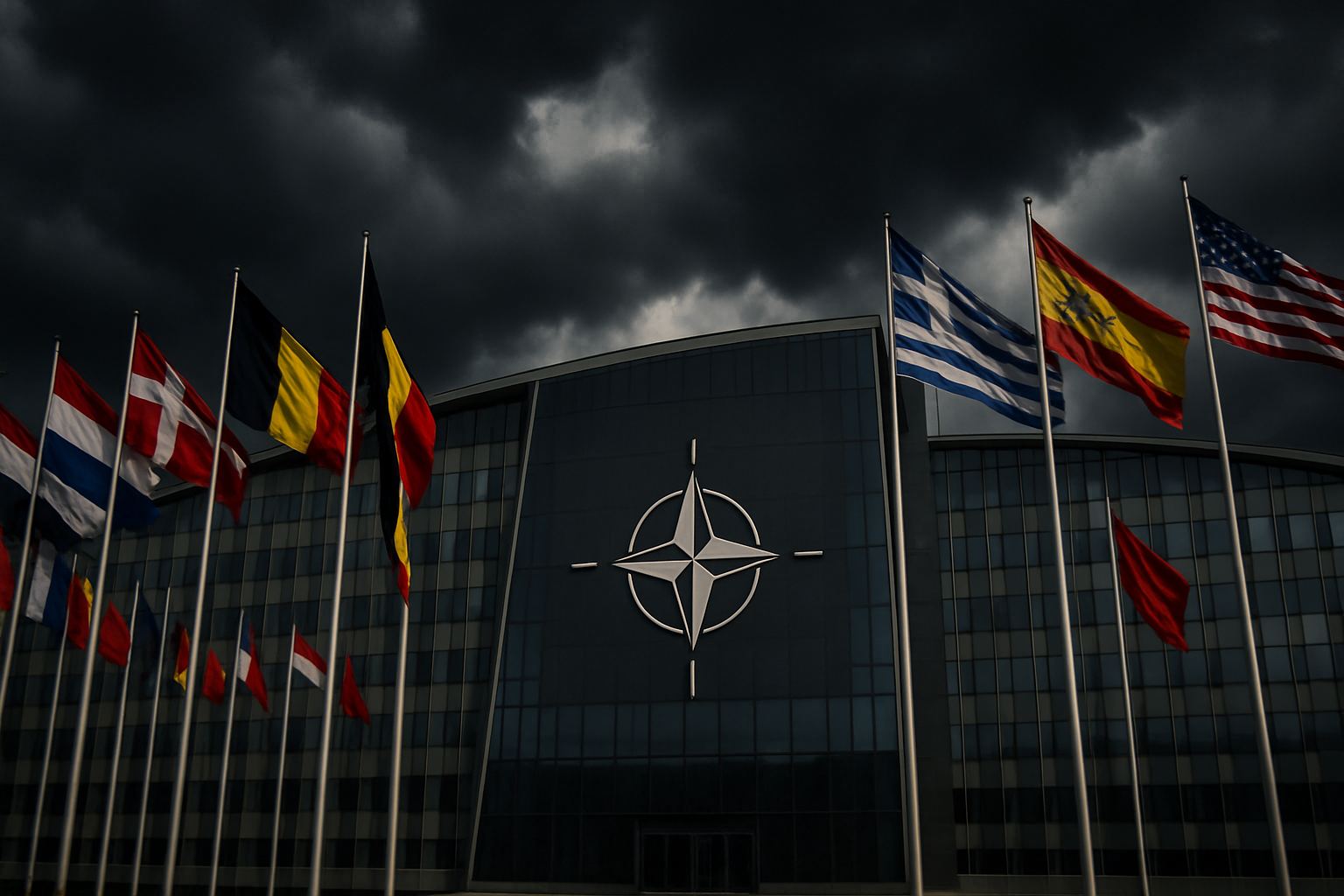
President Donald Trump has told The Daily Telegraph he is "seriously considering" withdrawing the United States from NATO, calling the alliance a "paper tiger" after European allies delivered a crushing rejection of naval coalition requests for Iran war support - the most serious threat to the transatlantic alliance since its 1949 founding.
The unprecedented escalation in US-NATO tensions comes after German Defense Minister Boris Pistorius led coordinated European resistance to Trump's demands for warship deployments in the Strait of Hormuz, asking pointedly: "What does Donald Trump expect a handful of European frigates to do that the powerful US Navy cannot?"
France explicitly rejected warship deployment, while Japan and Australia declined to send naval vessels despite their heavy dependence on Middle Eastern oil. Sweden's Prime Minister Ulf Kristersson refused assistance entirely, citing "Iraq lessons," in what marks the most comprehensive rejection of American military leadership since the 2003 Iraq War.
Trump's Unilateral Policy Reversal
Trump's fury at the allied refusal manifested in a dramatic Truth Social declaration: "We no longer 'need' or want assistance from NATO countries—IN FACT, WE NEVER NEEDED IT!" The statement represents a complete departure from traditional coalition-building to an isolated approach that has stunned diplomatic observers.
The president had already threatened Spain with trade cutoffs after Prime Minister Pedro Sánchez denied US military base access for Iranian operations, and criticized the UK as "not Winston Churchill's Britain" for lukewarm support of Operation Epic Fury.
"NATO withdrawal is now beyond reconsideration because of the lack of support from European leaders for the strikes on Iran."
— Donald Trump, speaking to The Daily Telegraph
The dramatic policy reversal comes as Operation Epic Fury, the largest US-Israeli military operation since 2003, has cost $11.3 billion in its first week alone, with operations now extending through September 2026 - far beyond the initial 4-6 week timeline. More than 150 US troops have been wounded, with 3 confirmed deaths, making this the first American casualties in the Iran conflict.
European Strategic Autonomy Demonstrated
The crisis has revealed a paradoxical pattern in European strategic thinking: while rejecting American "optional wars," European nations showed unprecedented unity in defending their own territory. When Iranian drones struck RAF Akrotiri in Cyprus - the first attack on European territory since World War II - four nations immediately deployed a naval coalition featuring HMS Dragon and Spanish, Italian, French, Dutch, and Greek vessels.
The European Union activated its ESTIA crisis mechanism for the first time in history to coordinate the Cyprus evacuation, demonstrating that European strategic autonomy has evolved from aspiration to concrete reality - territorial defense cooperation while refusing discretionary interventions.
Global Crisis Reaches Historic Scale
The Iran crisis has triggered disruptions not seen since the height of the COVID-19 pandemic. Oil prices have soared to $119.50 per barrel for Brent crude, representing an 18.98% record jump, as Iran's Revolutionary Guard deployed between 2,000-6,000 naval mines in the Strait of Hormuz, effectively closing 40% of global oil transit.
The International Energy Agency authorized the largest strategic petroleum reserve release in its 50-year history - 400 million barrels from 32 countries. Aviation networks have collapsed with 18,000+ flights cancelled worldwide and eight countries simultaneously closing their airspace.

Nuclear Diplomacy Collapse
The current crisis emerged from the complete breakdown of US-Iran nuclear talks despite achieving what diplomats called "broad agreement on guiding principles" - the most progress since the 2018 JCPOA collapse. However, fundamental scope disagreements proved insurmountable, with Iran maintaining that ballistic missiles and regional proxies were "red lines" excluded from nuclear-only negotiations, while the US demanded comprehensive agreements covering missiles, armed groups, and human rights.
The diplomatic failure has occurred against the backdrop of a nuclear governance crisis, with the New START treaty expiring in February 2026 - the first time in over 50 years without US-Russia nuclear constraints. Iran continues enriching uranium to 60% purity with over 400 kilograms of weapons-grade material, sufficient for multiple nuclear weapons.
Trump's Regime Change Demands
Trump has escalated his rhetoric beyond nuclear concerns to explicit regime change advocacy, demanding Iran's "unconditional surrender" and claiming the right to "personally choose" Iran's next Supreme Leader. He has rejected the hereditary succession of Mojtaba Khamenei as "lightweight," representing the most direct assertion of American control over Iranian affairs since 1979.
This policy evolution from nuclear-focused diplomacy to comprehensive political transformation has eliminated diplomatic solutions and drawn sharp criticism from congressional leaders. Senator Richard Blumenthal stated he is "more concerned than ever" about ground troop deployment, as the conflict maintains historically low 25% public support.
Congressional and International Opposition
Unprecedented bipartisan resistance has emerged in Congress, with lawmakers demanding comprehensive briefings on strategy, costs, and ground troop risks. The Pentagon's operations timeline extending through September, far beyond initial projections, has intensified opposition. Financial markets have emerged as what analysts call the "ultimate constraint" on escalation, with Pakistan's stock exchange suffering its largest decline in history at -8.97%.
Internationally, the crisis has strained regional coalitions, with the unprecedented Saudi/UAE/Qatar/Egypt consensus supporting diplomacy severely threatened by Iranian retaliation targeting their territories. Egypt's President Sisi condemned attacks on "sisterly countries," warning of "comprehensive chaos spreading throughout the region."
Humanitarian Crisis Mounting
The Iran Red Crescent reports over 787 civilian casualties from US-Israeli strikes, with the Pentagon confirming responsibility for an elementary school attack that killed between 165-185 students due to "outdated targeting data." International evacuations have reached Arab Spring 2011 scales, with Australia reporting 115,000 citizens trapped and Germany evacuating 30,000 nationals.
The humanitarian emergency has prompted the first activation of the EU's ESTIA evacuation plan, as Cyprus became the first European territory attacked since World War II.
Template-Setting Historical Significance
UN Secretary-General António Guterres has characterized the crisis as the "greatest test of multilateral cooperation in the modern era." April 2026 represents a potential watershed moment for determining whether 21st-century disputes will be resolved through diplomatic or military solutions, with implications extending decades beyond the current events.
The European choice of strategic autonomy over traditional American deference, while maintaining territorial defense coordination, has established a template that tests alliance obligations versus sovereignty principles. The stakes include American credibility, Western unity, and the sustainability of the post-World War II international order.
"This is the most dangerous crisis since the end of the Cold War, affecting energy security architecture, nuclear governance credibility, and alliance structures with implications extending decades."
— Senior European diplomat, speaking anonymously
Alliance at the Crossroads
NATO faces its most severe test since formation, with the question of whether alliance unity can survive Trump's fury or marks a fundamental global security realignment. The success or failure of containing this crisis will provide frameworks for nuclear dispute resolution, while failure could accelerate military solutions that reshape security architectures globally, encouraging proliferation and undermining diplomatic credibility worldwide.
The crisis has demonstrated the concrete reality of European strategic autonomy - the ability to coordinate territorial defense while refusing discretionary interventions. This selective cooperation challenges traditional NATO frameworks and may establish precedents for how democratic nations balance alliance obligations with national sovereignty in the multipolar era.
As European leaders prepare for potential American withdrawal from NATO, the alliance system that has underpinned Western security for over seven decades faces its greatest existential challenge, with consequences that will determine international relations for generations to come.