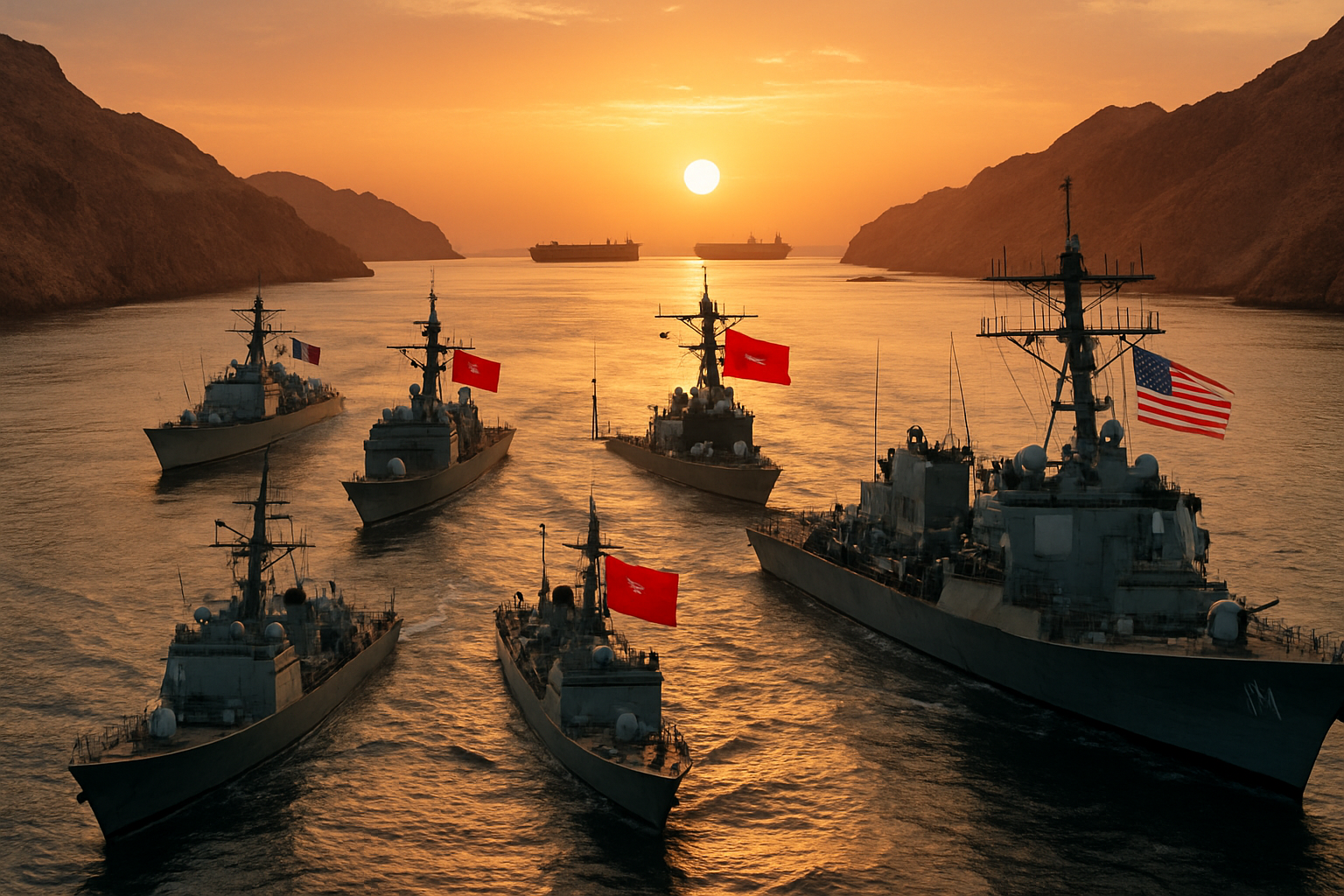
President Donald Trump is facing near-universal rejection from European allies after demanding an international naval coalition to break Iran's blockade of the Strait of Hormuz, as the critical waterway carrying 40% of global oil transit remains effectively closed for the third week running.
Trump's unprecedented calls for China, France, Japan, South Korea, and the United Kingdom to deploy warships alongside U.S. forces have met with sharp resistance from NATO partners, creating the most serious transatlantic crisis in decades. The refusal comes as oil prices have surged past $100 per barrel for the first time since 2022, with Brent crude reaching a peak of $119.50 and West Texas Intermediate jumping a record 18.98% to $108.15.
European Leaders Deliver Resounding 'No'
German Defense Minister Boris Pistorius led the European resistance with a blunt assessment: "What does Donald Trump expect a handful of European frigates to do that the powerful U.S. Navy cannot?" The comment underscored the skepticism among European leaders about joining what many view as an American military adventure rather than a collective security necessity.
Japan and Australia explicitly declined to send naval vessels despite direct U.S. requests, dealing a significant blow to Trump's coalition-building efforts. Italy's Prime Minister Giorgia Meloni, despite her previously warm relationship with Trump, also rejected participation in the proposed mission.
"This is not Europe's war. We will not be drawn into a wider conflict in the Middle East that stems from American policy decisions."
— Senior EU Official, speaking on condition of anonymity
The International Energy Agency responded to the crisis with the largest strategic petroleum reserve release in its 50-year history—400 million barrels from 32 countries, double the amount released during the 2022 Ukraine crisis. Japan is releasing 80 million barrels, marking its first deployment since the 2011 Fukushima disaster.
Iran's Revolutionary Strategy
Iran's Revolutionary Guard has deployed an estimated 2,000-6,000 naval mines throughout the 21-mile strait, effectively making it "unsafe for shipping" as declared by Tehran. The U.S. has destroyed 28 Iranian mine-laying vessels in response, but more than 150 oil and LNG tankers worth billions remain stranded in the Persian Gulf.
The Iranian strategy appears designed to impose global economic costs while fracturing international coalitions. Major shipping companies Maersk and MSC have suspended all Persian Gulf operations, while Qatar has halted LNG production at its Ras Laffan and Mesaid facilities, representing approximately 20% of global liquefied natural gas exports.
Natural gas prices have exploded 24% in Europe and 78% in the United States, reaching €47.32/MWh—the highest level since February 2025. Qatar's Energy Minister Saad Al Kaabi warned that Gulf states may declare force majeure "within weeks," with oil potentially approaching $150-200 per barrel, threatening to "bring down economies worldwide."
Aviation Industry in Crisis
The conflict has triggered the worst aviation crisis since COVID-19, with over 18,000 flights cancelled worldwide. Eight Middle Eastern countries have simultaneously closed their airspace, effectively severing Europe-Asia flight corridors. Dubai International Airport, the world's busiest with 86 million passengers annually, remains completely shut down due to missile damage.
Major airlines including Emirates, Air France-KLM, Wizz Air, and Bulgaria Air have suspended operations indefinitely, stranding hundreds of thousands of passengers globally. Airlines are implementing emergency fuel surcharges as jet fuel costs have jumped from $85-90 per barrel to $150-200.
Congressional Opposition Mounts
Trump is facing unprecedented bipartisan opposition in Congress over the Iran conflict, with lawmakers demanding clear answers on strategy, costs, and potential ground troop deployment. Senator Richard Blumenthal stated he is "more concerned than ever" about the possibility of "boots on the ground," while the conflict maintains only 25% public support—described by experts as "almost unprecedented" unpopularity for early-stage military operations.
Operation Epic Fury, the largest U.S.-Israeli military campaign since 2003, has cost $11.3 billion in its first week alone, with the Pentagon preparing operations through September—far beyond the administration's initial 4-6 week timeline.
Nuclear Diplomacy Collapse
The current crisis emerged from the complete breakdown of U.S.-Iran nuclear negotiations, despite achieving a "broad agreement on guiding principles" in Geneva—the most progress since the 2018 JCPOA collapse. The fundamental disagreement proved insurmountable: Iran excluded ballistic missiles and regional proxies as "red lines," demanding nuclear-only talks, while the U.S. insisted on a comprehensive agreement including missiles, armed groups, and human rights.
Iran continues uranium enrichment at 60% purity with over 400kg of material sufficient for multiple weapons if weaponized. The crisis unfolds amid the broader collapse of nuclear governance, with New START having expired in February 2026—the first time in over 50 years without U.S.-Russia nuclear constraints.
Regional Coalition Under Strain
An unprecedented regional coalition of Saudi Arabia, UAE, Qatar, and Egypt that had been supporting diplomatic solutions is now severely strained as Iranian retaliation has directly targeted their territories. The UAE suffered one civilian killed in Abu Dhabi, Kuwait reported 32 injured in airport strikes, and Qatar intercepted 65 missiles and 12 drones, resulting in 8 injuries despite successful Patriot missile defenses.
Egyptian President Abdel Fattah el-Sisi condemned attacks on "sisterly countries," warning of "comprehensive chaos" if the escalation continues. The fracturing of this remarkable Middle Eastern unity represents a significant blow to regional stability.
"When we needed allies to stand with us, they weren't that enthusiastic. Some are countries that we've helped for many, many years."
— President Donald Trump
Global Economic Shockwaves
Financial markets have crashed worldwide, with Pakistan's KSE-100 recording its largest single-day decline in history at -8.97%. South Korea's KOSPI fell 12%, triggering circuit breakers, while the Korean won hit a 17-year low. PayPal has postponed its $1.1 billion IPO indefinitely due to market volatility.
The crisis has exposed fundamental vulnerabilities in global supply chains, with manufacturing in automotive, electronics, and textiles severely disrupted due to dependence on Gulf logistics networks. The Persian Gulf serves as a critical trade hub beyond energy, affecting consumer goods and industrial materials worldwide.
Consumer impacts are severe globally: Bangladesh has implemented fuel rationing for 170 million people, Pakistan has introduced wartime austerity with four-day government work weeks, and several European countries are experiencing significant energy price increases.
Trump's Escalating Demands
Trump has escalated his rhetoric beyond military coalition-building to demanding Iran's "unconditional surrender" and claiming the right to personally choose Iran's next Supreme Leader. This represents the most direct assertion of American control over Iranian affairs since the 1979 revolution, transforming what began as nuclear-focused operations into comprehensive regime change objectives.
The approach has created additional tensions with European allies already skeptical of military involvement. Spain has threatened to "cut off all trade" after Trump criticized Prime Minister Pedro Sánchez for condemning U.S.-Israeli operations as a "breach of international law."
Template-Setting Crisis
UN Secretary-General António Guterres has called this the "greatest test of multilateral cooperation in crisis management of the modern era." The rapid transition from diplomatic breakthrough to military escalation demonstrates the fragility of crisis management in the multipolar era.
The stakes extend far beyond the immediate conflict: success in containing the crisis could provide a framework for future nuclear disputes, while failure may accelerate military solutions for decades, encouraging proliferation globally and undermining diplomatic credibility worldwide.
Energy security experts warn that the crisis highlights dangerous over-dependence on strategic chokepoints, requiring fundamental restructuring to reduce geopolitical volatility. The 21-mile Strait of Hormuz represents a single-point failure for modern logistics, with no realistic alternatives to handle diverted volume.
As the crisis enters its fourth week, the international community faces a watershed moment that will determine whether multilateral cooperation can manage 21st-century security challenges or if there will be a fundamental shift toward military confrontation as the primary dispute resolution mechanism. The decisions made in the coming days will reverberate through international relations for decades, affecting conflict resolution approaches, energy architecture evolution, and the credibility of diplomatic solutions worldwide.