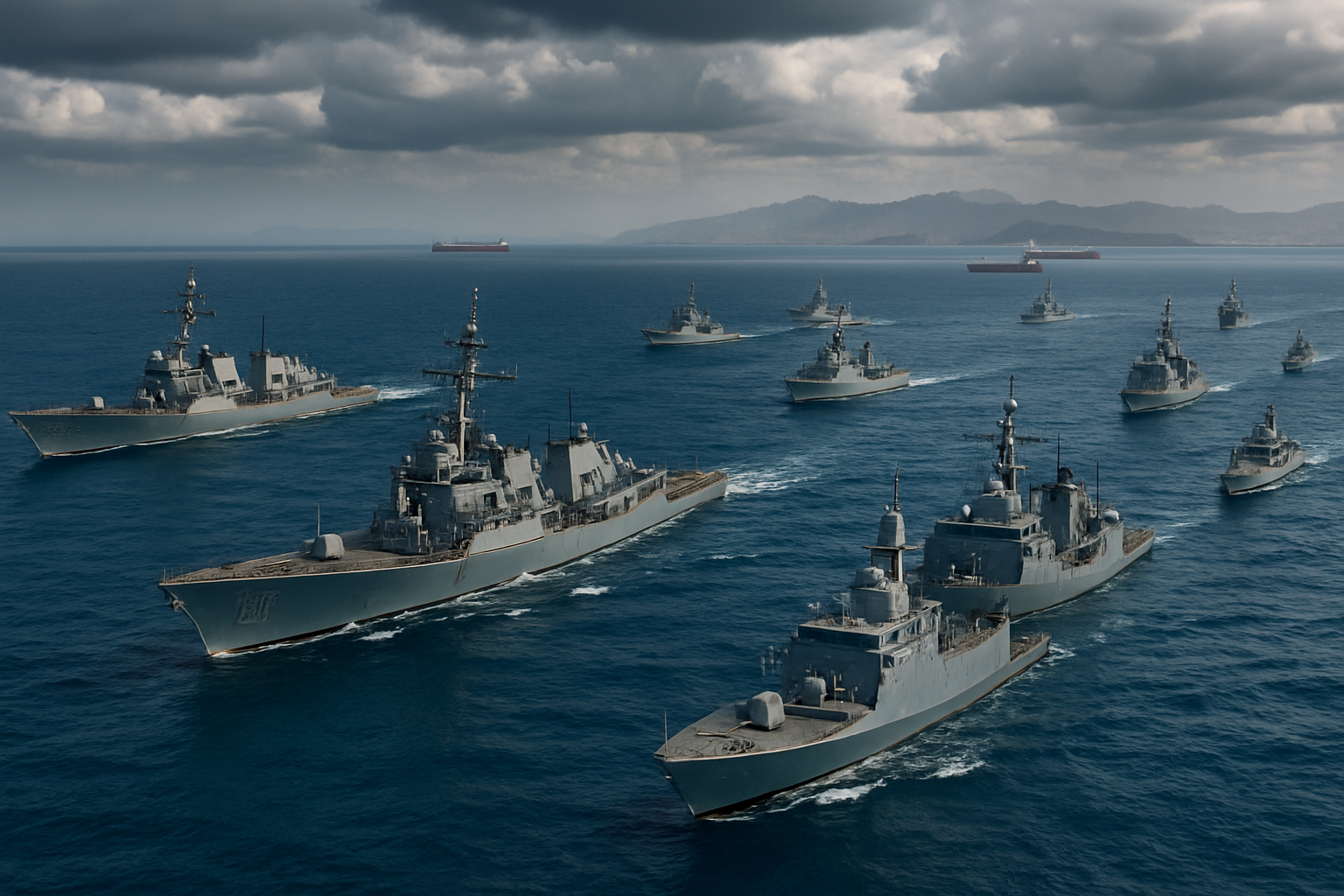
President Donald Trump has issued urgent calls for international allies to deploy warships to the Strait of Hormuz as the Iran conflict enters its most dangerous phase, with the critical waterway effectively closed and global energy markets in chaos.
The dramatic appeal comes as Iranian forces have declared the strategic strait "unsafe for shipping," cutting off 40% of the world's seaborne oil transit and stranding over 150 oil and LNG tankers worth billions in cargo. Oil prices have surged past $80 per barrel, marking the highest levels since 2014, while natural gas prices have exploded 24% in Europe and 78% in the United States.
Naval Coalition Building
Trump specifically called on China, France, Japan, South Korea, and the United Kingdom to send naval vessels to join American forces in securing the 21-mile-wide waterway that serves as a critical chokepoint for global energy supplies. The request represents an unprecedented international coordination effort as the conflict threatens to destabilize the entire Middle East.
"Many countries, especially those affected by Iran's attempted closure of the Hormuz Strait, will be sending warships, in conjunction with the United States, to keep the strait open and safe," Trump posted on Truth Social, signaling the international scope of the crisis.
The appeal follows Iran's Revolutionary Guard declaring under "Operation True Promise 4" that "no red lines remain" in their systematic targeting of Western assets across the region. Iranian forces have successfully struck military installations from Iraq to Cyprus, marking the first attack on European territory since World War II.
Global Crisis Deepens
The conflict has precipitated the most severe international crisis since the Cold War's end, affecting multiple domains simultaneously. Aviation networks have collapsed with over 18,000 flights cancelled worldwide—the most extensive disruption since COVID-19. Eight Middle Eastern countries have maintained simultaneous airspace closures, severing critical Asia-Europe air corridors.
"This is the greatest test of multilateral cooperation in crisis management of the modern era."
— UN Secretary-General António Guterres
Dubai International Airport, the world's busiest with 86 million annual passengers, remains shuttered due to missile damage. Major carriers including Emirates, Air France-KLM, and Wizz Air have suspended operations indefinitely, affecting hundreds of thousands of travelers globally.
Energy Architecture Under Siege
The crisis has exposed critical vulnerabilities in global energy infrastructure. Qatar, which provides approximately 20% of global LNG exports, has halted production at its Ras Laffan and Mesaid facilities due to Iranian attacks on Gulf infrastructure. The International Energy Agency has authorized the largest strategic petroleum reserve release in its 50-year history, deploying 400 million barrels from 32 countries.
Major shipping companies Maersk and MSC have suspended Persian Gulf operations entirely, creating a supply chain catastrophe that extends far beyond energy to affect automotive, electronics, and textile industries dependent on Gulf logistics networks.
Diplomatic Breakdown
The current military escalation emerged from the complete collapse of nuclear negotiations that had achieved breakthrough progress just weeks earlier. Geneva talks in February had resulted in what Iranian Foreign Minister Abbas Araghchi called "broad agreement on guiding principles"—the most significant diplomatic progress since the 2018 JCPOA collapse.
However, fundamental disagreements proved insurmountable. Iran maintained that ballistic missiles and regional proxy activities were "red lines" excluded from nuclear-only discussions, while the United States demanded a comprehensive agreement addressing missiles, armed groups, and human rights concerns.
The diplomatic failure has left Iran continuing uranium enrichment at 60% purity—approaching the 90% weapons-grade threshold—with intelligence assessments indicating sufficient material for multiple nuclear weapons if weaponized.
Regional Coalition Under Pressure
An unprecedented regional coalition of Saudi Arabia, UAE, Qatar, and Egypt that had supported diplomatic engagement now faces severe strain as Iranian retaliation directly targets member territories. Egyptian President Sisi condemned attacks on "sisterly Arab countries," warning of "comprehensive chaos" throughout the region.
The UAE has reported one civilian killed in Abu Dhabi, while Kuwait suffered 32 injured in airport drone strikes. Qatar intercepted 65 missiles and 12 drones but still sustained eight injuries, demonstrating the broad scope of Iranian operations.
European Security Implications
The conflict fundamentally altered from a regional Middle Eastern dispute to a direct European security threat when Iranian drones struck RAF Akrotiri in Cyprus—the first attack on European territory since World War II. This prompted an unprecedented naval coalition response, with HMS Dragon, Spanish frigates, and vessels from Italy, France, the Netherlands, and Greece deploying to the Eastern Mediterranean.
The European Union activated its ESTIA evacuation plan for the first time in the bloc's history, while French President Emmanuel Macron made an emergency visit to Cyprus amid warship deployments.
Congressional and International Scrutiny
The conflict's costs and scope have drawn mounting bipartisan congressional opposition. Operation Epic Fury has consumed $3.7 billion in its first week, with Pentagon operations now planned through September 2026—far beyond the initially projected 4-6 week timeline. Senator Richard Blumenthal expressed being "more concerned than ever" about potential ground troop deployment.
International evacuations have reached massive scales not seen since the Arab Spring of 2011, with Australia reporting 115,000 nationals trapped and Germany evacuating 30,000 tourists from the region.
Nuclear Governance Crisis
The crisis unfolds against the backdrop of a broader nuclear governance breakdown. The New START treaty expired in February 2026, marking the first time in over 50 years without US-Russia nuclear constraints. Combined with China's nuclear expansion and Iran's advancing program, UN Secretary-General Guterres has warned that nuclear risks are at their "highest in decades."
Trump's demands for Iran's "unconditional surrender" and his claim to personally choose Iran's next Supreme Leader represent the most direct assertion of American control over Iranian affairs since 1979, effectively eliminating diplomatic solutions in the near term.
Economic and Market Impact
Financial markets have experienced severe disruption, with Pakistan's KSE-100 recording an 8.97% decline—the largest single-day drop in the exchange's history. South Korea's KOSPI fell 12%, triggering circuit breakers, while the Korean won hit 17-year lows.
The Persian Gulf's role as a critical trade hub extends far beyond energy, affecting global supply chains for consumer goods and industrial materials. The vulnerability of the 21-mile Strait of Hormuz as a single point of failure for modern logistics has exposed the need for fundamental energy architecture restructuring.
Succession Crisis in Iran
Adding to the crisis complexity, Iran has undergone its first hereditary succession in Islamic Republic history. Mojtaba Khamenei, son of Supreme Leader Ali Khamenei who was killed on March 1, has emerged as the new leader under Revolutionary Guard pressure. CIA assessments suggest an unprecedented shift from clerical to military governance control.
This succession during wartime conditions represents a fundamental transformation of Iranian power structures, potentially affecting future diplomatic engagement possibilities.
Looking Forward
The March 2026 crisis represents a watershed moment in international relations, with template-setting implications for 21st-century conflict resolution. The rapid transition from promising diplomatic engagement to military escalation demonstrates the fragility of crisis management mechanisms in the multipolar era.
Success in containing the conflict could provide a framework for future nuclear and territorial dispute resolution. Failure may establish a precedent favoring military solutions over diplomacy, potentially encouraging nuclear proliferation and undermining diplomatic credibility globally.
As Trump's naval coalition request awaits international responses, the stakes extend far beyond the immediate crisis to encompass regional war prevention, global energy security, nuclear governance credibility, and the evolution of international law enforcement mechanisms for the coming decades.