President Donald Trump has escalated demands for international military support in the Strait of Hormuz while threatening further strikes on Iran's Kharg Island oil hub, as the Iran-US-Israel war enters its third week with unprecedented global consequences.
Speaking to NBC News on Saturday, Trump warned that additional attacks on Iran's critical oil export facility were possible, stating: "We might hit it a few more times just for fun." The comments marked a sharp escalation from previous statements that the US was targeting only military sites on the island that handles 90% of Iran's crude oil shipments.
International Naval Coalition Request
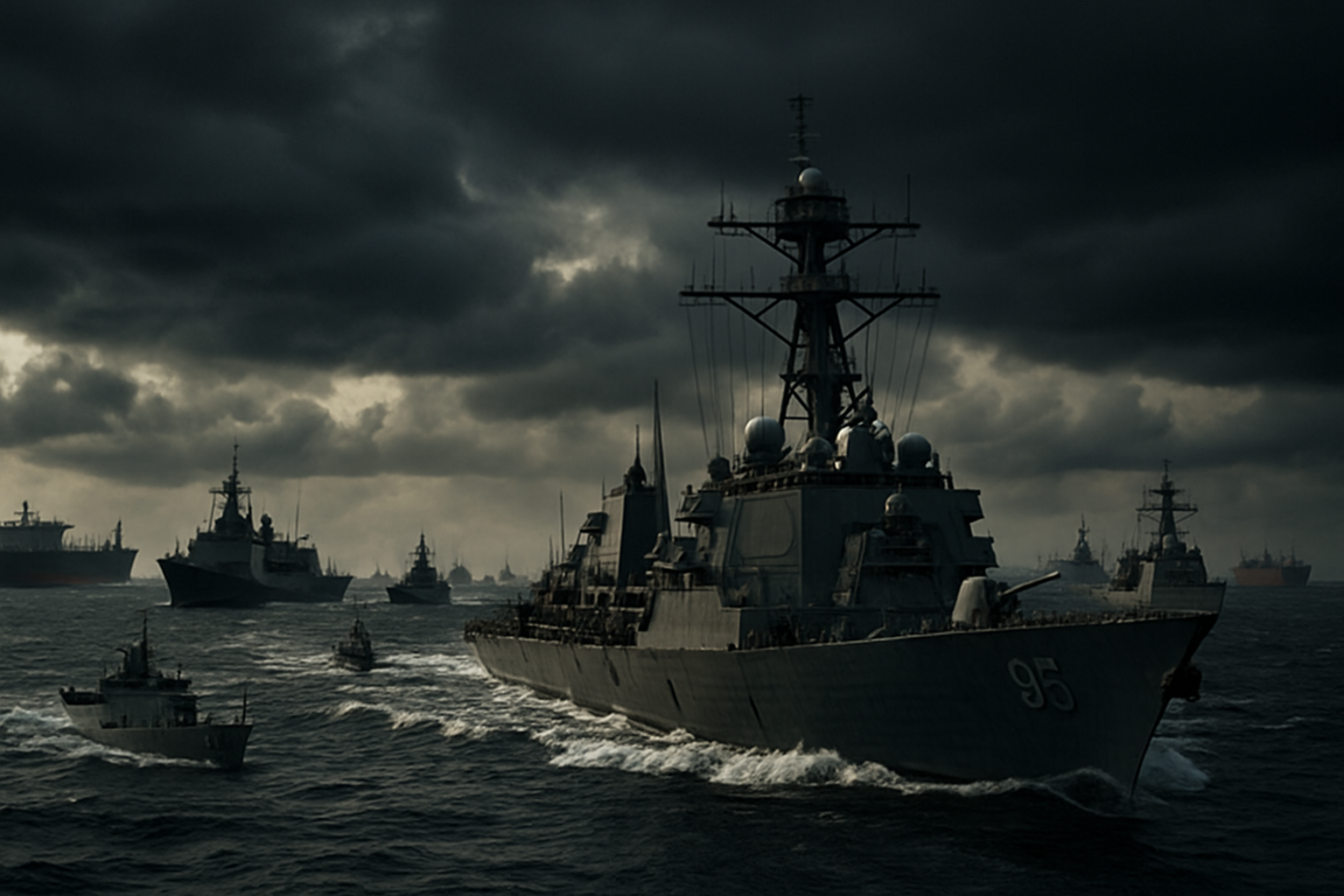
Trump has explicitly called on China, France, Japan, South Korea, the United Kingdom, and other nations to send warships to jointly secure the Strait of Hormuz alongside US forces. In a Truth Social post, the president declared that "many countries, especially those affected by Iran's attempted closure of the Hormuz Strait, will be sending warships, in conjunction with the United States, to keep the strait open and safe."
However, international response has been lukewarm. France has rejected sending warships despite Trump's request, with the French Foreign Ministry stating that Paris would not deploy additional military forces to the critical maritime corridor amid escalating regional tensions. The ministry noted that the French aircraft carrier strike group remains positioned in the eastern Mediterranean rather than entering the Persian Gulf.
Australia has indicated wariness about the deployment request, with sources noting that Trump has not formally asked Canberra to send warships to the critical chokepoint as he seeks to form a coalition to protect global oil trade.
Strait of Hormuz Crisis Deepens
Iran's Revolutionary Guards have declared the strategic waterway "unsafe for shipping," effectively closing the route that carries 40% of global seaborne oil transit. Intelligence reports indicate Iran has been deploying naval mines from an estimated stockpile of 2,000-6,000 mines, using small vessels carrying 2-3 mines each.
The closure has stranded over 150 oil and LNG tankers worth billions of dollars in the Persian Gulf. Major shipping companies Maersk and MSC have suspended operations indefinitely, while Qatar has halted LNG production affecting approximately 20% of global LNG exports.
"Iran had threatened that US-linked oil and energy firms would be 'turned into a pile of ashes' if they were hit."
— Australian Broadcasting Corporation Report
Oil prices have surged past $80 per barrel, representing a 10% increase, with warnings from Iranian officials that prices could reach $200 per barrel if the crisis continues. Natural gas prices have jumped 24% in Europe and 78% in the United States.
Diplomatic Overtures Amid Warfare
Despite the military escalation, diplomatic channels remain partially open. Turkey's Foreign Minister Hakan Fidan revealed that Iran has expressed willingness to engage in secret, behind-the-scenes talks with the United States, despite the absence of any serious initiative to restart formal negotiations.
"The current environment is not suitable for open diplomacy," Fidan told the Associated Press on Saturday. "However, Iran may still be willing to engage in backchannel communications even as the military situation continues."
Trump himself has made contradictory statements about negotiations. While claiming that Iran wants to make a deal to end the conflict, he stated that he's not ready to agree to terms because "the conditions aren't good enough yet." The president has consistently demanded Iran's "unconditional surrender" and claimed the right to personally choose Iran's next Supreme Leader.
Global Impact Reaches Crisis Levels
The war has created the most extensive global disruption since COVID-19, with over 18,000 flights cancelled worldwide. Eight countries have simultaneously closed their airspace: Iran, Iraq, Israel, UAE, Qatar, Syria, Kuwait, and Bahrain. Dubai International Airport, the world's busiest, remains completely shut down due to missile damage.
Major airlines including Emirates, Air France-KLM, and Wizz Air have suspended operations indefinitely, affecting hundreds of thousands of passengers globally and severing critical Asia-Europe flight corridors.
European Territory Under Attack
In an unprecedented escalation, Iranian drones struck RAF Akrotiri in Cyprus, marking the first attack on European territory since World War II. The assault prompted an immediate and historic naval coalition response, with HMS Dragon leading British forces while Spanish frigates and vessels from Italy, France, Netherlands, and Greece deploy to protect European interests.
The European Union activated its ESTIA evacuation plan for Cyprus for the first time in the bloc's history, while conducting the largest international evacuation operation since the Arab Spring in 2011. Australia has 115,000 nationals trapped in the region, while Germany is working to evacuate 30,000 stranded tourists.
Operation Epic Fury Costs Mount
The US-Israeli military campaign, dubbed "Operation Epic Fury," has cost an estimated $11.3 billion in its first week alone, representing daily costs of $891.4 million. The operation involves the largest coordinated military action since the 2003 Iraq invasion, utilizing dual-carrier deployment with the USS Gerald Ford and USS Abraham Lincoln, representing approximately one-third of the active US Navy fleet.
US casualties have reached 150 troops wounded, with 8 in critical condition and 3 confirmed killed. In a historic naval engagement, the USS Charlotte submarine sank the Iranian frigate IRIS Dena off Sri Lanka, killing over 80 crew members—marking the first enemy vessel sunk by a US submarine since World War II.
Iranian Leadership Transition
Following the confirmed death of Supreme Leader Ali Khamenei on March 1, Iran is undergoing its first hereditary succession in the Islamic Republic's 47-year history. Mojtaba Khamenei, the late leader's son, has emerged as the favored successor, with CIA assessments suggesting Revolutionary Guards control over the process indicates a historic shift from clerical to military governance.
The succession crisis occurs during active warfare, with a three-member transitional council managing the country. Iran's new leadership has vowed to continue "Operation True Promise 4" with "no red lines remaining," systematically targeting US and Israeli assets across the region.
Congressional Opposition Grows
Bipartisan lawmakers in Congress are demanding answers about strategy, costs, and the potential deployment of ground troops. Senator Richard Blumenthal expressed being "more concerned than ever" about the prospect of "boots on the ground," while Pentagon preparations reportedly extend through September, far beyond the initial 4-6 week timeline.
The conflict faces "almost unprecedented" unpopularity for early-stage military operations, with only 25% of Americans supporting the strikes according to recent polling. Financial markets have emerged as what experts call an "ultimate constraint" on further escalation, with Pakistan's stock exchange suffering its largest single-day decline in history at -8.97%.
Nuclear Diplomacy Completely Collapsed
The current military confrontation emerged from the complete breakdown of Geneva nuclear negotiations, despite achieving a "broad agreement on guiding principles"—the most diplomatic progress since the 2018 JCPOA collapse. Fundamental scope disagreements proved insurmountable, with Iran excluding ballistic missiles and regional proxies as "red lines" while the US demanded comprehensive agreements covering missiles, armed groups, and human rights.
Iran continues uranium enrichment at 60% purity with over 400kg of weapons-grade material—sufficient for multiple nuclear weapons if weaponized. The crisis unfolds amid broader nuclear governance breakdown, as the New START treaty expired in February, leaving the world without US-Russia nuclear constraints for the first time in over 50 years.
Template-Setting Crisis for 21st Century
UN Secretary-General António Guterres has called the situation "the greatest test of multilateral cooperation in crisis management in the modern era." The rapid transition from diplomatic framework to military escalation demonstrates what experts describe as the fragility of crisis management in the multipolar era.
The stakes include regional war prevention, global energy security, nuclear governance credibility, and international law enforcement, with post-World War II order principles being tested simultaneously. Success in containing the crisis could provide a diplomatic template for future nuclear disputes, while failure may accelerate military solutions and reshape international approaches to conflict resolution for decades.
Regional Coalition Under Severe Strain
The unprecedented diplomatic coalition of Saudi Arabia, UAE, Qatar, and Egypt that had supported negotiations is severely strained as Iranian attacks target member territories directly. Egyptian President Abdel Fattah el-Sisi condemned attacks on "sisterly countries" while warning of "comprehensive chaos" spreading across the region.
Regional casualties from Iranian retaliation continue mounting: UAE reported 1 civilian killed in Abu Dhabi from missile debris, Kuwait suffered 32 injuries from airport drone strikes, and Qatar sustained 8 injuries despite successfully intercepting 65 missiles and 12 drones using Patriot systems.
As the conflict enters its third week, the international community faces what may be the most consequential crisis since the Cold War's end, with implications extending far beyond the Middle East to affect global energy architecture, aviation networks, nuclear proliferation mechanisms, and diplomatic precedents that will shape international relations for decades to come.