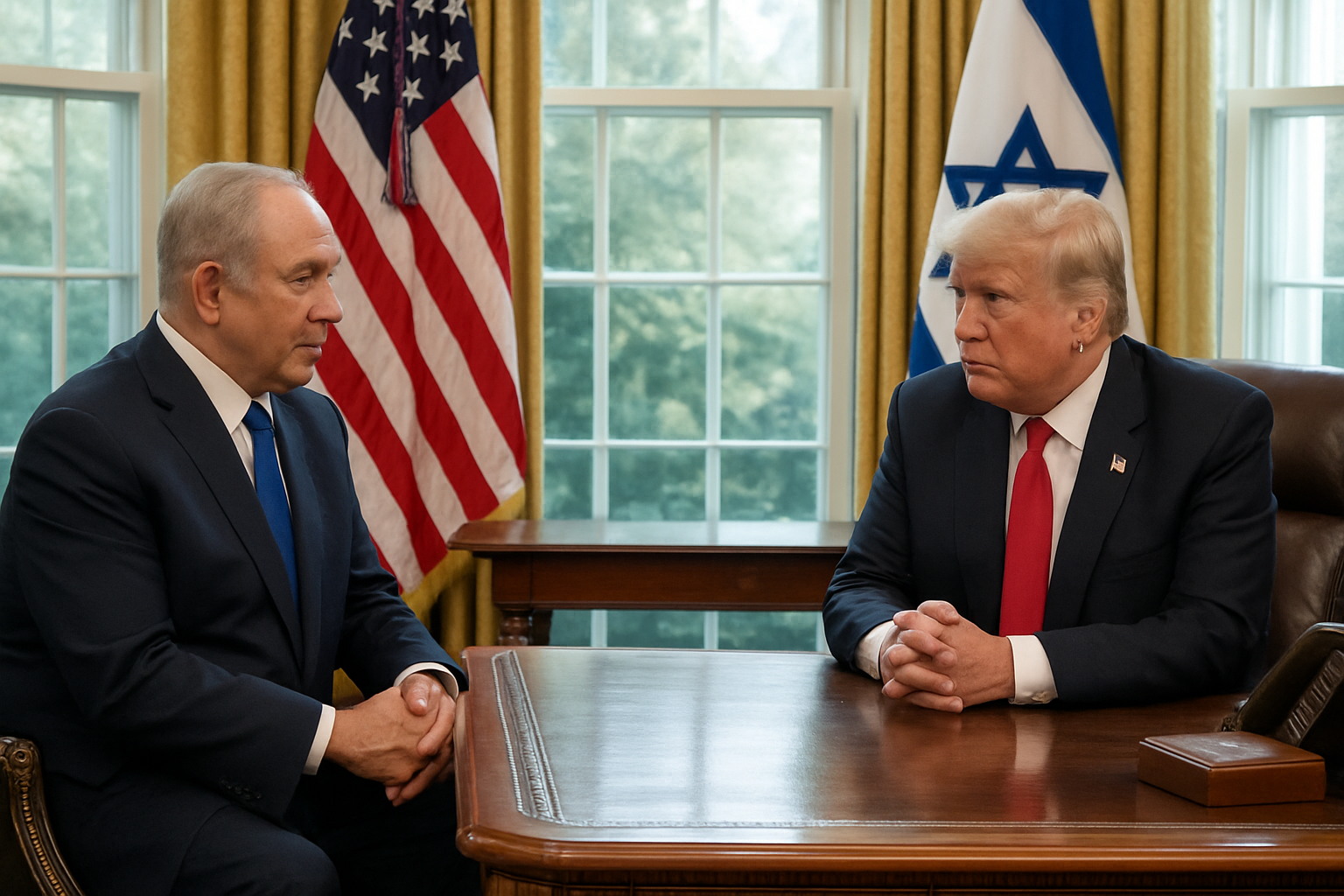
President Trump demonstrated diplomatic restraint during a crucial White House meeting with Israeli Prime Minister Benjamin Netanyahu, insisting that nuclear negotiations with Iran must continue despite mounting Israeli pressure for expanded military action against Tehran's ballistic missile program and regional proxy networks.
The February 11-12 meeting, their seventh encounter since Trump's return to office, underscored a significant divergence in approach between the two allies as Iran continues enriching uranium at 60% purity—approaching weapons-grade levels—while maintaining its support for proxy forces across the Middle East.
Diplomatic Talks Take Precedence Over Military Options
Following the closed-door discussions, Trump declared on Truth Social that he "insisted that negotiations with Iran continue to see if a deal is possible," marking a notable shift toward diplomatic engagement despite his administration's maximum pressure campaign against Tehran. This statement came after what sources described as intense discussions about Iran's nuclear advancement and regional activities.
The timing proves particularly significant as US-Iran nuclear talks in Oman have established a framework for continued negotiations, despite fundamental disagreements over scope. Iranian Foreign Minister Abbas Araghchi has maintained Iran's "red lines" excluding ballistic missiles and regional proxy activities from nuclear-only discussions, while US Secretary Marco Rubio demands a comprehensive agreement addressing all Iranian threat dimensions.
Iran's current uranium enrichment at 60% purity represents a dramatic escalation from the 3.67% limit established under the original Joint Comprehensive Plan of Action (JCPOA). Intelligence assessments suggest Iran possesses sufficient enriched uranium for multiple weapons if weaponized, creating urgency around diplomatic solutions.
Israeli Security Concerns Drive Expansion Demands
Netanyahu emphasized during the meeting that "all negotiations must include limiting ballistic missiles, ending support for Iranian axis," reflecting Israel's comprehensive threat assessment. Israeli officials view Iran's integrated missile and proxy network—including Hezbollah, Hamas, and Houthis—as equal concerns to the nuclear program, arguing that nuclear-only agreements leave existential security threats unaddressed.
The Israeli position reflects decades of strategic planning against what Tel Aviv characterizes as an "axis of resistance" spanning from Tehran through Syria to Lebanon, with additional influence in Gaza and Yemen. Recent military incidents, including Iran sealing its Isfahan nuclear facility with earth and concrete amid fears of US-Israeli strikes, demonstrate the volatile security environment.
"Security needs of the State of Israel in the context of negotiations require comprehensive solutions that address the full threat matrix from Iran's capabilities"
— Senior Israeli Official, speaking on background
Regional Powers Support Diplomatic Track
The Trump-Netanyahu discussions occurred against the backdrop of unprecedented regional support for diplomatic engagement. Saudi Arabia, the UAE, Qatar, and Egypt have all endorsed the negotiation framework—representing remarkable Middle Eastern consensus for preventing military confrontation that could destabilize the Persian Gulf region handling 40% of global oil transit.
Oman's neutral mediation has proved essential, leveraging its historical role in the 2015 JCPOA negotiations to facilitate structured dialogue despite significant trust deficits. The Omani framework has enabled both sides to establish communication protocols while maintaining their fundamental positions on scope and substance.
Military tensions continue alongside diplomatic engagement, with recent incidents including a US F-35C shooting down an Iranian Shahed-139 drone near the USS Abraham Lincoln in the Arabian Sea, and IRGC vessels harassing US tankers in the Strait of Hormuz. Oil prices have risen over $1 per barrel on these incidents, demonstrating the economic stakes involved.
Domestic Pressures Complicate Negotiations
Both administrations face significant domestic political pressures affecting their negotiating positions. Iran confronts over 42,000 protest arrests and severe economic sanctions creating regime survival imperatives, while prioritizing nuclear capabilities over economic relief through sanctions removal.
The Trump administration must balance Republican hawk pressure viewing any engagement as appeasement against the foreign policy victory potential of a successful nuclear agreement. This dynamic influences the maximum pressure campaign maintenance through economic coercion, including new tariffs on Iran-trading countries implemented immediately after declaring talks "very good."
Iranian President Masoud Pezeshkian's unprecedented apology for government failures during the 47th Islamic Revolution anniversary, while maintaining nuclear defiance, illustrates Tehran's complex domestic calculations. Foreign Minister Araghchi's declaration that Iran would "never abandon uranium enrichment even if war imposed" suggests limited flexibility despite diplomatic engagement.
International Context Adds Urgency
The Iran nuclear crisis unfolds amid broader nuclear governance challenges, including the February 5 expiration of the New START treaty—marking the first time in over 50 years without US-Russia nuclear constraints—and China's expanding nuclear arsenal complicating multilateral frameworks.
UN Secretary-General António Guterres has warned that nuclear risks are "higher than at any time in decades," adding international pressure for diplomatic solutions. The Iran negotiations represent a critical test of whether innovative diplomacy can resolve nuclear proliferation challenges in an era of great power competition.
European allies have provided cautious support for renewed US-Iran dialogue while emphasizing the need for robust verification mechanisms exceeding the original JCPOA's complexity. Advanced centrifuge technology and expanded nuclear infrastructure require unprecedented monitoring capabilities if agreements are achieved.
Strategic Implications for Middle East Security
The Trump administration's measured approach reflects calculations about regional stability and the risks of military confrontation that could reshape Middle Eastern geopolitics for decades. Success in diplomatic engagement could provide a template for nuclear crisis resolution, while failure may accelerate military solutions with global energy security implications.
Intelligence suggests Iran may consider significant concessions, including a three-year enrichment halt and stockpile transfer to Russia, though hardline statements cast doubt on compromise possibilities. The fundamental scope disagreement between Iran's nuclear-only compartmentalized approach and US integrated threat assessment including missiles and proxies remains the core obstacle unchanged from decade-old diplomatic challenges.
Netanyahu's coordination with Trump occurs as Israel implements comprehensive West Bank settlement expansion policies that have drawn unprecedented international condemnation from eight Arab nations, Germany, Britain, and the EU. This broader regional context complicates alliance management as the US seeks regional support for Iran containment while managing Israeli territorial policies.
Coming Weeks Prove Decisive
Both sides have agreed to continue negotiations "early next week" through Omani mediation, though venue and detailed agenda remain undetermined. The framework establishment represents progress despite substantive disagreements, but requires innovative diplomatic solutions to bridge decade-old challenges between compartmentalized versus comprehensive approaches.
The stakes extend beyond bilateral US-Iran relations to encompass regional war prevention, nuclear governance credibility, and international law enforcement for territorial sovereignty principles. Trump's insistence on continuing talks despite Israeli pressure for military expansion demonstrates a pragmatic assessment of diplomatic possibilities versus the risks of broader regional conflict.
As military preparations continue—including potential second aircraft carrier deployment to the Middle East—the dual-track approach of diplomacy backed by deterrence represents the administration's strategy for managing what may be the most significant nuclear crisis since the Cuban Missile Crisis. The coming weeks will determine whether diplomatic innovation can succeed where traditional approaches have failed, or whether the region moves toward military confrontation with global implications.