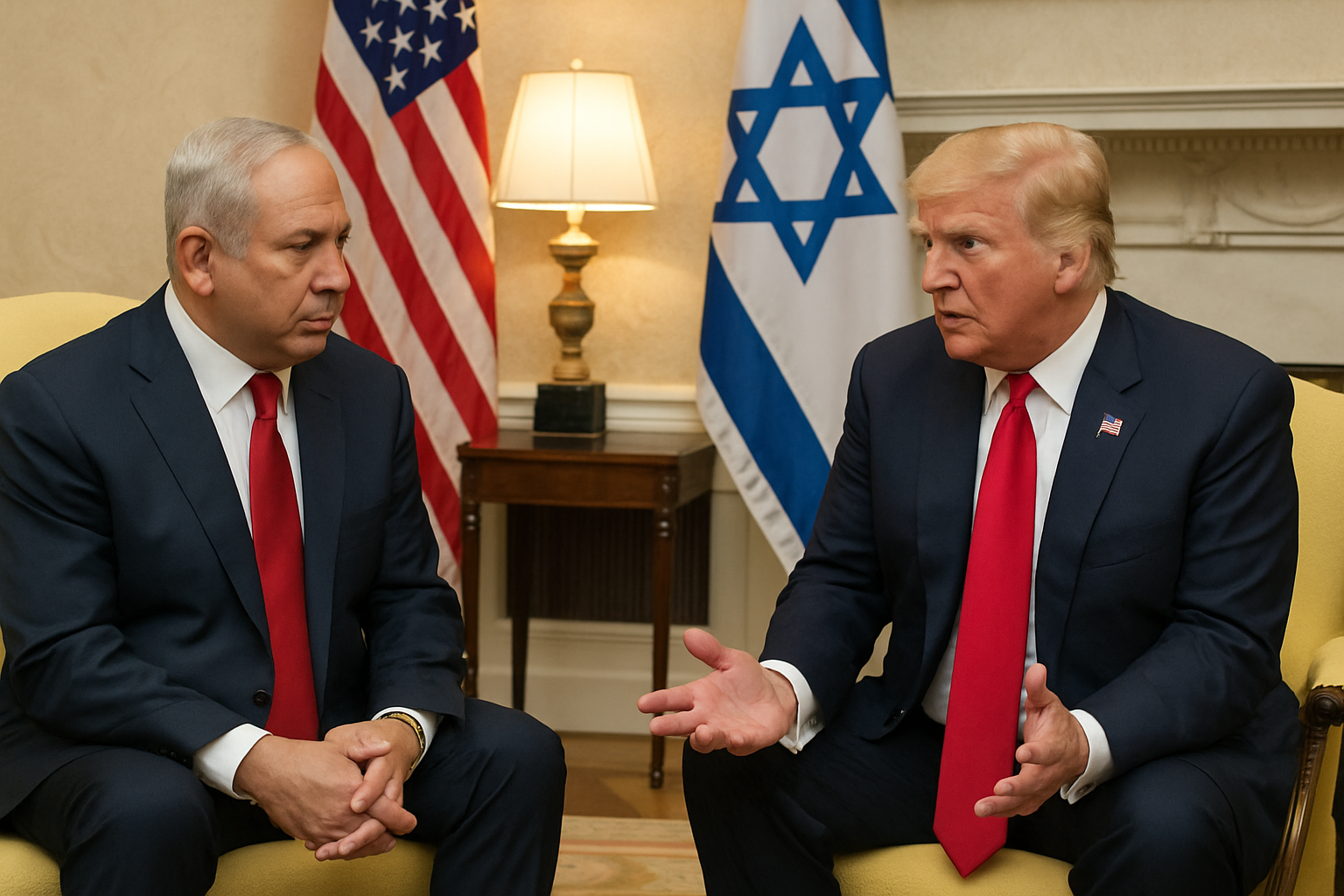
President Donald Trump met with Israeli Prime Minister Benjamin Netanyahu at the White House on Wednesday, focusing on coordination of Iran nuclear strategy following recent diplomatic breakthroughs in Oman, though no definitive agreement was reached on broader regional security concerns.
The meeting, their seventh encounter since Trump returned to office, lasted over two and a half hours and was described by both sides as "very good," with Trump later posting on Truth Social that he "insisted that negotiations with Iran continue to see if a deal is possible."
Key Developments from White House Meeting
The closed-door discussions centered on the ongoing U.S.-Iran nuclear negotiations that resumed February 7 in Muscat, Oman, where both sides agreed to continue talks despite fundamental disagreements over scope and substance. Iranian Foreign Minister Abbas Araghchi had described the Oman talks as having a "positive atmosphere" while maintaining Iran's position that ballistic missiles and regional proxy activities remain "red lines" excluded from nuclear-only discussions.
Netanyahu emphasized what Israeli officials call comprehensive security requirements, stating that "all negotiations must include limiting ballistic missiles and ending support for the Iranian axis." This position puts Israel at odds with Iran's compartmentalized approach to nuclear talks while aligning with U.S. Secretary of State Marco Rubio's demands for a comprehensive agreement addressing missiles, armed groups, and human rights.
Nuclear Crisis Context and Regional Stakes
The meeting occurs against the backdrop of Iran's continued uranium enrichment at 60% purity—significantly above the 3.67% limit established under the original Joint Comprehensive Plan of Action (JCPOA) and approaching the 90% threshold needed for weapons-grade material. Intelligence reports suggest Iran may consider a three-year enrichment halt and stockpile transfer to Russia as potential concessions, though recent hardline statements from Iranian leadership cast doubt on such compromises.
Recent military tensions have continued to simmer alongside diplomatic efforts. A U.S. F-35C fighter jet from the USS Abraham Lincoln shot down an Iranian Shahed-139 drone in the Arabian Sea, while Iranian Revolutionary Guard Corps (IRGC) vessels have harassed U.S.-flagged tankers in the Strait of Hormuz, through which 40% of global oil transit passes.
Unprecedented Regional Coalition
The diplomatic process has gained remarkable support from an unprecedented regional coalition, with Saudi Arabia, the United Arab Emirates, Qatar, and Egypt all backing the negotiation framework. This represents an unusual consensus among traditionally opposing Middle Eastern powers, reflecting regional investment in preventing military confrontation that could destabilize global energy markets.
"The security needs of the State of Israel must be addressed in the context of any negotiations with Iran," Netanyahu's office stated following the meeting.
— Israeli Prime Minister's Office
Oman's role as neutral mediator has proved crucial, leveraging its historical mediation in the 2015 JCPOA negotiations. The sultanate's ability to maintain diplomatic relationships with both Washington and Tehran has enabled the structured dialogue framework despite deep mutual mistrust.
Scope Disagreement Remains Core Obstacle
The fundamental challenge facing negotiators remains the scope disagreement that has plagued nuclear diplomacy for over a decade. Iran insists on nuclear-only talks while excluding what it considers sovereign rights to ballistic missile capabilities and regional partnerships. The United States and Israel view these as interconnected security threats requiring comprehensive solutions.
This structural disagreement has prevented breakthrough agreements since the JCPOA collapse in 2018, with Iran maintaining that its missile program and support for regional allies like Hezbollah, Hamas, and the Houthis are non-negotiable sovereign rights. U.S. and Israeli officials argue that nuclear agreements without addressing delivery systems and regional proxy threats are insufficient for meaningful security.
Domestic Pressures on All Sides
Iran faces severe domestic pressure with over 42,000 protest arrests since 2022 and crushing economic sanctions that have created what analysts describe as a regime survival imperative for sanctions relief. However, Iranian leadership appears to be prioritizing nuclear capabilities and regional influence over immediate economic relief, as evidenced by Foreign Minister Araghchi's declaration that Iran would "never abandon uranium enrichment even if war is imposed."
The Trump administration must balance Republican congressional pressure viewing engagement as appeasement against the need for foreign policy victories. Meanwhile, Netanyahu faces pressure from Israeli security establishment figures who view incomplete nuclear-only agreements as insufficient to address existential security threats from Iran's integrated missile and proxy network.
International Context and Nuclear Governance Crisis
The Iran nuclear crisis unfolds against broader challenges to international nuclear governance. The New START treaty between the United States and Russia expired February 5, marking the first time in over 50 years without bilateral nuclear constraints between superpowers. China's nuclear expansion and refusal to participate in trilateral arms control further complicates multilateral frameworks.
UN Secretary-General António Guterres has warned that nuclear risks are "higher than at any time in decades," lending urgency to successful conflict resolution in Iran while maintaining non-proliferation principles. Success could provide a diplomatic template for other nuclear challenges, while failure might accelerate military solutions with global implications.
Technical and Verification Challenges
Any agreement would require unprecedented verification mechanisms far exceeding the original JCPOA's complexity. Iran's advanced centrifuge technology, expanded nuclear infrastructure, and 60% enrichment capability represent significant technical challenges for international monitoring. The Islamic Republic has also developed sophisticated uranium production and storage facilities that would require comprehensive oversight.
Intelligence agencies estimate that Iran possesses sufficient enriched uranium for multiple nuclear weapons if the decision were made to weaponize, though the process would still require additional technical steps and time. This creates pressure for robust verification while maintaining Iran's cooperation in the diplomatic process.
Coming Weeks Decisive for Regional Stability
Both sides have agreed to continue negotiations "early next week," though the venue and specific agenda remain under discussion. The framework establishment represents diplomatic progress despite substantive disagreements, with Omani mediation proving essential for maintaining dialogue momentum.
The critical test ahead will be whether innovative diplomatic solutions can bridge decade-old challenges or whether the talks represent another false start in nuclear crisis resolution. Regional war prevention, global nuclear governance credibility, and Middle East stability architecture all depend on the outcomes of these negotiations.
"While it's possible to negotiate, I indicated to the Prime Minister that this will be my preference," Trump stated following the meeting.
— President Donald Trump
Strategic Implications for Middle East Order
The success or failure of U.S.-Iran nuclear diplomacy will have far-reaching implications for Middle East order and international conflict resolution mechanisms. The unprecedented regional coalition supporting negotiations demonstrates that even traditional adversaries recognize the stakes involved in preventing military confrontation.
For Israel, the challenge remains ensuring that any nuclear agreement addresses the full spectrum of Iranian threats rather than providing partial solutions that leave missile and proxy threats unaddressed. For the United States, the test is whether diplomatic engagement backed by maximum pressure can achieve comprehensive security objectives while maintaining alliance relationships.
As negotiations continue, the international community watches for signs of genuine breakthrough versus continued deadlock that could accelerate toward military solutions. The coming weeks will determine whether 21st-century nuclear crises can be resolved through diplomatic innovation or whether the region faces an escalation that could reshape Middle Eastern geopolitics for decades to come.