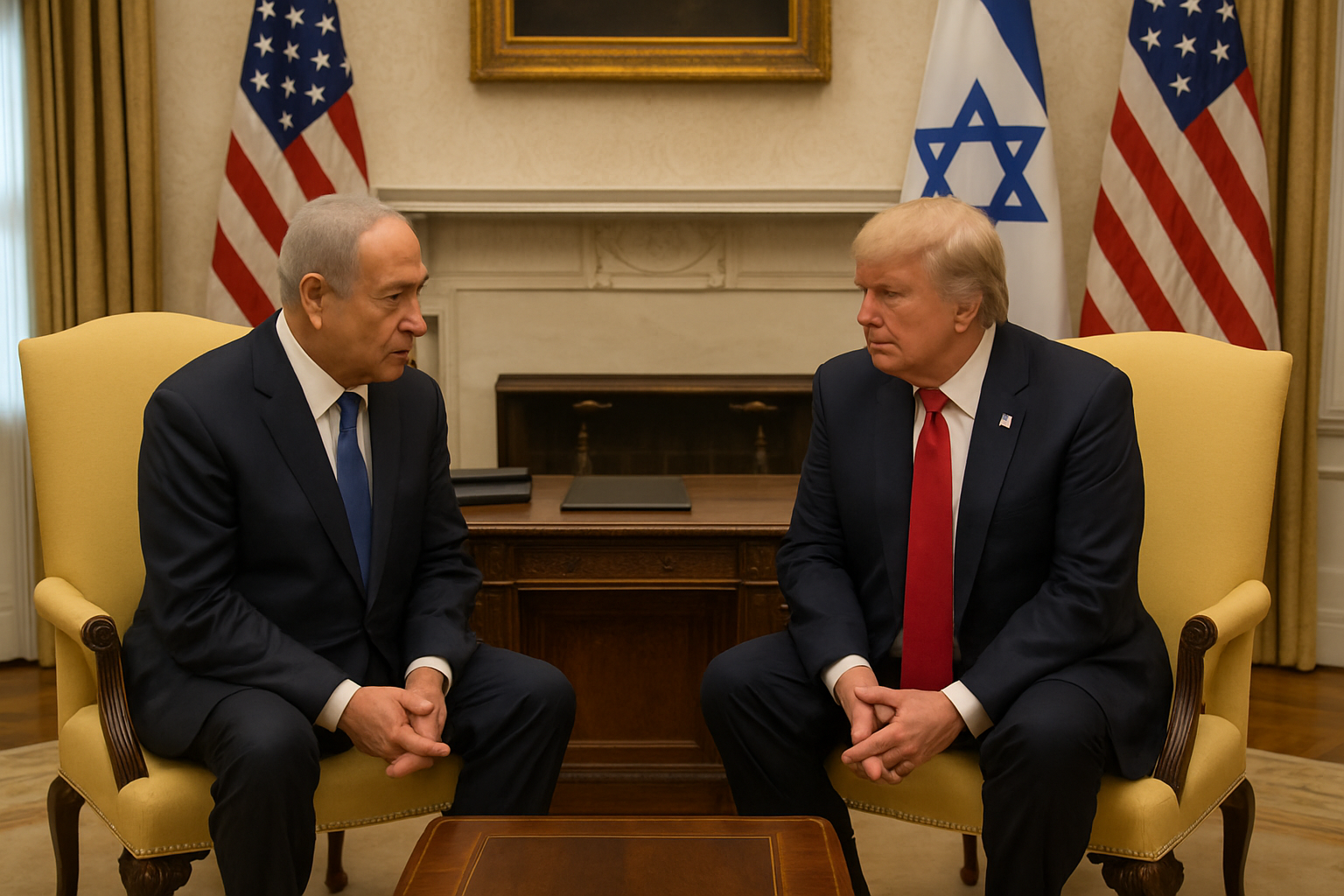
President Donald Trump met with Israeli Prime Minister Benjamin Netanyahu at the White House on Wednesday, reaffirming his commitment to continue nuclear negotiations with Iran despite the Israeli leader's push for a more comprehensive and harder-line approach toward Tehran.
The high-stakes meeting, lasting over two and a half hours behind closed doors, represented the seventh encounter between the two leaders since Trump's return to office. The discussions centered on Iran's nuclear program following the February 7 talks in Oman between U.S. and Iranian officials, which Trump characterized as having a "positive atmosphere."
Trump's Diplomatic Priority: Nuclear-Focused Engagement
Writing on his Truth Social platform after the meeting, Trump emphasized his determination to pursue diplomatic solutions with Iran. "No definitive decisions were made, except that I insisted that negotiations with Iran continue to see if a deal is possible," Trump stated, describing the encounter as a "very good meeting" while noting that no major announcements were made.
The President's stance maintains the dual-track approach his administration has pursued since taking office—combining diplomatic engagement with maximum pressure tactics. This position has yielded some early results, with both sides agreeing to continue talks following the Oman negotiations mediated by Sultan Haitham bin Tariq.
Iran currently enriches uranium at 60% purity, significantly above the 3.67% limit established in the original Joint Comprehensive Plan of Action (JCPOA) and approaching the 90% threshold needed for weapons-grade material. Intelligence reports suggest Tehran may consider a three-year enrichment halt and the transfer of existing stockpiles to Russia as potential concessions.
Netanyahu's Broader Security Concerns
Netanyahu arrived in Washington with a different agenda, emphasizing what Israeli officials describe as "red lines" for any agreement with Iran. His office issued a statement following the meeting noting that the Prime Minister "stressed the security needs of the State of Israel in the context of the negotiations."
Israeli sources indicate Netanyahu pressed Trump to expand negotiations beyond Iran's nuclear program to include strict limitations on Tehran's ballistic missile arsenal and an end to support for regional proxy groups including Hezbollah, Hamas, and the Houthis. From Israel's perspective, addressing only the nuclear dimension while leaving missile and proxy threats unaddressed would constitute an incomplete solution to existential security concerns.
The Israeli position reflects broader regional dynamics where Iran's network of allied groups—often referred to as the "axis of resistance"—poses direct security challenges to Israeli territory through rocket attacks and border infiltrations.
Fundamental Scope Disagreement Persists
The Trump-Netanyahu meeting highlighted a fundamental disagreement that has plagued nuclear diplomacy for over a decade: the scope of any potential agreement. Iran has established explicit "red lines" excluding ballistic missiles and regional proxy activities from nuclear-only discussions, demanding compartmentalized negotiations.
Conversely, U.S. Secretary of State Marco Rubio has insisted that any comprehensive agreement must address Iran's missile capabilities, support for armed groups, and human rights record. This position aligns more closely with Israeli concerns but creates structural obstacles to reaching an agreement acceptable to Tehran.
Iranian Foreign Minister Abbas Araghchi reinforced this position in a defiant declaration just days after the Oman talks, stating that Iran would "never abandon uranium enrichment even if war is imposed" on the Islamic Republic. He emphasized uranium enrichment as Iran's "inalienable right" while maintaining that ballistic missiles remain off-limits in nuclear discussions.
Regional Coalition Provides Diplomatic Foundation
Despite these fundamental disagreements, the current diplomatic effort enjoys unprecedented regional support. Saudi Arabia, the United Arab Emirates, Qatar, and Egypt have all backed the negotiation process—a remarkable consensus among traditionally competing Middle Eastern powers.
This regional coalition reflects shared concerns about the potential for military confrontation in the Persian Gulf, which handles approximately 40% of global oil transit. The prospect of conflict has already affected energy markets, with oil prices rising over $1 per barrel during periods of heightened tension.
Oman's role as neutral mediator has proven particularly crucial, leveraging the Sultanate's historical involvement in the 2015 JCPOA negotiations and its diplomatic relationships with all parties. The venue change from Turkey to Oman at Iran's request enabled more focused discussions on nuclear issues specifically.
Military Tensions Amid Diplomatic Engagement
The diplomatic efforts continue against a backdrop of significant military tensions. Recent incidents include a U.S. F-35C fighter jet shooting down an Iranian Shahed-139 drone that aggressively approached the USS Abraham Lincoln aircraft carrier in the Arabian Sea, approximately 800 kilometers from Iran's coast.
Additionally, Islamic Revolutionary Guard Corps vessels harassed a U.S.-flagged tanker in the Strait of Hormuz during the same period as the nuclear talks. These incidents demonstrate the challenges of maintaining military deterrence while pursuing diplomatic solutions.
Trump's administration has deployed significant naval assets to the region, including the Abraham Lincoln carrier strike group, while maintaining that military options remain on the table if diplomatic efforts fail. The President has warned that "bad things would happen" if negotiations do not produce results.
Domestic Pressures Shape Negotiating Positions
Both sides face substantial domestic pressures that influence their negotiating positions. Iran confronts severe economic sanctions that have created what analysts describe as a regime survival imperative for sanctions relief. The Islamic Republic has also dealt with over 42,000 protest arrests since 2022, reflecting significant internal dissent.
However, Iranian leadership appears to prioritize nuclear capabilities over immediate economic relief, as evidenced by continued uranium enrichment despite international pressure. The regime's hardline statements suggest that substantive nuclear concessions may be unlikely without corresponding U.S. commitments.
For the Trump administration, the challenge involves balancing engagement with Iran while managing pressure from Republican hawks who view diplomatic talks as a form of appeasement. The President also faces the need to demonstrate foreign policy achievements while avoiding the military risks associated with a regional conflict.
International Context and Global Implications
The Iran nuclear negotiations occur within a broader international context that includes the recent expiration of the New START treaty between the United States and Russia—the first time in over 50 years without nuclear arms control agreements between the superpowers. This development has created what UN Secretary-General António Guterres describes as a "grave turning point" for global security.
The situation is further complicated by China's expanding nuclear arsenal and ongoing conflicts in Ukraine and Gaza. Success in the Iran negotiations could provide a diplomatic template for nuclear crisis resolution, while failure might accelerate military solutions with destabilizing effects throughout the Persian Gulf region.
European allies have expressed cautious support for renewed dialogue while emphasizing the need for robust verification mechanisms that exceed the complexity of the original JCPOA. Any new agreement would require unprecedented monitoring systems given Iran's advanced centrifuge technology and expanded nuclear infrastructure.
Looking Ahead: Critical Diplomatic Test
The Trump-Netanyahu meeting represents a critical juncture in Middle East diplomacy, with both leaders acknowledging the continuation of talks while maintaining distinct priorities. Trump's insistence on diplomatic engagement reflects his administration's assessment that negotiations remain viable, despite Iranian resistance to broader discussions.
Netanyahu's emphasis on comprehensive security solutions underscores Israeli concerns about incomplete agreements that might address nuclear issues while leaving missile and proxy threats unresolved. This tension between nuclear-focused and comprehensive approaches represents the central challenge for future negotiations.
The coming weeks will prove decisive in determining whether innovative diplomatic solutions can bridge these decade-old challenges or whether the talks represent another false start in nuclear crisis resolution. The stakes extend far beyond bilateral U.S.-Iran relations to encompass regional stability, global nuclear governance, and the credibility of diplomatic alternatives to military conflict.
Success would prevent potential regional war while establishing precedents for nuclear diplomacy in an era of great power competition. Failure could accelerate military confrontation with implications for global energy security and the international non-proliferation regime. As both leaders emphasized their commitment to continued engagement, the international community watches closely for signs of substantive progress or fundamental deadlock in one of the world's most consequential diplomatic efforts.