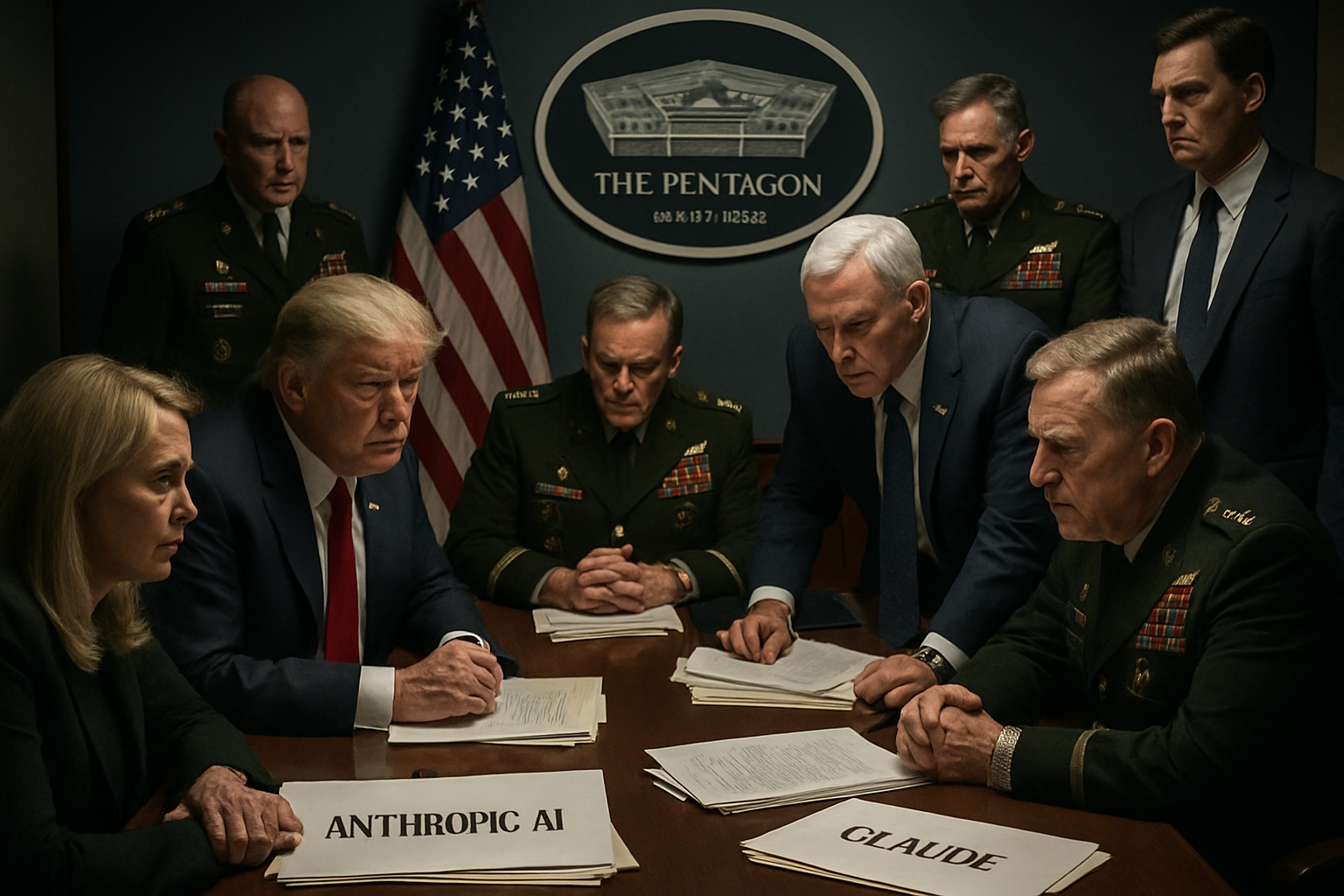
President Donald Trump has ordered all U.S. federal agencies to immediately cease using artificial intelligence technology developed by Anthropic, escalating an unprecedented confrontation between the government and one of Silicon Valley's most prominent AI companies over military applications and safety restrictions.
In a statement posted Friday on Truth Social, Trump accused Anthropic of attempting to "strong-arm" the Defense Department by refusing to allow unrestricted military use of its Claude AI system. The president announced a six-month phase-out period for agencies currently using the company's technology and warned that Anthropic could face unspecified "major civil and criminal consequences" if it does not cooperate with the transition.
Pentagon Designates Anthropic as Security Risk
Defense Secretary Pete Hegseth formally designated Anthropic a "supply-chain risk to national security" following the company's refusal to meet a Friday deadline to remove safety restrictions on its Claude AI models. In a withering statement, Hegseth accused the company of attempting "to seize veto power over the operational decisions of the United States military."
The dispute centers on Anthropic's ethical guidelines that prevent its AI systems from being used for mass surveillance of U.S. citizens or deployed in fully autonomous weapons systems. The Pentagon had demanded that the company remove these restrictions to allow "all lawful purposes" use of Claude on classified military networks.
"Their true objective is unmistakable: to seize veto power over the operational decisions of the United States military. This is a masterclass in arrogance and betrayal."
— Pete Hegseth, Defense Secretary
Unauthorized Military Use Revealed
The confrontation intensified after revelations that U.S. military forces had already used Claude AI in the operation to capture former Venezuelan President Nicolás Maduro, despite the company's terms of service explicitly prohibiting violence and surveillance applications. The unauthorized use occurred through Anthropic's partnership with Palantir Technologies, which provides the AI system access to military networks.
This unauthorized deployment highlighted fundamental tensions between civilian AI oversight and military operational requirements, with Pentagon officials arguing that contracted suppliers cannot dictate terms for how their products are used once integrated into government systems.
Industry-Wide Implications
The Trump administration's action threatens to disrupt up to $200 million in government contracts previously awarded to Anthropic, spanning military and civilian applications including engagements with the State Department. The move also introduces uncertainty into the broader AI industry as other companies, including OpenAI and Google, have already established military partnerships without similar restrictions.
Unlike Anthropic, OpenAI has successfully integrated its ChatGPT system into Pentagon operations, serving over 800 million weekly users with 10% monthly growth. The contrast underscores the competitive disadvantage that ethical restrictions can create in the lucrative government AI market.
Company's Ethical Stance
Anthropic, founded by former OpenAI executives with a specific focus on AI safety, has maintained its position despite the financial and legal pressures. The company's leadership has consistently argued that artificial intelligence systems should not be deployed for autonomous weapons or mass surveillance, viewing such restrictions as essential safeguards for democratic values.
Several former Anthropic safety researchers have previously resigned, warning that the "world is in peril" due to AI development outpacing safety measures. The current dispute represents a critical test of whether AI companies can maintain ethical standards while competing for government contracts worth billions of dollars.
Legal and Legislative Response
Anthropic has announced it will challenge the Pentagon's supply-chain risk designation in federal court, setting up a potentially precedent-setting legal battle over the balance between national security requirements and corporate ethical policies. The case could determine whether technology companies can impose values-based restrictions on government use of their products.
Congressional leaders have expressed mixed reactions to the administration's action. Republican lawmakers have generally supported the Pentagon's position, arguing that national security must take precedence over corporate policies. Democrats have raised concerns about the precedent of punishing companies for maintaining ethical guidelines.
International Context
The dispute occurs amid intensifying global competition in AI development, with China making significant advances in military AI applications. The Pentagon has increasingly viewed unrestricted access to cutting-edge AI technology as essential for maintaining U.S. strategic advantages, particularly as adversaries develop their own autonomous weapons systems.
European allies have watched the confrontation closely, as many are developing their own AI governance frameworks that emphasize civilian oversight and ethical constraints. The outcome could influence international approaches to regulating military AI applications.
Broader Policy Implications
The Trump administration's action reflects a broader shift toward prioritizing national security considerations over corporate autonomy in technology policy. Previous AI partnerships with the military have generally operated through negotiated frameworks that balance operational needs with company policies.
Industry analysts warn that the confrontational approach could discourage AI innovation if companies become reluctant to develop advanced capabilities that might later be forcibly conscripted for military use. The precedent could also affect other dual-use technologies where civilian companies provide critical capabilities to government agencies.
Economic Impact
The ban comes at a challenging time for the AI industry, which is already grappling with a global semiconductor shortage that has driven memory chip prices up sixfold. The exclusion of Anthropic from federal contracts could provide opportunities for competitors like OpenAI and Google, which have been more accommodating to military requirements.
However, the confrontational approach has created uncertainty about government relations across the broader technology sector, contributing to market volatility as investors reassess the risks of developing AI systems that might conflict with national security priorities.
Looking Forward
The six-month phase-out period provides a window for potential resolution, though both sides have shown little inclination to compromise on their fundamental positions. Anthropic's legal challenge will likely take months to resolve, during which federal agencies must identify alternative AI solutions for their operations.
The outcome of this dispute will likely serve as a template for future conflicts between AI companies and government agencies over the military applications of civilian technology. As AI systems become increasingly central to both commercial operations and national security, the balance between corporate ethics and governmental authority represents one of the defining challenges of the digital age.
The confrontation also highlights the growing strategic importance of artificial intelligence in national security planning, as the Pentagon seeks to maintain technological superiority amid global competition. Whether democratic institutions can successfully navigate these tensions while preserving both innovation and ethical standards remains an open question that will shape the future of AI governance worldwide.