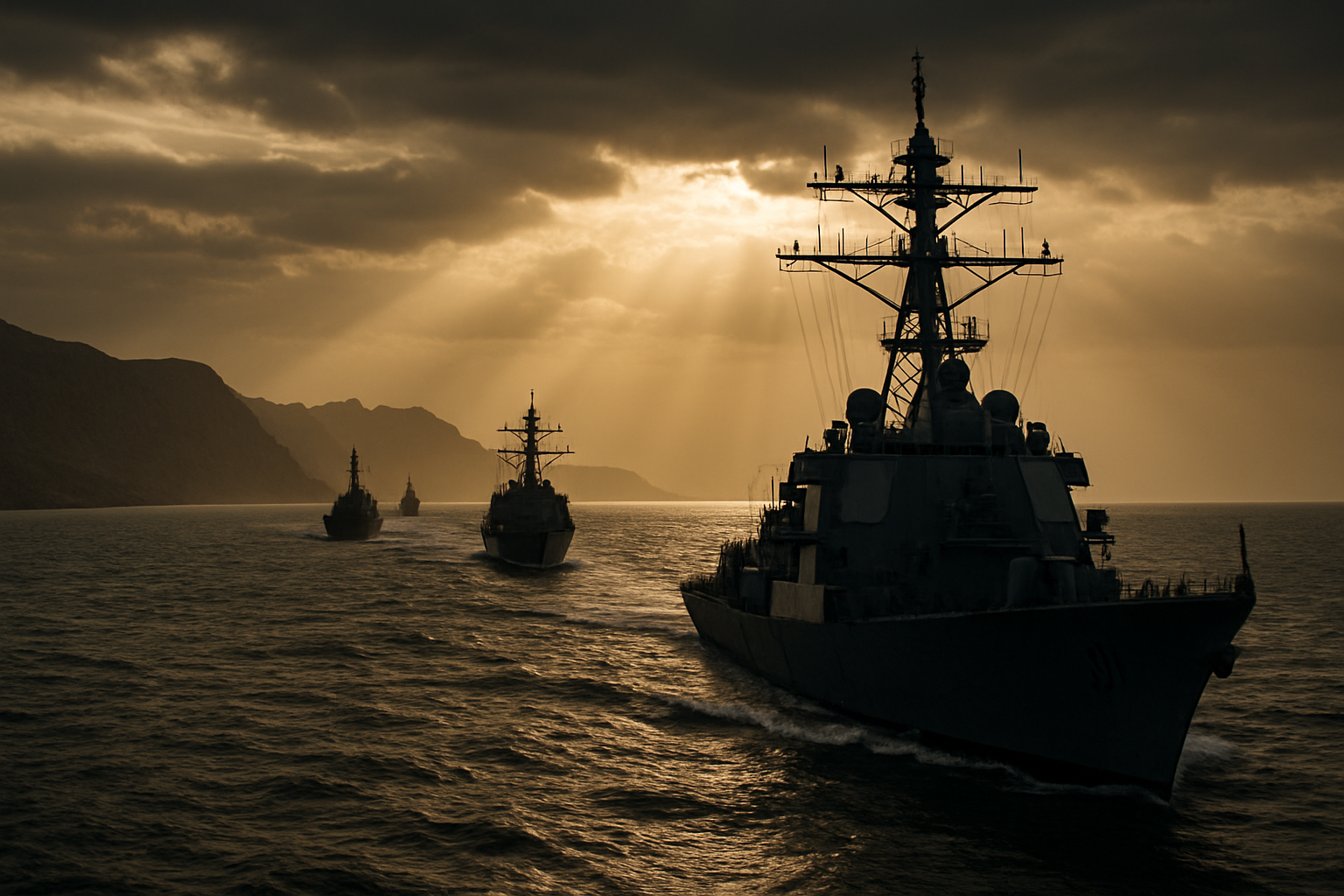
President Donald Trump announced Sunday that the United States Navy will immediately begin blockading the Strait of Hormuz following the collapse of historic peace negotiations with Iran in Pakistan, marking a dramatic escalation in tensions over the strategic waterway that handles 40% of global oil transit.
The announcement came hours after Vice President JD Vance declared that 21 hours of marathon negotiations in Islamabad had failed to produce an agreement, ending the most direct US-Iran diplomatic engagement since the 1979 Islamic Revolution. The talks, mediated by Pakistan's leadership, represented the culmination of unprecedented diplomatic efforts that had briefly resolved the most dangerous international crisis since the Cold War.
Blockade Declaration and Military Response
"Effective immediately, the United States Navy, the Finest in the World, will begin the process of BLOCKADING any and all Ships trying to enter, or leave, the Strait of Hormuz," Trump posted on Truth Social Sunday. The president added that he had "instructed our Navy to seek and interdict every vessel in International Waters that has paid a toll to Iran."
"No one who pays an illegal toll will have safe passage on the high seas. Any Iranian who fires at us, or at peaceful vessels, will be BLOWN TO HELL!"
— Donald Trump, US President
The blockade represents a naval act generally considered equivalent to a declaration of war under international law. Trump's threats came after Iran's Revolutionary Guards declared they maintained "complete control" of the waterway and threatened to catch enemies in a "deadly whirlpool" if they made "wrong moves."
Pakistan Mediation Efforts Collapse
The failure marks the end of Pakistan's unprecedented mediation success that had achieved a historic ceasefire just 88 minutes before Trump's previous "whole civilization will die tonight" deadline on April 8, 2026. Prime Minister Shehbaz Sharif and Field Marshal Asim Munir had successfully used an innovative "message relay system" to facilitate indirect talks when direct US-Iran communication proved impossible.
The "Islamabad Accord" framework had triggered an immediate 20% crash in oil prices from $119.50 to below $100 per barrel Brent crude, ending a global energy crisis that had seen 18,000+ flights cancelled worldwide and Dubai International Airport shut due to missile damage.
Nuclear Program at Center of Breakdown
According to sources familiar with the negotiations, the primary sticking point remained Iran's nuclear program. The United States demanded an affirmative commitment that Iran would not seek nuclear weapons or rapid production capability, while Iran maintained its 60% uranium enrichment program with over 400 kilograms of weapons-grade material stockpiled.
Iranian Foreign Ministry spokesman Baghaei confirmed that "two or three important topics" remained unresolved, including new Strait of Hormuz control mechanisms. Iran has implemented a cryptocurrency payment system requiring $1 per barrel from oil tankers, which the US considers an illegal toll on international waters.
Lebanon Crisis Complication
A critical factor in the talks' failure was Israeli Prime Minister Netanyahu's explicit exclusion of Lebanon from the ceasefire framework. During the negotiations, Israeli strikes killed over 254 people in Lebanon in a single day—the deadliest bombardment since the conflict began. Iran threatened withdrawal from talks unless comprehensive enforcement covered all fronts.
Vice President Vance acknowledged Iran's "legitimate misunderstanding" but maintained that the United States had never agreed to include Lebanese operations in any ceasefire agreement. The crisis has displaced 1.2 million Lebanese—25% of the population—with systematic targeting of medical facilities continuing.
Global Economic Implications
The failure threatens to reverse significant economic relief that began following the initial ceasefire. The Strait of Hormuz closure affects approximately 40% of global seaborne oil transit, with over 150 tankers previously stranded carrying billions of dollars in cargo.
The International Energy Agency had begun reducing its record 400 million barrel strategic reserve release—the largest in 50-year history—following the diplomatic breakthrough. Asian markets had surged with Pakistan's KSE-100 posting a record 8.15% gain, while airlines had begun planning resumption of Middle East routes.
- Bangladesh reviewing fuel rationing affecting 170 million people
- Pakistan considering reversal of wartime austerity measures
- Qatar resuming LNG production representing 20% of global exports
- Shipping companies mobilizing 150+ stranded tankers
Regional Coalition Under Strain
The Saudi-UAE-Qatar-Egypt coalition, which had maintained unprecedented unity despite Iranian attacks during the earlier crisis, now faces renewed pressure. During Iran's "Operation True Promise 4" systematic retaliation, the UAE suffered 1 death in Abu Dhabi, Kuwait had 32 injured in airport strikes, and Qatar sustained 8 wounded while intercepting missiles and drones.
Egyptian President Sisi had warned of "comprehensive chaos" spreading across the region if "sisterly countries" attacks continued, but the coalition had supported the diplomatic process throughout the crisis.
Nuclear Governance Context
The crisis occurs amid a broader nuclear governance breakdown. The New START treaty between the US and Russia expired in February 2026, marking the first time in over 50 years without nuclear constraints between the superpowers. UN Secretary-General Guterres has called current nuclear risks the "highest in decades."
Iran's continued 60% uranium enrichment creates weapons capability concerns, though the ceasefire had created a diplomatic window that is now closing. The failure represents a blow to diplomatic solutions in an increasingly volatile international environment.
Historical Significance of Failed Diplomacy
The collapse marks the end of what UN Secretary-General António Guterres called the "greatest test of multilateral cooperation in the modern era." Pakistan's mediation had demonstrated that middle powers could effectively bridge major adversary divides when traditional great power mechanisms failed.
"21 hours of substantive discussions with the Iranians... we have not reached an agreement. This is bad news for Iran, much more than for the United States."
— JD Vance, US Vice President
The template-setting nature of Pakistan's diplomatic innovation had offered hope for 21st-century conflict resolution approaches. China had provided "full support" for Pakistan's initiative, while Germany noted "positive signs" for continued diplomatic momentum.
Path Forward Uncertain
With Vance's departure from Islamabad after presenting what he termed America's "final best offer," the immediate diplomatic window has closed. Both sides indicated willingness to continue dialogue through Pakistan, but Iran's ceasefire commitment remains uncertain given the Lebanon crisis and unresolved nuclear issues.
Trump's renewed military threats suggest the region faces a possible return to the dangerous escalation that had threatened global energy security and regional stability. The two-week window that Pakistan's mediation had created now appears to be closing rapidly.
Template for Future Crisis Management
Despite the immediate failure, Pakistan's achievement in bringing the world's most bitter adversaries to the negotiating table represents an unprecedented diplomatic accomplishment. The innovative "message relay system" proved crucial in maintaining communication between powers when direct contact was impossible.
The stakes extend far beyond bilateral US-Iran relations, affecting territorial sovereignty enforcement, energy security paradigms, nuclear governance credibility, and international law enforcement mechanisms with implications extending decades into the future.
April 12, 2026, marks a critical juncture in determining whether diplomatic innovation can ultimately triumph over military confrontation in 21st-century international relations. The failure of these talks represents both the end of an unprecedented diplomatic achievement and potentially the beginning of an even more dangerous phase in Middle Eastern geopolitics.
As naval forces position for the blockade operations, the international community watches to see whether Pakistan's mediation framework can be salvaged or whether the world will return to the most dangerous crisis since the Cold War ended.