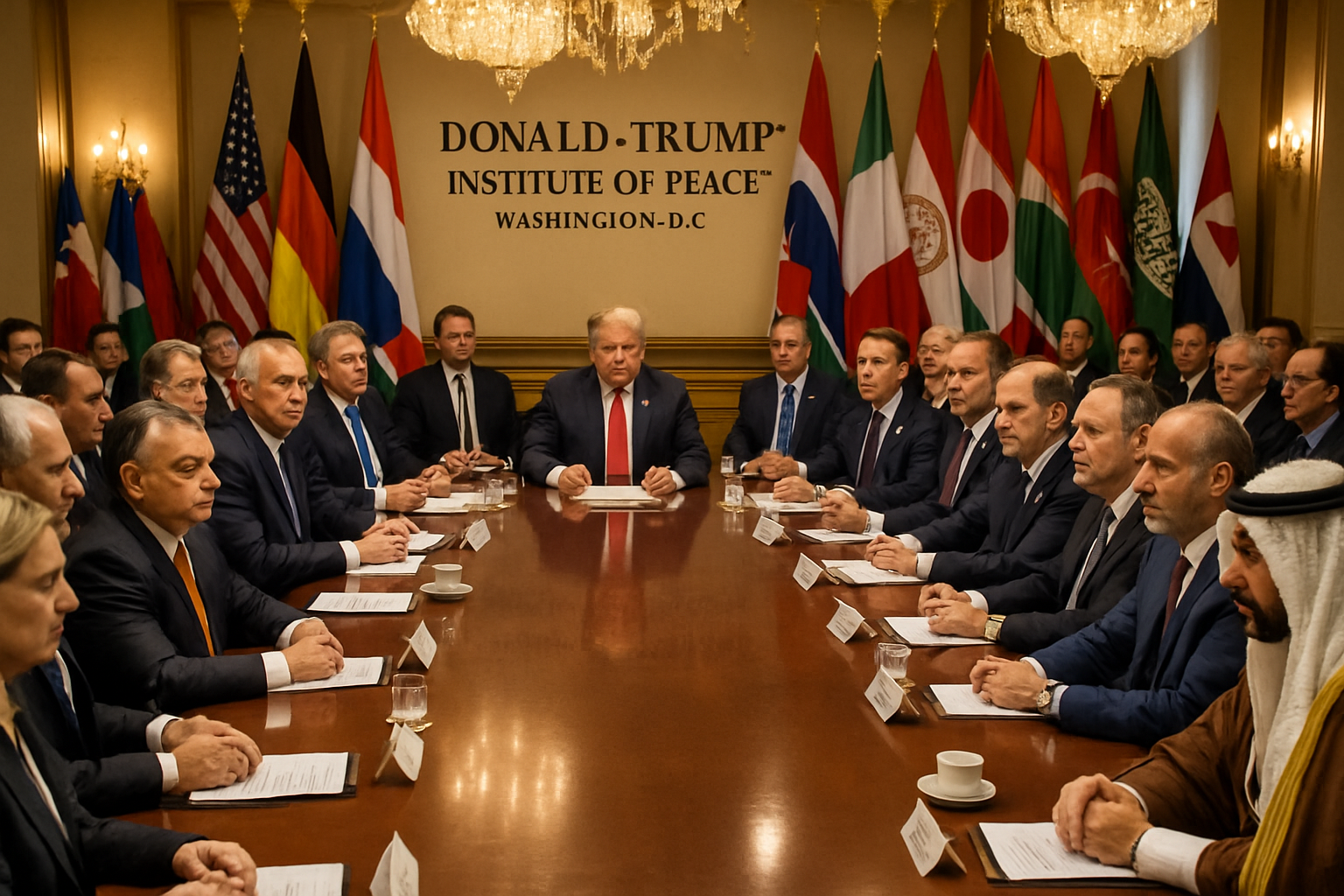
President Donald Trump's ambitious Board of Peace initiative faces its first major diplomatic test as world leaders gather in Washington D.C. for the inaugural summit on February 19, 2026, while the Vatican's high-profile rejection and escalating Gaza ceasefire violations cast shadows over the $5 billion reconstruction commitment.
The summit, hosted at the newly renamed Donald Trump Institute of Peace, brings together representatives from 27 member nations in what the Trump administration describes as a "business approach" to conflict resolution, departing from traditional UN frameworks with the president maintaining executive authority as chairman.
Vatican Declines Participation Citing "Particular Nature"
In a significant diplomatic setback, Cardinal Pietro Parolin, the Vatican's top diplomatic official, announced the Holy See would not participate in Trump's Board of Peace initiative. "The Holy See will not participate in the Board of Peace because of its particular nature, which is evidently not that of other States," Parolin stated, emphasizing that crisis management should remain under UN authority.
The Vatican's rejection comes despite Pope Leo, the first US pope, receiving a personal invitation to join the board in January. The decision reflects broader international skepticism about the initiative's potential to compete with or replace established UN conflict resolution mechanisms.
"Efforts to handle crisis situations should be managed by the United Nations."
— Cardinal Pietro Parolin, Vatican Secretary of State
International Participation Despite Concerns
Despite the Vatican's withdrawal, the Board of Peace has confirmed participation from 27 member nations, with Hungarian Prime Minister Viktor Orbán's attendance representing a significant diplomatic endorsement. Observer status has been secured from key European allies, including Italy's Prime Minister Giorgia Meloni, Cyprus President Nikos Christodoulides, and Romania's President Nicușor Dan, who is making his first US visit since taking office.
Pakistan Prime Minister Shehbaz Sharif has arrived in Washington to participate in the summit, which administration officials describe as focusing on three primary objectives: consolidating the Gaza ceasefire, mobilizing the promised $5 billion in reconstruction pledges, and finalizing the institutional framework for Trump's proposed global conflict resolution forum.
However, Mexico's President Claudia Sheinbaum declined the invitation, citing her government's policy on Palestine state recognition, highlighting the complex political dynamics surrounding the initiative.
Gaza Crisis Threatens Core Mission
The Board of Peace initiative faces immediate challenges from the deteriorating situation in Gaza, where systematic ceasefire violations have been documented since the October 2025 truce agreement. According to the Gaza Government Media Office, over 1,600 violations have resulted in 573+ Palestinian deaths during what was intended to be a peace period.
The Rafah crossing, which reopened in February, operates under severe restrictions with only 27 Palestinians crossing daily against a quota of 200. Hamas has condemned what it describes as "systematic harassment" by Israeli security forces, with 38 of 50 planned returnees denied passage and 20,000 Palestinians still awaiting medical evacuation.
These violations directly threaten the Board of Peace's flagship Gaza reconstruction initiative, which relies on donor confidence in sustainable peace conditions. The continuing crisis has prompted eight Arab nations—Saudi Arabia, Jordan, Egypt, UAE, Qatar, Indonesia, Pakistan, and Turkey—to issue joint condemnations calling the Israeli actions violations of international law.
Hamas Rejects Disarmament Demands
Adding to the challenges, Hamas leadership has categorically rejected international disarmament demands that form a cornerstone of traditional post-conflict reconstruction models. Khaled Meshaal, speaking at the Al Jazeera Forum in Doha, declared that "criminalizing resistance, weapons and those who carried it out" remains unacceptable while calling armed resistance a fundamental right under international law "as long as occupation exists."
Israeli sources estimate Hamas maintains approximately 20,000 fighters despite the ceasefire, creating a fundamental obstacle to the security conditions typically required for international reconstruction aid. This position challenges the Board of Peace's ability to implement conventional post-conflict frameworks in occupied territory scenarios.
Trump's "Business Approach" to Diplomacy
The Board of Peace represents Trump's attempt to apply business-oriented methodologies to international conflict resolution, with the president maintaining executive authority over a forum designed to act more decisively than traditional multilateral institutions. The initiative evolved from conceptual discussions at the January 2026 World Economic Forum in Davos to an active international organization with a signed charter.
Administration officials emphasize the Board's potential to mobilize resources more effectively than existing UN frameworks, pointing to the unprecedented $5+ billion in reconstruction pledges as evidence of the approach's viability. The summit is strategically scheduled for the day after a bilateral meeting between Trump and Israeli Prime Minister Benjamin Netanyahu, demonstrating the integrated nature of the administration's Middle East diplomatic calendar.
European Skepticism and Observer Participation
European responses to the Board of Peace have been mixed, with some officials supporting diplomatic innovation while others express concern about undermining established international institutions. Cyprus President Christodoulides described his invitation as "particularly important," while Italy's participation faced heated parliamentary debate with opposition parties accusing the government of supporting "colonialism."
The observer status adopted by several European nations allows participation while maintaining distance from more controversial aspects of the initiative. This diplomatic middle ground reflects broader European concerns about the long-term implications of departing from UN-based conflict resolution frameworks.
"The board, with him as chair, would be expanded to tackle global conflicts."
— Trump Administration Official
Broader Diplomatic Context
The Board of Peace summit occurs against a backdrop of multiple international crises testing traditional diplomacy. The initiative coincides with ongoing Ukraine-Russia peace efforts, Iran nuclear negotiations, and the February 5 expiration of the New START treaty—the first time in over 50 years without US-Russia nuclear constraints.
This confluence of challenges has created what UN Secretary-General António Guterres describes as nuclear risks at their "highest level in decades," lending urgency to diplomatic innovations like the Board of Peace while raising questions about the sustainability of parallel conflict resolution mechanisms.
Implementation Challenges Ahead
The success of the February 19 summit will be measured by its ability to secure meaningful financial commitments from member nations while maintaining political unity for sustained peace efforts. Traditional post-conflict reconstruction models face particular challenges in the Gaza context, where ongoing resistance to demilitarization requirements and continued ceasefire violations complicate standard international aid frameworks.
The initiative must also navigate complex questions about its relationship with existing international law and UN authority. Critics argue that the Board of Peace risks fragmenting international consensus on conflict resolution, while supporters contend that innovative approaches are necessary when traditional institutions fail to produce results.
Strategic Implications
The Board of Peace represents a potential paradigm shift in international peace-building, with implications extending far beyond the current administration. Success could provide a template for leader-driven conflict resolution in the 21st century, while failure might undermine confidence in alternative approaches to established multilateral frameworks.
The initiative's focus on Gaza reconstruction serves as a proof-of-concept for the broader application of business-oriented diplomacy to international conflicts. The ability to deliver concrete results in this challenging environment will determine whether the Board of Peace model can be applied to other global crises, including the ongoing conflicts in Ukraine and emerging tensions in the South China Sea.
As world leaders gather in Washington for this unprecedented diplomatic experiment, the international community watches to see whether Trump's Board of Peace can transcend traditional limitations and deliver the tangible results that have proven elusive through conventional diplomatic channels. The stakes extend beyond any single conflict, touching on fundamental questions about the future of international cooperation and conflict resolution in an increasingly multipolar world.