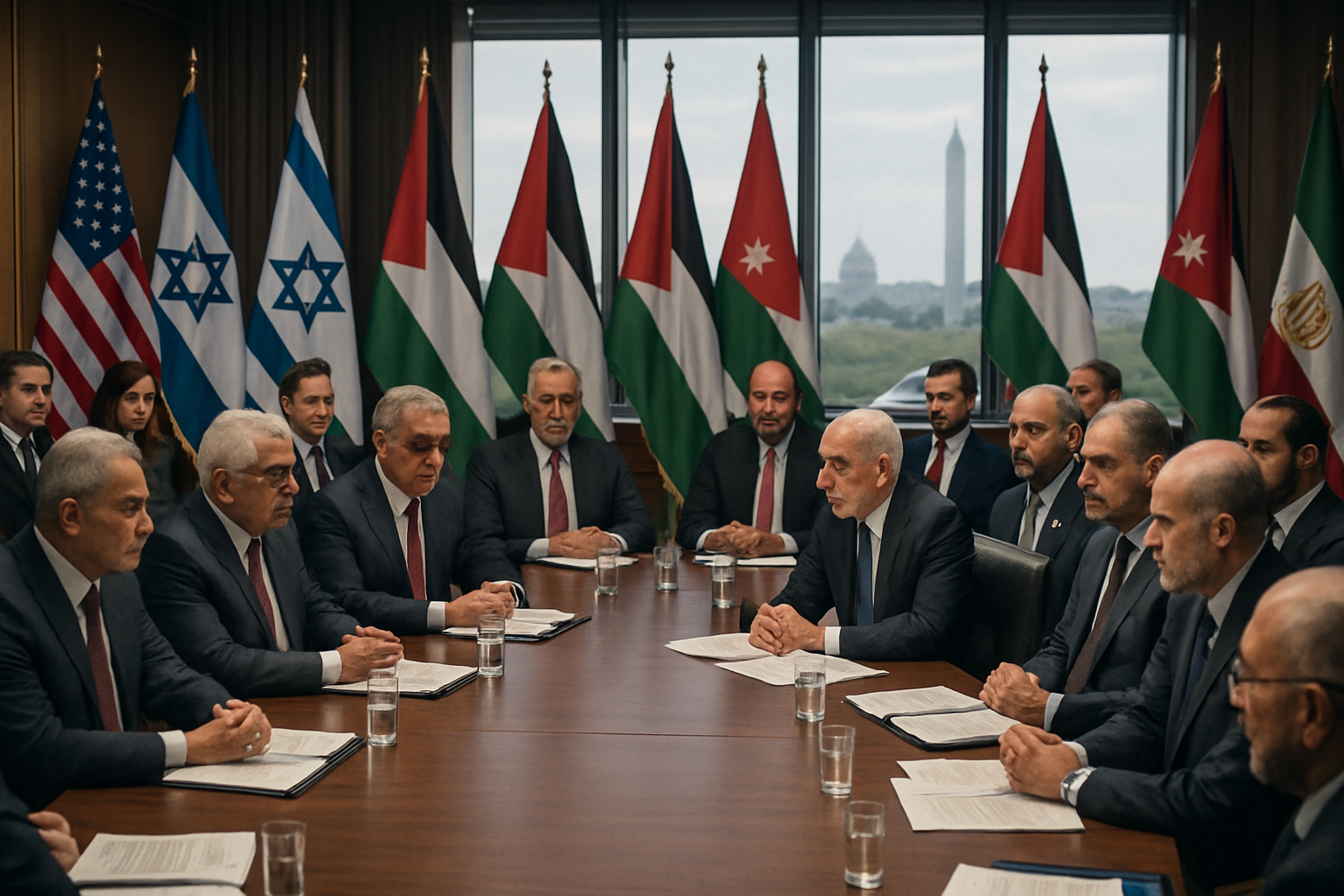
President Donald Trump's ambitious Peace Council initiative faces unprecedented challenges as it prepares for its inaugural summit on February 19, 2026, with systematic Gaza ceasefire violations and Israel's historic West Bank territorial expansion threatening to undermine international diplomatic efforts just as 27 member nations prepare to pledge over $5 billion for Gaza reconstruction.
The summit at the newly renamed Donald Trump Institute of Peace in Washington comes amid a cascade of diplomatic crises that have erupted across the Middle East in recent weeks, testing Trump's "business approach" to conflict resolution against deeply entrenched regional tensions that have defied traditional diplomatic frameworks for decades.
Peace Council Initiative Under Pressure
The Peace Council, which evolved from a conceptual proposal at the January 2026 World Economic Forum in Davos to an active international organization with a signed charter, represents Trump's departure from traditional UN frameworks. With Hungarian Prime Minister Viktor Orbán's attendance confirmed and observer status granted to Italy, Cyprus, and Romania, the initiative has secured over $5 billion in reconstruction pledges plus commitments for thousands of personnel for an international stabilization force.
However, the ambitious diplomatic venture faces immediate obstacles that threaten its credibility before the first meeting convenes. The Vatican declined participation through Cardinal Pietro Parolin, citing "critical issues" and emphasizing that "the UN should manage crisis situations." Mexico's President Claudia Sheinbaum also declined, citing her nation's Palestine state recognition policy.
"This is a historic moment that requires unprecedented international cooperation, but we must address the systematic violations that are undermining the very foundations of peace we're trying to build."
— Senior diplomatic source familiar with Peace Council preparations
Gaza Ceasefire Violations Reach Crisis Point
The Gaza Government Media Office has documented over 1,600 systematic ceasefire violations since the October 10, 2025 truce began, resulting in 573+ Palestinian deaths during what was supposed to be a peace period. The total Gaza death toll has reached 71,800, with international observers describing the pattern as "systematic implementation failures" rather than isolated incidents.
Most alarming for international mediators, the Rafah crossing—reopened on February 2 after nearly two years of closure—operates under severe restrictions that have rendered it largely ineffective for humanitarian purposes. Only 27 Palestinians crossed on the opening day versus the agreed quota of 200, with Hamas condemning "systematic harassment" by Israeli security forces who denied passage to 38 of 50 planned returnees.
The humanitarian crisis has deepened with Gaza's Civil Defense completely shut down due to fuel shortages, hampering emergency response capabilities while 20,000 Palestinians await medical evacuation. Eight Arab nations—Saudi Arabia, Jordan, Egypt, UAE, Qatar, Indonesia, Pakistan, and Turkey—have issued joint condemnations of the violations, representing an unprecedented diplomatic consensus that spans traditional regional divisions.
Historic West Bank Land Seizure Sparks International Condemnation
Compounding the Gaza crisis, Israel's government has approved the most comprehensive West Bank land registration since the 1967 occupation began. Finance Minister Bezalel Smotrich's proposal, approved by the security cabinet, targets hundreds of thousands of dunams with strategic focus on the Jordan Valley, marking what Palestinian sources describe as the largest land confiscation operation since the occupation commenced.
The decision represents a dramatic departure from previous settlement policies, moving from piecemeal expansion to systematic territorial control. Energy Minister Eli Cohen publicly acknowledged the measures constitute "factual sovereignty" implementation, stating the steps will "establish reality on the ground that there will be no Palestinian state."
The international response has been swift and unprecedented in its scope. Eighty-five UN member states issued a joint condemnation, warning of "de facto annexation" that violates international law. UN Secretary-General António Guterres expressed "grave concern," describing the measures as a "dangerous escalation" that threatens the viability of a two-state solution.
European Unity Against Israeli Policies
European nations have coordinated their opposition with unusual unity. The European Union characterized Israeli actions as a "step in the wrong direction," emphasizing that annexation remains illegal under international law. Britain demanded Israel reverse the moves, warning of "unilateral attempts to alter the geographic or demographic makeup of Palestine" that are "wholly unacceptable."
Over 400 EU diplomats have called for increased pressure on Israeli authorities, while a European Left Coalition petition against EU-Israel partnerships has exceeded 400,000 signatures, demonstrating growing public pressure for policy changes.
Hamas Rejects Disarmament Demands
Adding another layer of complexity to the peace efforts, Hamas leader Khaled Meshaal delivered a definitive policy statement in Doha categorically rejecting disarmament demands. Speaking at the 17th Al Jazeera Forum, Meshaal declared that "criminalizing resistance, weapons and those who carried it out" is unacceptable, maintaining that armed resistance remains justified "while there is occupation."
This position directly challenges traditional post-conflict reconstruction models that typically require demilitarization before international aid flows. Israeli sources estimate Hamas maintains approximately 20,000 fighters despite the ceasefire, creating fundamental obstacles to the Peace Council's reconstruction framework.
Trump Administration's Diplomatic Balancing Act
The Trump administration finds itself navigating unprecedented diplomatic complexity as multiple Middle East crises converge. Despite the President's traditionally pro-Israel stance, White House officials have expressed opposition to formal Israeli annexation, stating that a "stable West Bank keeps Israel secure."
The administration's "business approach" to diplomacy faces its first major test as systematic violations threaten donor confidence in Gaza reconstruction efforts. The Peace Council's success depends on maintaining political unity among 27 diverse member nations while addressing fundamental security and territorial disputes that have defied resolution for decades.
Regional diplomatic coordination has intensified, with Egypt leading mediation efforts while maintaining 150 hospitals on alert and 300 ambulances deployed for Gaza medical evacuations. The Organization of Islamic Cooperation has condemned what it terms "continuing massacres," describing the situation as a dangerous escalation.
Strategic Implications for Regional Stability
The convergence of crises represents more than immediate diplomatic challenges—it tests fundamental principles of international law enforcement and conflict resolution in the 21st century. The systematic nature of ceasefire violations combined with unprecedented territorial seizures has created what observers describe as a comprehensive challenge to Palestinian statehood and regional stability.
Success or failure of international opposition to Israeli policies will influence territorial sovereignty disputes globally, affecting precedents for occupied territories worldwide. The Peace Council initiative itself represents a critical test of whether leader-driven "business diplomacy" can succeed where traditional multilateral frameworks have stalled.
"We are witnessing a watershed moment that will determine whether international law and diplomatic agreements retain their credibility in resolving territorial and security disputes."
— International law expert familiar with the negotiations
Looking Ahead to February 19
As the Peace Council prepares to convene, the stakes extend far beyond the immediate Gaza crisis or West Bank territorial disputes. The initiative occurs amid broader global challenges to traditional diplomacy, including the February 5 expiration of the New START treaty—leaving the world without US-Russia nuclear constraints for the first time in over 50 years—and ongoing Ukraine-Russia peace negotiations.
The coming weeks will prove decisive in determining whether innovative diplomatic formats can mobilize resources more effectively than established institutions, or whether the accumulated challenges will undermine confidence in alternative approaches to international conflict resolution.
For the 2.3 million residents of Gaza, 20,000 Palestinians awaiting medical evacuation, and millions more affected by the broader Israeli-Palestinian conflict, the success or failure of the Peace Council represents more than diplomatic theater—it may determine whether a viable path to peace remains possible or whether the region slides toward further escalation and the technical unfeasibility of a two-state solution.
The February 19 summit will serve as a critical test of whether economic incentives and direct leader engagement can overcome deep-rooted political and security challenges that have frustrated peacemakers for generations, with implications that will resonate far beyond the current administration and reshape approaches to international conflict resolution in the multipolar world.