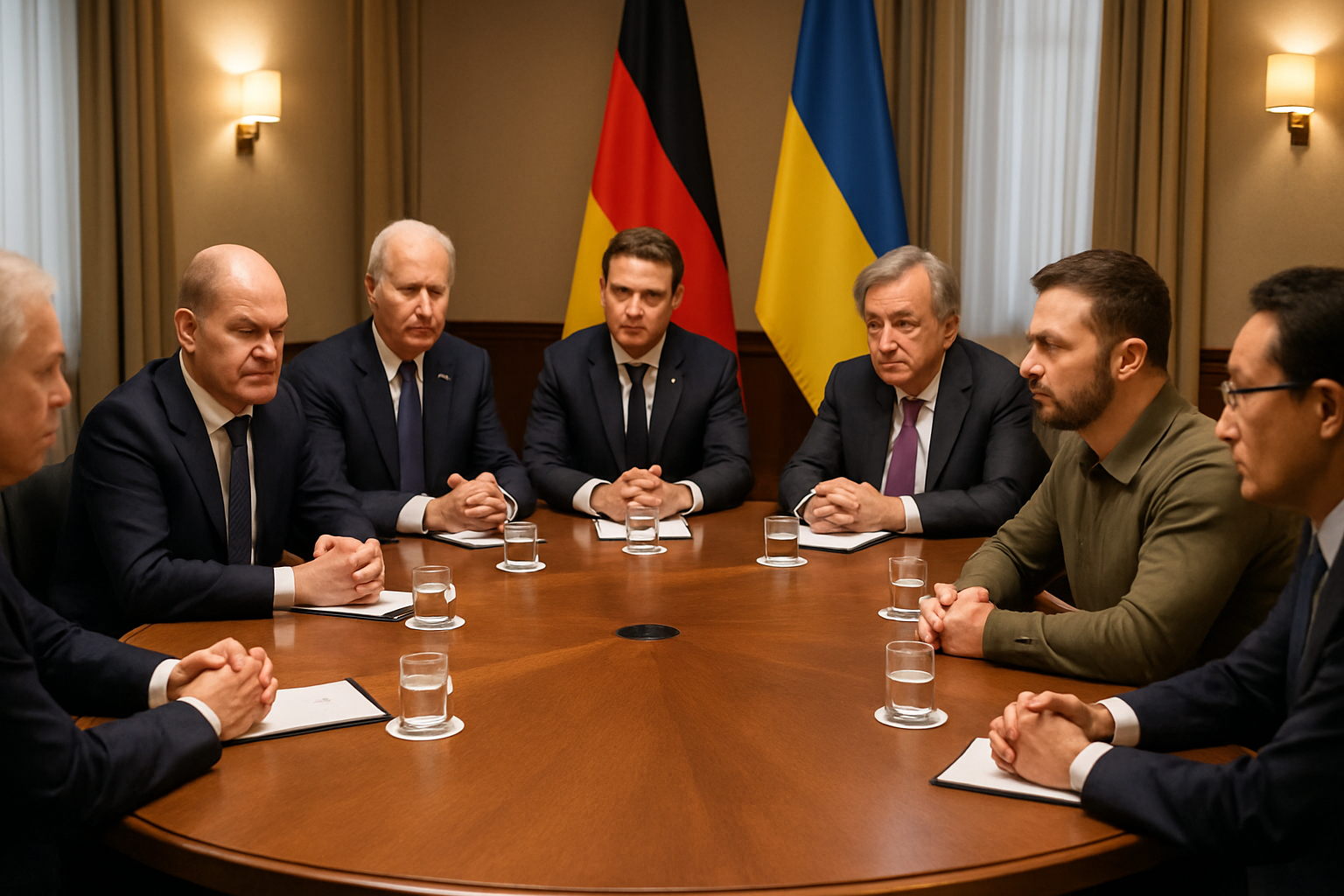
President Donald Trump is set to convene the first meeting of his newly established "Peace Council" on February 19, 2026, marking a dramatic departure from traditional UN-based diplomatic frameworks as international efforts intensify to resolve the Ukraine conflict.
The inaugural session, to be held at the newly renamed Donald Trump Institute of Peace in Washington, will bring together 27 world leaders who accepted Trump's invitation in January to join his alternative global peace-building mechanism. The meeting comes as Germany continues its behind-the-scenes mediation efforts and follows recent breakthroughs in Abu Dhabi trilateral talks between Ukraine, Russia, and the United States.
Peace Council Framework Emerges
Trump's "Peace Council" represents his administration's bold attempt to circumvent what he views as ineffective United Nations processes. The initiative, first conceptualized at January's Davos World Economic Forum, has evolved into an active international organization with a signed charter and executive committee structure.
Hungarian Prime Minister Viktor Orban has confirmed his attendance at the February 19 summit, lending credibility to Trump's unconventional diplomatic approach. The meeting will focus primarily on Gaza reconstruction efforts, with over $1 billion in international commitments expected to be announced.
"We want a business approach to conflict resolution, not endless bureaucratic procedures that achieve nothing,"
— Senior Trump Administration Official
The Peace Council represents a significant shift toward bilateral and regional partnerships over traditional multilateral frameworks. Critics argue this approach undermines established international law mechanisms, while supporters praise its potential for innovative, results-driven diplomacy.
Germany's Continued Mediation Role
Behind the scenes, Germany has maintained its role as a key mediator in Ukraine peace efforts, even as public attention focuses on Trump's more dramatic initiatives. German diplomatic sources confirm ongoing coordination with both Ukrainian and Russian officials through established channels, complementing rather than competing with the Abu Dhabi framework.
The German approach emphasizes technical negotiations on prisoner exchanges, humanitarian corridors, and infrastructure protection - the building blocks that have enabled recent breakthroughs including the historic 314-prisoner swap achieved in early February.
European divisions persist over engagement strategies, with Germany opposing direct Putin talks while France and Italy support broader diplomatic channels. This split has created space for Trump's Peace Council to position itself as a middle ground between European caution and Russian demands.
Abu Dhabi Success Sets Precedent
Recent trilateral talks in Abu Dhabi between Ukraine, Russia, and the United States have provided the most significant diplomatic breakthrough since the conflict began. The February 5 conclusion saw the restoration of US-Russia military communications after a four-year suspension and the successful exchange of 314 prisoners - the first such swap in five months.
Ukrainian Defense Minister Rustem Umerov described the talks as "substantial and productive," while US Special Envoy Steve Witkoff confirmed concrete results on ceasefire monitoring mechanisms. The UAE's neutral hosting proved crucial for structured negotiations despite ongoing military operations.
The success has established a tested framework for complex conflict resolution that Trump's Peace Council aims to build upon. The main sticking point remains eastern Ukrainian territories under Russian control, where fundamental positions have not changed despite diplomatic progress.
International Response and Skepticism
The international community remains divided on Trump's Peace Council initiative. European officials privately express concern about undermining established UN frameworks, while regional partners in the Middle East have shown cautious support for innovative diplomatic approaches.
The timing of the February 19 meeting is strategic, occurring just one day after Netanyahu's scheduled bilateral meeting with Trump on February 18. This scheduling suggests coordination between Gaza reconstruction efforts and broader Middle East peace initiatives.
Critics point to the selective membership of the Peace Council, arguing that excluding certain nations while privileging others based on political alignment could compromise the initiative's credibility. Supporters counter that the UN's track record justifies experimenting with alternative approaches.
Military Context Complicates Diplomacy
Despite diplomatic progress, military escalation continues to complicate peace efforts. Russia launched what DTEK described as the "most powerful blow" of 2026 against Ukrainian energy infrastructure, leaving over 1,170 buildings in Kyiv without heating during minus-30°C temperatures.
The attack broke an informal Trump-Putin agreement to avoid targeting energy facilities before negotiations, demonstrating the fragility of diplomatic progress amid ongoing hostilities. NATO Secretary-General Mark Rutte condemned the strikes as a "bad signal" before peace talks.
Russian forces captured 481 square kilometers in January 2026 compared to 260 square kilometers in December, showing accelerated territorial gains that strengthen Moscow's bargaining position while complicating Ukrainian negotiation strategies.
Nuclear Arms Control Crisis Adds Urgency
The expiration of the New START nuclear arms control treaty on February 5, 2026, has created additional urgency for diplomatic initiatives. For the first time in over 50 years, no binding nuclear agreement exists between the United States and Russia.
UN Secretary-General António Guterres called the expiration a "grave turning point" for global security, warning that nuclear weapon use risks are "higher than at any time in decades." This nuclear governance crisis provides backdrop for both the Peace Council initiative and ongoing Ukraine negotiations.
Trump rejected Putin's proposal for a 12-month treaty extension, demanding a "modernized" agreement including China's expanding nuclear arsenal. China has refused trilateral participation, creating diplomatic deadlock that the Peace Council may attempt to address.
Gaza Reconstruction as Proof of Concept
The February 19 meeting will focus heavily on Gaza reconstruction efforts, serving as a proof-of-concept for Trump's business-oriented diplomatic approach. With 2.3 million Gaza residents affected by conflict, the reconstruction challenge requires unprecedented international coordination and funding.
The Rafah crossing reopened February 2 but remains severely limited, with only 27 Palestinians crossing versus the 200 daily quota. Hamas has condemned "systematic harassment" by Israeli security forces, complicating humanitarian access that reconstruction efforts will require.
European sources report over 400 EU diplomats have called for increased pressure on Israeli authorities regarding ceasefire compliance, while eight Arab nations have condemned ongoing violations. The Peace Council's approach to these enforcement challenges will indicate its potential effectiveness for broader conflicts.
Looking Ahead: Innovation vs. Established Order
The February 19 Peace Council meeting represents a critical test of whether innovative, leader-driven diplomatic formats can mobilize resources and political will more effectively than traditional multilateral institutions.
Success in Gaza reconstruction could provide a template for addressing the Ukraine conflict and other global challenges. However, failure to deliver meaningful results could undermine confidence in alternative diplomatic approaches and strengthen arguments for maintaining established frameworks.
The international community will be watching closely to see whether Trump's "business approach" to conflict resolution can bridge the gap between diplomatic innovation and the complex realities of territorial disputes, humanitarian crises, and nuclear governance.
With multiple global conflicts testing traditional diplomacy simultaneously - from Ukraine to Iran's nuclear program to Middle East stability - the coming weeks will determine whether the Peace Council represents a breakthrough in international relations or another chapter in the ongoing crisis of global governance.