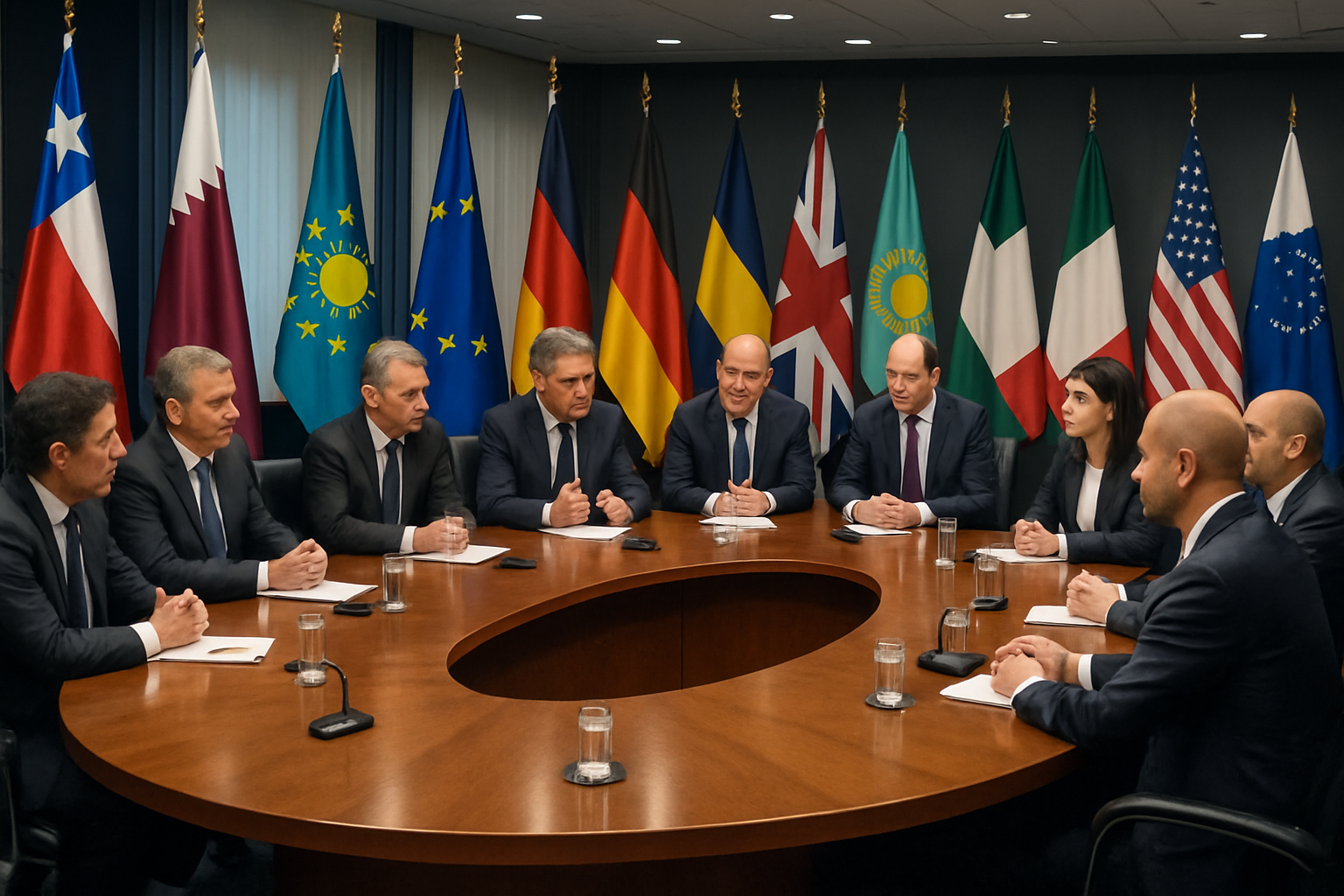
As President Trump's Peace Council prepares for its inaugural February 19, 2026 summit at the newly renamed Donald Trump Institute of Peace in Washington, international responses reveal a complex diplomatic landscape with some nations embracing participation while others maintain cautious distance.
Bulgaria's government approved participation in the Peace Council's introductory session, appointing a three-member delegation led by Ivan Naydenov, Permanent Secretary of the Ministry of Foreign Affairs. The delegation will include Constantine Dimitrov and an additional representative, marking Bulgaria among the founding members of Trump's diplomatic initiative.
In stark contrast, Mexican President Claudia Sheinbaum declined Trump's invitation to join the Peace Council, citing her administration's recognition of Palestine as a sovereign state. "We recognize the pursuit of peace, but in this case, when it comes to peace in the Middle East and in Palestine, given that we [Mexico] were the first government to give state treatment to Palestine," Sheinbaum explained during a press conference.
European Participation and Constitutional Concerns
Italy's participation sparked intense parliamentary debate, with Foreign Minister Antonio Tajani defending the decision amid opposition criticism. "Italy will be there, we do not wag our tail," Tajani declared before the Chamber of Deputies, responding to accusations that the government was subservient to Trump's agenda. Opposition parties, including the Democratic Party and Five Star Movement, condemned the participation as "colonialism."
Despite the controversy, Italy confirmed its role as an observer nation, with the government approving participation while maintaining constitutional oversight. The debate reflected broader European concerns about the Peace Council's departure from traditional UN frameworks and its potential to compete with established international institutions.
Uzbekistan's President Shavkat Mirziyoyev departed for the United States on February 17 to attend the summit, demonstrating Central Asian engagement with the initiative. The visit marks significant diplomatic outreach from the Trump administration to include diverse regional perspectives in the peace process.
Gaza Crisis Context and Reconstruction Plans
The Peace Council initiative emerges against the backdrop of ongoing Gaza ceasefire violations, with documented reports of over 1,600 systematic breaches since the October 2025 truce. Palestinian authorities report more than 573 deaths during what was intended as a peace period, raising questions about the viability of reconstruction efforts.
Trump administration officials have confirmed that Peace Council member states have pledged over $5 billion for Gaza reconstruction and humanitarian aid, with formal announcements scheduled for the February 19 summit. The initiative also includes commitments for "thousands of personnel" to be deployed as part of an International Stabilization Force for Gaza.
However, implementation challenges persist. The Rafah crossing operates under severe restrictions, with only 27 Palestinians crossing daily against a quota of 200. Hamas leadership has categorically rejected disarmament demands, with Khaled Meshaal stating in Doha that armed resistance will continue "while occupation exists."
Diplomatic Innovation vs. Traditional Frameworks
The Peace Council represents Trump's "business approach" to conflict resolution, departing from UN frameworks with the president maintaining executive authority. Critics argue this undermines established international institutions, while supporters view it as necessary innovation for addressing complex 21st-century conflicts.
Viktor Orbán's confirmed attendance at the summit highlights the initiative's appeal to leaders seeking alternatives to multilateral diplomatic processes. The Hungarian Prime Minister's participation demonstrates the Peace Council's ability to attract significant international figures despite institutional concerns.
European officials remain privately concerned about the precedent of bypassing established international legal mechanisms. The initiative's timing coincides with multiple global crises, including the Ukraine-Russia conflict resolution efforts and Iran nuclear negotiations, testing whether innovative leader-driven formats can mobilize resources more effectively than traditional institutions.
Regional Implications and Observer Status
The mixed response from regional powers illustrates the delicate balance between diplomatic innovation and institutional stability. Cyprus President Nikos Christodoulides described the invitation as "particularly important," while Romania's President Nicușor Dan will make his first US visit since taking office to participate as an observer.
Observer status allows European nations to participate while maintaining distance from controversial aspects of the initiative. This diplomatic compromise enables engagement without full endorsement of Trump's departure from multilateral frameworks.
Eight Arab nations, including Saudi Arabia, Jordan, Egypt, UAE, Qatar, Indonesia, Pakistan, and Turkey, have previously condemned ongoing ceasefire violations, creating additional complexity for the Peace Council's Gaza-focused agenda. Their response to the February 19 summit will significantly influence the initiative's regional credibility.
Implementation Challenges Ahead
The success of Trump's Peace Council depends on securing meaningful financial commitments while maintaining political unity among diverse member nations. Traditional post-conflict reconstruction models typically require stable security environments, which remain elusive in Gaza despite ceasefire agreements.
Hamas's estimated 20,000 fighters refusing disarmament, combined with ongoing ceasefire violations, create substantial obstacles for donor confidence and reconstruction implementation. The Gaza Civil Defense's shutdown due to fuel shortages further complicates emergency response capabilities essential for stabilization efforts.
The initiative faces the fundamental challenge of bridging humanitarian objectives with security requirements. While the $5 billion pledge represents substantial financial commitment, translating these resources into meaningful peace-building requires addressing underlying political and security challenges that have defied resolution through traditional diplomatic channels.
Global Stakes and Future Implications
As the February 19 summit approaches, the Peace Council represents a critical test of whether innovative leader-driven peace initiatives can overcome deep-rooted political and security challenges through economic incentives. The initiative's success could provide a template for 21st-century conflict resolution, while failure might undermine confidence in alternative diplomatic approaches.
The varied international response—from Bulgaria's founding membership to Mexico's principled decline—reflects broader tensions between diplomatic innovation and institutional continuity. The summit's outcomes will influence not only Middle East stability but also the evolution of international peace-building mechanisms in an era of complex global challenges.
With multiple global conflicts simultaneously testing traditional diplomacy, Trump's Peace Council serves as both diplomatic experiment and potential precedent. The February 19 Washington summit will reveal whether this business-oriented approach can deliver concrete results or represents another chapter in the ongoing struggle to achieve sustainable peace in one of the world's most intractable conflicts.