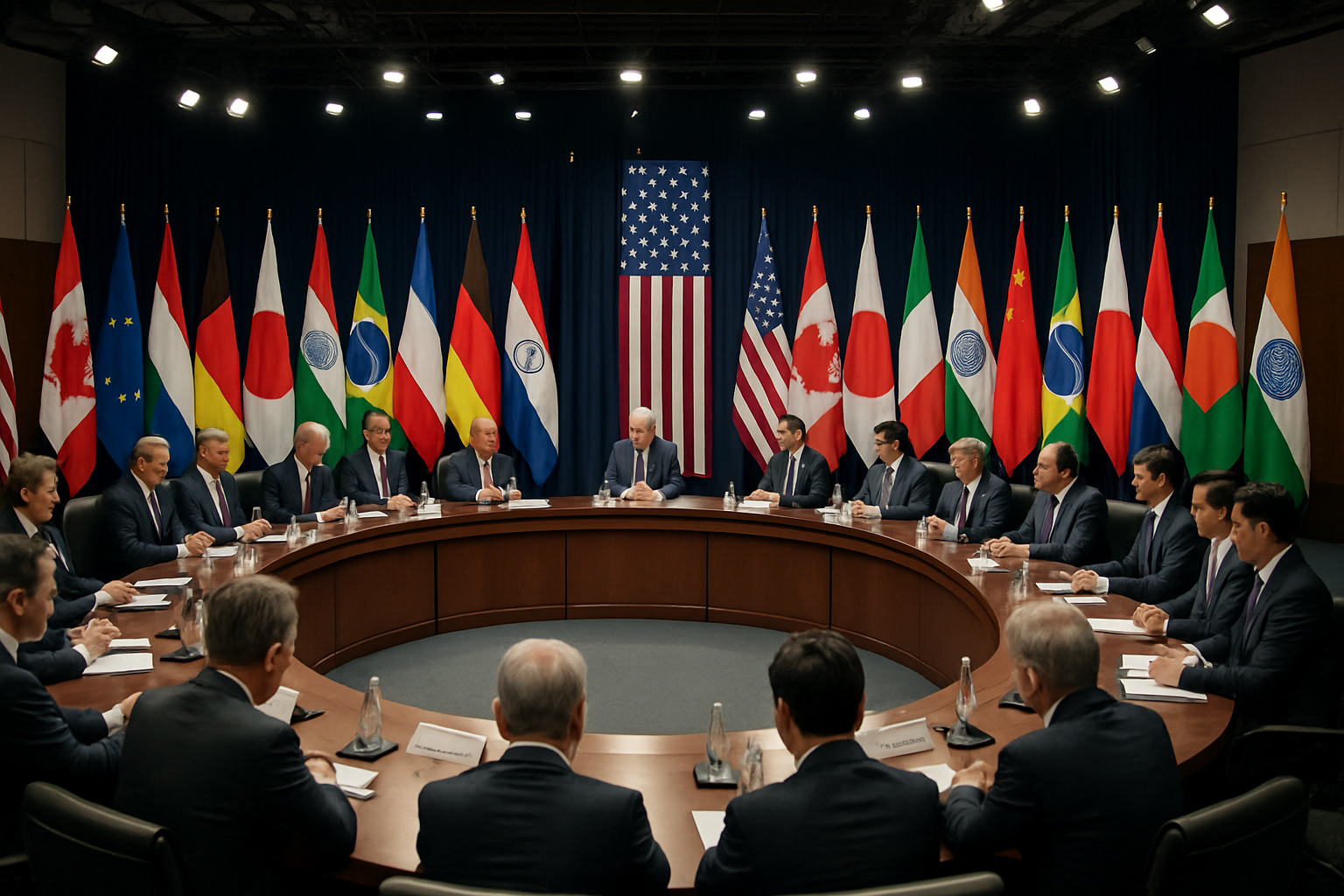
President Donald Trump's ambitious Peace Council initiative has secured participation from 27 member nations for its inaugural summit on February 19, 2026, at the newly renamed Donald Trump Institute of Peace in Washington, D.C., despite growing international skepticism and the Vatican's high-profile withdrawal from the organization.
The summit represents Trump's signature "business approach" to international conflict resolution, departing from traditional UN frameworks while positioning the United States as the central mediator in global peace efforts. However, the initiative faces significant challenges as key institutions decline participation and European Union members struggle to present a unified response.
Vatican Withdraws Citing "Critical Issues"
The Vatican dealt a significant blow to the initiative's legitimacy when Secretary of State Cardinal Pietro Parolin announced the Holy See would not participate in Trump's "Board of Peace," citing "critical issues" with the organization's structure and mandate. The Vatican's decision, reported across multiple international outlets, emphasized that "the UN manages crisis situations" and questioned the need for parallel diplomatic mechanisms.
The Vatican's withdrawal is particularly significant given the Holy See's traditional role in international mediation and peace processes. Cardinal Parolin's statement reflects broader concerns about the initiative's potential to undermine established international institutions.
Mixed European Response Reveals EU Divisions
European Union members have failed to establish a unified position on Trump's Peace Council, with individual nations taking divergent approaches. Albania's Socialist Party chairman Taulant Balla defended his country's immediate acceptance of the invitation, citing Albania's "special relationship with the United States" when questioned by German MEP Michael Gahler during a European Parliament delegation visit to Tirana.
Lithuania's Foreign Minister Kęstutis Budrys called for the EU to develop a unified stance, acknowledging that the organization raises "fundamental questions" for Lithuania while noting the absence of European consensus. The division is stark: some EU members have confirmed participation while others have explicitly declined or remained silent.
Romania decided "at the last moment" to participate as an observer, according to Romanian media reports, highlighting the diplomatic uncertainty surrounding the initiative. Italy's participation remains under debate, with complex constitutional and political considerations affecting the decision-making process.
Growing International Participation
Despite institutional resistance, the Peace Council has attracted significant international participation. Kazakhstan's President Kassym-Jomart Tokayev will attend the inaugural meeting during his February 18-19 working visit to Washington at Trump's personal invitation, according to the Akorda press service. The Kazakh president's participation represents the first formal meeting of the Board of Peace under its UN Security Council mandate established earlier this year.
Malaysia and other nations have expressed varying degrees of skepticism, with Malaysian sources noting that "several points remain perplexing and require further explanation" regarding the initiative's scope and objectives. Moldova's opposition leader Irina Vlah has urged the country's Ministry of Foreign Affairs to examine cooperation prospects with the "Peace Council," describing its establishment as a significant diplomatic development.
Trump's "Business Approach" to Diplomacy
The Peace Council initiative represents what Trump administration officials describe as a "business approach" to international conflict resolution, emphasizing direct engagement between leaders and economic incentives over traditional multilateral frameworks. This approach evolved from conceptual discussions at the January Davos World Economic Forum to an active international organization with a signed charter.
Romanian media analysis suggests the Trump administration has deliberately avoided providing detailed information about the organization's operational structure, though it's confirmed that Trump will serve as the absolute leader of the Council. This centralized authority structure has raised concerns among European officials about democratic governance and institutional accountability.
The initiative targets several high-profile international conflicts, with particular emphasis on Gaza reconstruction efforts. Member states have reportedly committed over $5 billion for reconstruction and humanitarian aid, along with "thousands of personnel" for international stabilization forces.
Gaza Focus Amid Ongoing Violations
The Peace Council's emphasis on Gaza reconstruction comes amid documented systematic ceasefire violations that threaten the initiative's credibility. According to Palestinian sources, over 1,600 ceasefire violations have been documented since the October 2025 truce, resulting in hundreds of casualties during what was supposed to be a peace period.
Hamas leadership has categorically rejected disarmament demands, with political bureau leader Khaled Meshaal stating in Doha that armed resistance will continue "while occupation exists." This position complicates traditional post-conflict reconstruction models that typically require demilitarization as a prerequisite for international aid.
The ongoing violations have drawn condemnation from eight Arab nations, including Saudi Arabia, Jordan, Egypt, UAE, Qatar, Indonesia, Pakistan, and Turkey, who issued a joint statement calling the situation a threat to regional stability and international law.
Challenges to Traditional Frameworks
The Peace Council initiative reflects broader frustrations with existing international institutions, particularly the United Nations Security Council, which has faced criticism for gridlock on major global conflicts. Trump's approach attempts to bypass traditional diplomatic channels through direct bilateral engagement backed by economic incentives.
However, critics argue that this approach risks undermining established international law and diplomatic precedents. European officials have privately expressed concerns about the precedent of creating parallel institutions that could weaken multilateral cooperation on future global challenges.
The timing of the initiative is particularly significant, occurring amid multiple international crises including Ukraine-Russia peace negotiations, Iran nuclear talks, and the expiration of the New START treaty between the United States and Russia. This context has intensified debate about whether innovative diplomatic approaches can succeed where traditional frameworks have stalled.
February 19 Summit Expectations
The February 19 summit at the Donald Trump Institute of Peace will test whether the President's unconventional approach to international relations can produce meaningful results. With 27 member nations confirmed to participate, the meeting represents one of the largest international gatherings hosted by the Trump administration.
Key participants will include Hungarian Prime Minister Viktor Orbán, whose attendance has been specifically confirmed, and observers from several European nations. The summit's agenda is expected to focus on Gaza reconstruction funding commitments and the establishment of operational frameworks for the Peace Council's ongoing activities.
Success at the summit could provide a template for Trump's broader foreign policy approach, potentially influencing how the administration addresses other international conflicts. However, failure to achieve concrete results could undermine confidence in alternative diplomatic approaches and strengthen arguments for maintaining traditional multilateral institutions.
Future Implications
The Peace Council initiative represents a significant test of whether leader-driven, business-oriented diplomacy can effectively address complex international conflicts in the 21st century. The mixed international response reflects broader tensions between innovation and institutional stability in global governance.
As the February 19 summit approaches, the international community will be watching closely to see whether Trump's approach can deliver the promised reconstruction funding and sustainable peace mechanisms, or whether it will join the list of ambitious but unsuccessful diplomatic initiatives that have struggled to resolve entrenched conflicts.
The outcome of this summit may well determine the future trajectory of international peace efforts and the role of traditional institutions versus innovative bilateral approaches in addressing global challenges.