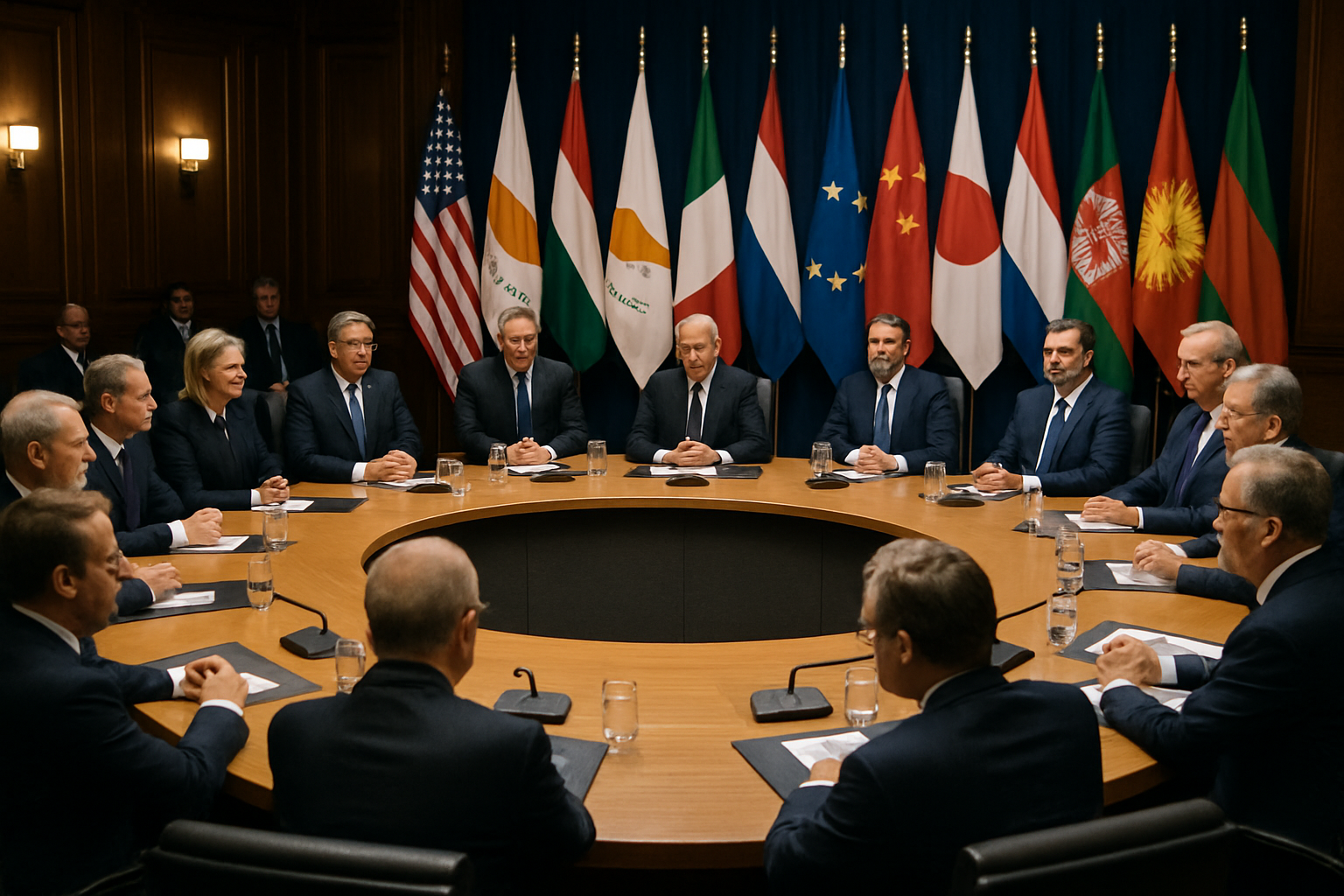
President Trump's controversial Peace Council initiative is gaining international traction as several European nations confirm their participation as observers in the February 19 meeting, despite initial constitutional concerns and diplomatic reservations about the framework.
Italian Prime Minister Giorgia Meloni announced Saturday that Italy will participate in the Peace Council as an observer nation, resolving previous constitutional complications she had raised three weeks earlier. "We were invited as an observer country and in our view, this is a good solution to the problem we have regarding constitutional compatibility with membership in the Peace Council," Meloni told reporters.
The decision represents a significant shift for Italy, which had previously expressed concerns about the legal framework of the initiative. Meloni emphasized that Italy's participation as an observer rather than a full member addresses these constitutional issues while maintaining Italian involvement in what she described as necessary European engagement in Middle Eastern stabilization efforts.
Cyprus Balances Opportunity with Diplomatic Caution
Cyprus President Nikos Christodoulides has described his nation's invitation to participate as an observer in the Peace Council meeting on Gaza as "particularly important for the country." Speaking after a religious service in Nicosia, Christodoulides expressed satisfaction that the United States is allowing Cyprus to participate through observer status.
However, Cyprus faces a complex diplomatic situation. When the country initially received the invitation on January 17 to join Trump's "Peace Council" for Gaza, the government welcomed it as recognition of Cyprus's enhanced international standing. That enthusiasm quickly tempered as diplomatic sources raised concerns about Trump's broader intentions.
"Suspicion has spread internationally that the Council aims to become an international body operating either in competition with the UN or replacing its role in conflict resolution."
— Diplomatic analysts quoted in Cypriot media
Despite these reservations, Cyprus will highlight its own Gaza reconstruction plan at the gathering. President Christodoulides noted that Cyprus's specific Gaza proposals were a determining factor in receiving the invitation, positioning the island nation as a constructive participant in regional peace efforts.
Romania Confirms Presidential Participation
Romanian President Nicușor Dan will make his first official visit to the United States since taking office, traveling to Washington next week to participate in the Peace Council meeting. The Romanian presidency confirmed that Dan will attend the inaugural Peace Council session and "reaffirm our firm support for peace" during the proceedings.
Romania's participation as an observer underscores the growing European engagement with Trump's diplomatic initiative, despite ongoing questions about the framework's relationship with established international institutions.
Constitutional and Diplomatic Concerns Persist
The Peace Council initiative has faced scrutiny from diplomatic circles concerned about its potential to undermine existing international frameworks. Critics worry that the Council represents an attempt to create an alternative to United Nations mechanisms for conflict resolution, operating outside established diplomatic protocols.
The number and composition of countries that attended the official presentation at the World Economic Forum in Davos and signed the founding declaration have reinforced these concerns. Some European officials have privately expressed worry about the implications for international law and multilateral diplomacy.

Gaza Focus and Reconstruction Commitments
The February 19 meeting will take place at the newly renamed Donald Trump Institute of Peace in Washington, bringing together 27 international member nations for Gaza reconstruction funding. The initiative is targeting over $1 billion in commitments, with Hungarian Prime Minister Viktor Orbán already confirmed to attend.
The timing is significant, as the meeting is scheduled for the day after a planned bilateral meeting between Trump and Israeli Prime Minister Benjamin Netanyahu on February 18. This coordination suggests the Peace Council initiative is closely integrated with broader Middle East diplomatic efforts.
However, the Council faces substantial challenges. The Gaza ceasefire continues to face violations, with the Gaza Government Media Office documenting over 1,600 systematic violations since the October 2025 truce, resulting in more than 573 Palestinian deaths during the ceasefire period. These ongoing violations threaten the stability necessary for effective reconstruction efforts.
Alternative Diplomatic Architecture
The Peace Council represents what Trump administration officials describe as a "business approach" to conflict resolution, departing from traditional UN frameworks with Trump maintaining executive authority over the initiative. This approach builds on other diplomatic successes, including the recent Ukraine-Russia-US trilateral talks in Abu Dhabi that achieved a 314-prisoner exchange and restored military communications after a four-year suspension.
European responses to the initiative remain mixed. While some support diplomatic innovation, others are concerned about undermining established international institutions and legal frameworks. The success of the February 19 meeting will likely depend on securing meaningful financial commitments from the 27 member nations while maintaining political unity for sustained peace efforts.
Strategic Timing and Broader Context
The Peace Council initiative emerges at a time of multiple global conflicts testing traditional diplomacy. The timing coincides with ongoing Iran-US nuclear talks, the expiration of the New START treaty creating the first nuclear constraints void in over 50 years, and continued efforts to resolve the Ukraine conflict through innovative diplomatic channels.
The initiative represents a potential new paradigm for international peace-building, with implications extending beyond the current administration. Its success or failure could influence how future administrations approach multilateral diplomacy and conflict resolution.
"After all the work Italy has done to stabilize the Middle East, an Italian and European presence is necessary."
— Prime Minister Giorgia Meloni
Challenges and Implementation
The Peace Council faces several implementation challenges. Hamas has categorically rejected disarmament demands, with leader Khaled Meshaal stating that "criminalizing resistance, weapons and those who carried it out" is unacceptable. This position complicates traditional post-conflict reconstruction models that typically require demilitarization before international aid flows.
Additionally, the Rafah crossing remains severely restricted, with only 27 Palestinians crossing versus the planned 200 daily quota. This limitation, combined with ongoing security concerns, creates practical obstacles for reconstruction efforts regardless of funding commitments.
The observer status chosen by Italy, Cyprus, and Romania allows these nations to participate while maintaining some distance from the initiative's more controversial aspects. This approach may provide a model for other European nations considering engagement with the Peace Council framework.
Looking Ahead
The February 19 meeting will serve as a crucial test of whether Trump's leader-driven diplomatic format can mobilize international resources more effectively than traditional institutional approaches. The participation of key European nations as observers suggests cautious international interest in alternative diplomatic mechanisms, even amid concerns about established institutional frameworks.
Success in securing substantial reconstruction commitments could validate the business-oriented approach to international diplomacy. However, failure to achieve concrete results might reinforce criticism that the initiative represents more style than substance in addressing complex international conflicts.
The coming week will determine whether the Peace Council can translate international participation into meaningful action for Gaza reconstruction while addressing broader concerns about its role in the international diplomatic architecture.