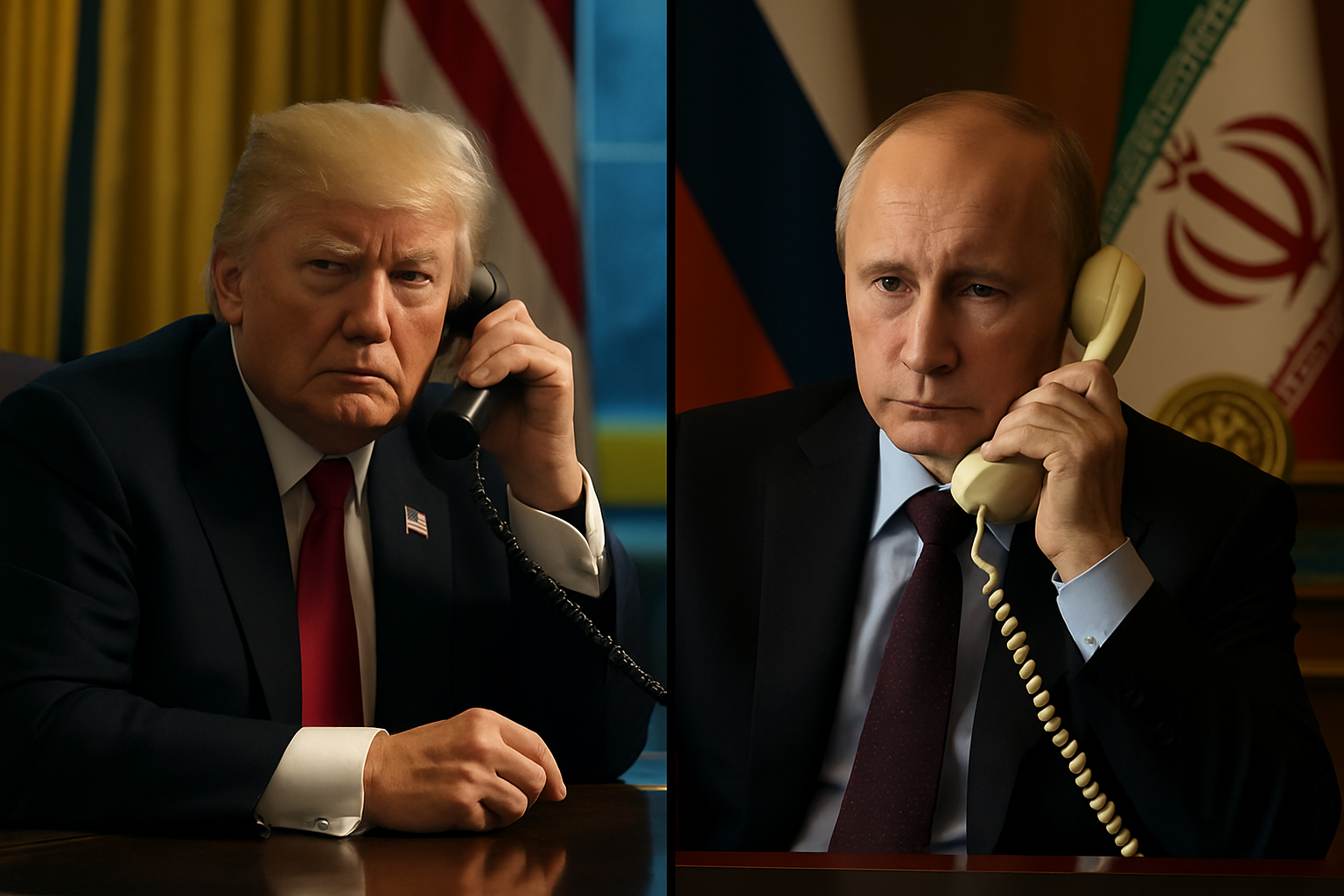
President Donald Trump and Russian President Vladimir Putin conducted their first phone call of 2026 on March 9-10, discussing the ongoing conflicts in Ukraine and Iran as both leaders navigate the most complex international crisis since the Cold War era.
The conversation, which marked the first direct communication between the two leaders in more than two months, occurred against a backdrop of unprecedented global tensions. According to multiple international sources, Trump characterized the discussion as having "progress toward peace" while addressing both the Ukrainian conflict and the escalating Iran crisis that has emerged as the most dangerous international situation in decades.
Ukraine Peace Process at Critical Juncture
The phone call comes as Ukraine-Russia peace negotiations have reached a crucial phase following the historic Geneva talks in February 2026. The diplomatic process, which began with the breakthrough Abu Dhabi talks that achieved a 314-prisoner exchange and restored US-Russia military communications after a four-year suspension, has evolved into the most significant peace effort since the conflict began.
According to Ukrainian sources, the leaders discussed the June 2026 deadline established by the Trump administration for a comprehensive peace agreement. This timeline has created unprecedented pressure for territorial compromise solutions, with talks potentially moving to Washington for presidential-level engagement.
However, fundamental disagreements persist over eastern Ukrainian territories currently under Russian control. Russia continues to demand territorial recognition and insists that any Putin-Zelensky meeting must occur in Moscow, while Ukraine maintains its territorial integrity position and seeks long-term security guarantees of 20-30 years.
Iran Crisis Dominates International Agenda
The Iran situation has escalated into what UN Secretary-General António Guterres calls the "greatest test of multilateral cooperation in the modern era." Following the death of Supreme Leader Ali Khamenei on March 1, 2026, during Operation Epic Fury, Iran has appointed his son Mojtaba Khamenei as the new Supreme Leader - marking the first hereditary succession in the Islamic Republic's 47-year history.
Trump has explicitly rejected this appointment as "unacceptable," claiming American involvement in choosing Iran's next leader represents the most direct assertion of US control over Iranian affairs since 1979. The president's demands for Iran's "unconditional surrender" have effectively ended diplomatic solutions that had shown promise in Geneva talks earlier this year.
Iranian President Pezeshkian has offered conditional ceasefires to regional neighbors while firmly rejecting American surrender demands, stating such expectations are "dreams they should take to their grave." Iran's Operation True Promise 4 has expanded to include systematic attacks on Gulf states and, for the first time since World War II, European territory - with Iranian drones striking RAF Akrotiri in Cyprus.
Global Economic and Security Implications
The twin crises have created a perfect storm of international instability. Over 18,000 flights have been cancelled worldwide - the most extensive disruption since COVID-19 - while oil prices have surged past $80 per barrel. Iran's closure of the Strait of Hormuz affects 40% of global oil transit, with 150+ tankers stranded in the Persian Gulf carrying billions in cargo.
Natural gas prices have increased 24% in Europe and 78% in the United States, while Qatar has halted LNG production. Major shipping companies Maersk and MSC have suspended Persian Gulf operations, exposing the fundamental vulnerability of global supply chains to geopolitical shocks.
The aviation crisis has particularly affected Dubai International Airport, the world's busiest, which remains closed due to missile damage. European carriers including Air France-KLM, Wizz Air, and regional airlines have suspended operations, stranding hundreds of thousands of passengers globally.
Nuclear Governance Crisis
The phone call occurred within the broader context of a nuclear governance crisis that began with the New START treaty expiration on February 5, 2026 - the first time in over 50 years that the US and Russia have operated without nuclear constraints. Both nations control approximately 80% of global nuclear weapons, with Russia possessing 4,380 warheads and the United States holding 3,708.
Iran's nuclear program adds another layer of complexity, as the new Supreme Leader inherits an advanced program with 60% uranium enrichment and over 400 kg of weapons-grade material - sufficient for multiple nuclear weapons. Nuclear diplomacy with Iran collapsed despite initial Geneva breakthrough progress, with fundamental scope disagreements proving insurmountable.
International Response and Coalition Strain
The regional coalition that had supported diplomatic processes is under severe strain. Saudi Arabia, UAE, Qatar, and Egypt - which had formed an unprecedented consensus backing peace efforts - now face direct Iranian attacks on their territories. Egyptian President Sisi condemned attacks on "sisterly countries" and warned of "comprehensive chaos" if the situation continues to escalate.
European nations have deployed an unprecedented naval coalition to protect Cyprus, with HMS Dragon, Spanish frigates, and vessels from Italy, France, Netherlands, and Greece responding to the first attack on European territory since World War II. The EU has activated the ESTIA Cyprus evacuation protocol for the first time.
Congressional scrutiny in the United States has intensified, with bipartisan lawmakers demanding answers about strategy, costs, and potential ground troop deployment. Operation Epic Fury has cost $3.7 billion in its first week alone, with Pentagon preparations extending through September - far beyond Trump's initial timeline.
Humanitarian Crisis and International Evacuations
The humanitarian toll continues to mount across multiple theaters. In Iran, the Red Crescent reports over 787 civilian casualties from US-Israeli strikes, while the controversial Minab school attack that killed 53-85 students and staff has drawn international condemnation and Geneva Conventions investigations.
International evacuations are occurring on a scale not seen since the Arab Spring of 2011, with Australia reporting 115,000 citizens trapped, Germany evacuating 30,000 stranded nationals, and multiple countries ordering complete evacuations from Iran due to "extremely uncertain" security conditions.
In Ukraine, the systematic civilian targeting continues with energy "terrorism" strategies leaving over 1,170 Kiev buildings without heating during minus-30°C temperatures. Ukrainian officials have disclosed that 55,000 soldiers have been officially killed, with a "large number" missing, though international estimates suggest actual casualties are 2-3 times higher.
Diplomatic Innovation vs. Traditional Frameworks
The Trump-Putin phone call represents a test of whether direct leader-to-leader diplomacy can succeed where traditional multilateral frameworks have struggled. The conversation occurred as European Commission President Ursula von der Leyen announced that Europe can no longer be "guardian of the old world order" and must adopt more "realistic" foreign policy approaches.
The failure of established diplomatic channels - from the UN Security Council to NATO consultations - has led to experimentation with alternative approaches. Trump's Board of Peace initiative, the bilateral US-Russia military communications restoration, and direct presidential engagement represent attempts to find new solutions to 21st-century challenges.
Looking Forward: Critical Decisions Ahead
The coming weeks will prove decisive for both conflicts and their global implications. The June 2026 deadline for Ukraine peace negotiations will test whether innovative territorial compromise solutions can bridge fundamental disagreements between Russian territorial demands and Ukrainian sovereignty insistence.
In Iran, the selection of Mojtaba Khamenei represents a shift from clerical to military-influenced governance, likely indicating escalation rather than moderation of confrontational policies. Trump's explicit regime change advocacy and demands for "unconditional surrender" have eliminated diplomatic solution possibilities, potentially leading to a broader Middle Eastern war.
The template-setting nature of these crises extends far beyond their immediate theaters. Success in containment could provide frameworks for future conflict resolution, while failure may accelerate military solutions and reshape international approaches to territorial disputes, nuclear governance, and diplomatic credibility for decades to come.
As the most dangerous international crisis since the end of the Cold War continues to unfold, the Trump-Putin phone call represents both an opportunity for breakthrough and a moment that will define the trajectory of international relations in the multipolar era. The decisions made in the coming days and weeks will reverberate through global politics for generations, determining whether diplomatic innovation can overcome military escalation or whether the world enters a new period of sustained international conflict.