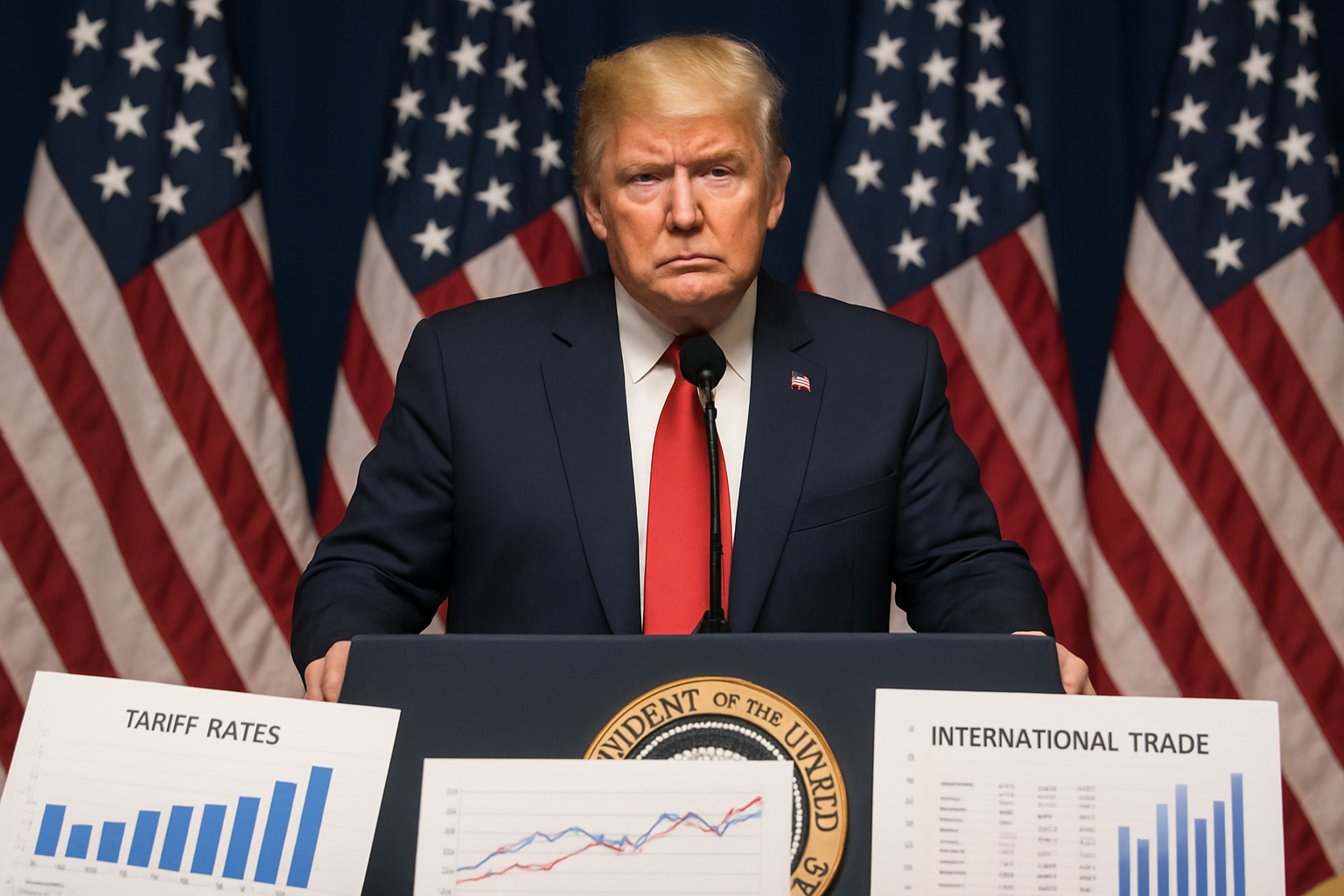
President Donald Trump announced Saturday he will raise global tariffs from 10% to 15% — the maximum level legally allowed — just one day after the U.S. Supreme Court delivered a devastating 6-3 ruling striking down his comprehensive tariff program as unconstitutional.
The escalation represents an unprecedented challenge to judicial authority and creates a constitutional crisis over executive trade powers, as Trump immediately defied the Court's decision by implementing alternative tariffs under different legal frameworks.
Supreme Court Delivers Historic Blow
On Friday, the Supreme Court ruled that the 1977 International Emergency Economic Powers Act (IEEPA) does not grant the president authority to impose what Trump described as "reciprocal tariffs" on virtually every country. Chief Justice John Roberts authored the majority opinion applying the "major questions doctrine," declaring that actions of "vast economic and political significance" require clear congressional authorization.
The ruling immediately invalidated tariffs that had generated approximately $200 billion in revenue since Trump's return to office, potentially requiring massive refunds to importers. The decision marked the first major defeat of Trump's economic agenda in his second term.
"The Court took away leverage but made it more draconian because they agreed the president has the right to a full embargo."
— Treasury Secretary Scott Bessent
Trump's Defiant Response
Within hours of the Supreme Court decision, Trump launched an unprecedented public attack on the justices, calling them "absolutely ashamed," a "disgrace to our nation," and "disloyal to the Constitution." He immediately announced a new 10% global tariff using the Trade Act of 1974, which he escalated to 15% on Saturday.
The new tariffs, imposed under Section 122 of the Trade Act, will remain in effect for 150 days — the maximum period allowed under the statute. Trump described the 15% rate as the "fully allowed and legally tested level," emphasizing his determination to maintain aggressive trade policies despite constitutional constraints.
Trump's direct confrontation with the Supreme Court through immediate alternative tariffs represents one of the most serious challenges to judicial authority in modern American history, raising fundamental questions about separation of powers and constitutional governance.
Global Economic Impact
Financial markets initially surged following the Supreme Court ruling, with the Nasdaq climbing 0.90% to 22,886.07 and the S&P 500 rising 0.69% to 6,090 points as investors celebrated reduced trade uncertainty. However, gains moderated after Trump announced replacement tariffs.
Oil prices rose more than $1 per barrel amid heightened geopolitical tensions, while the U.S. trade deficit remained at $901.5 billion annually as of December 2025 — essentially unchanged despite extensive tariff policies, demonstrating the structural nature of trade imbalances.
The new 15% tariffs maintain exemptions for minerals, fertilizers, metals, energy equipment, agricultural products, pharmaceuticals, and medical raw materials. The measures do not apply to USMCA agreements but affect virtually all other trading partners.
Congressional Rebellion Intensifies
The Supreme Court ruling came after the House of Representatives passed legislation 219-211 to end Trump's Canada tariffs, with six Republicans defecting to join Democrats in the first significant bipartisan rebuke of Trump's trade policies in his second term.
House Speaker Mike Johnson's unsuccessful attempt to prevent the floor vote highlighted growing Republican anxiety about Trump's unpredictable trade approach and its potential electoral consequences. The congressional opposition demonstrates institutional resistance to expanded presidential trade authority.
International Diplomatic Fallout
China welcomed the Supreme Court ruling as vindication of its position against unilateral trade measures, potentially strengthening Beijing's negotiating stance before Trump's scheduled March 31-April 2 visit to China.
European Union officials expressed cautious optimism about the Court decision but voiced concerns about Trump's immediate replacement tariffs. French President Emmanuel Macron had warned that Europe "cannot lower its guard" against Trump's trade policies.
The European Union secured dairy tariff reductions from China (21.9%-42.7% to 7.4%-11.7%) affecting over $500 million in trade, while Trump's actions create uncertainty for traditional allies.
Constitutional and Legal Implications
The Supreme Court's application of the major questions doctrine establishes a higher bar for executive branch economic policy without explicit congressional authorization. The decision strengthens institutional checks and balances during an era of expanded presidential power.
However, Trump's immediate defiance through alternative legal authorities creates unprecedented constitutional tensions. Legal experts question whether the new tariffs will face their own court challenges, particularly given concerns about WTO compliance and congressional oversight.
The confrontation represents a watershed moment in the tension between presidential authority and constitutional limitations, with implications extending far beyond trade policy to fundamental questions of governmental power balance in the 21st century.
Economic Effectiveness Under Question
Despite extensive tariff policies, the U.S. trade deficit reached $901.5 billion annually, demonstrating the limitations of tariffs as tools for economic rebalancing. The persistence of trade imbalances suggests that traditional policy approaches may be insufficient for addressing structural economic challenges.
Strong employment data — with 130,000 jobs added in January versus forecasts of 55,000 — provides some validation for Trump's economic policies, though unemployment remained at 4.3% amid ongoing trade uncertainties.
Global Strategic Competition
The tariff escalation occurs amid broader geopolitical tensions, with Trump simultaneously managing Iran nuclear negotiations, China relations, and Caribbean policy initiatives. The Supreme Court decision removes a key leverage tool from Trump's diplomatic arsenal weeks before critical international summits.
China announced zero-tariff access for 53 African countries beginning May 1, 2026, representing the most comprehensive China-Africa trade expansion in history and demonstrating alternative approaches to global economic engagement.
Looking Forward
The coming weeks will prove decisive in determining whether Trump's constitutional defiance succeeds or faces additional legal challenges. The new 15% tariffs' 150-day limitation creates pressure for either congressional approval or another policy shift.
International observers are monitoring American institutional resilience as a crucial factor for global cooperation. The success or failure of this confrontation between executive authority and judicial oversight will influence international approaches to democratic governance and economic policy coordination for years to come.
The crisis represents the most significant test of American constitutional democracy since Trump's return to office, with implications extending far beyond trade policy to the fundamental balance of powers that underpins democratic governance in the modern era.