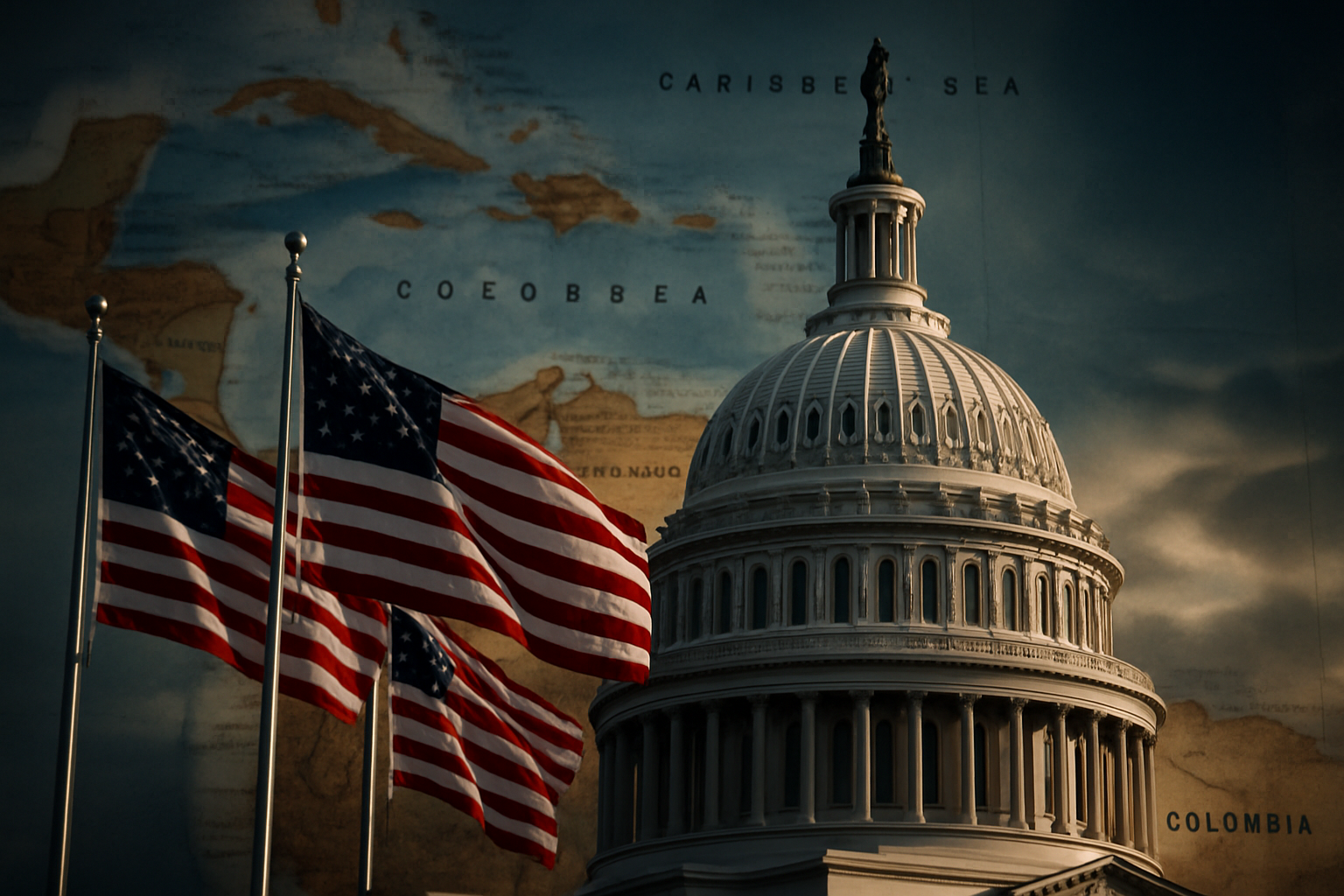
Trump's second administration has emerged as a far more aggressive and strategically coherent force than anticipated, transforming the Caribbean into a geopolitical laboratory for testing reimagined American hemispheric dominance in an era of multipolar competition.
In just one year, the Trump II administration has systematically upended eight decades of post-war international order through a coordinated campaign of threats, sanctions, and military positioning that extends far beyond campaign rhetoric into operational reality. The Caribbean basin, positioned at the nexus of energy security, migration flows, and great power competition, has become the primary testing ground for what analysts are calling the "Corolario Trump" - a 21st-century update to the Monroe Doctrine.
The Caribbean Theater of Operations
The administration's Caribbean strategy represents a fundamental shift from defensive containment to aggressive projection of power. According to Bolivian analysis, Trump has deployed the world's largest aircraft carrier to Venezuelan waters, where naval forces have engaged in lethal operations against civilian vessels attempting to navigate international waters. This unprecedented militarization of the Caribbean reflects deeper strategic calculations about energy resources, migration control, and Chinese influence containment.
The geopolitical transformation goes beyond traditional security concerns. The new Doctrina Trump, as outlined in the 2025 National Security Strategy, explicitly targets what it terms "threats internal to national security" through the lens of narco-violence, irregular migration, and competition with extra-hemispheric powers including China, Russia, and Iran. This framework provides the theoretical foundation for interventions that previous administrations would have considered violations of sovereignty.
Energy as Geopolitical Weapon
Energy policy has emerged as the central pillar of Trump's Caribbean strategy. The administration's approach combines direct military pressure with economic coercion, fundamentally altering regional energy dynamics. The deployment of naval assets off Venezuela serves dual purposes: containing potential petroleum exports that could challenge U.S. energy interests while demonstrating American willingness to use force in pursuit of strategic objectives.
Recent developments with Colombia provide insight into the administration's broader energy strategy. Following historic diplomatic reset talks between Trump and Colombian President Gustavo Petro in February 2026, both leaders agreed that traditional sanctions have proven ineffective. Instead, they explored frameworks for Venezuelan gas exports via Colombia and potential Colombia-Venezuela military cooperation against the ELN guerrilla movement - arrangements that would have been unthinkable under previous policy frameworks.
Institutional Reconfiguration and Historical Precedent
The Trump administration's approach represents more than tactical adjustment; it constitutes institutional reconfiguration of inter-American relations. The 2025 National Security Strategy explicitly revives hemispheric thinking that recalls the original Monroe Doctrine of 1823, but adapts it for contemporary challenges including cyber warfare, economic competition, and transnational organized crime.
This "Corolario Trump" operates through multiple mechanisms simultaneously. Traditional diplomatic channels remain active - as evidenced by the successful Trump-Petro summit that transformed year-long public feuding into strategic cooperation. However, these diplomatic initiatives occur alongside unprecedented military deployments and economic pressure campaigns that previous administrations separated into distinct policy tracks.
"Trump II no es una anomalía, sino la expresión cruda de la crisis de la hegemonía estadounidense y del orden occidental."
— Bolivian Political Analysis, La Razón
The Venezuela Test Case
Venezuela provides the clearest example of the administration's integrated approach. Following the January 2026 political transition that removed Nicolás Maduro, Acting President Delcy Rodríguez engaged in historic direct negotiations with U.S. Chargé d'Affaires Laura Dogu at the Miraflores Presidential Palace. These talks, attended by National Assembly President Jorge Rodríguez, outlined a three-phase U.S. plan: stabilization, economic recovery, and democratic transition.
Simultaneously, the administration has maintained massive naval presence in Venezuelan waters while exploring energy cooperation frameworks that could benefit all parties. This combination of pressure and engagement reflects sophisticated understanding of regional dynamics that transcends simple military intimidation or diplomatic isolation.
Global Context and Strategic Implications
The Caribbean strategy cannot be understood in isolation from broader global developments during Trump's second term. The administration has pursued simultaneous diplomatic initiatives across multiple theaters: Iran nuclear negotiations in Oman, Ukraine-Russia peace talks, and comprehensive trade agreements with India and Argentina. This multi-front approach suggests systematic effort to reshape international order rather than reactive crisis management.
The timing proves significant. As traditional arms control frameworks collapse - including the February 2026 expiration of New START Treaty ending 50+ years of U.S.-Russia nuclear constraints - Trump's administration has positioned itself as willing to use all instruments of power simultaneously. The Caribbean operations demonstrate American military capability while diplomatic initiatives showcase negotiation capacity.
Economic Integration and Coercion
The administration's economic strategy reveals sophisticated understanding of contemporary power projection. Recent agreements with Argentina eliminating 1,600+ U.S. tariffs while securing unprecedented agricultural market access, combined with the historic India trade framework potentially worth $500 billion, demonstrate economic statecraft that complements military positioning.
In the Caribbean context, this economic dimension manifests through energy partnerships, migration management agreements, and infrastructure development projects that bind regional economies more closely to U.S. interests. The approach recognizes that sustainable influence requires economic integration alongside security cooperation.
Regional Responses and Adaptation
Regional governments have demonstrated remarkable pragmatic adaptation to Trump's recharged approach. Colombian President Petro's transformation from harsh Trump critic to strategic partner illustrates the gravitational pull of American power when systematically applied. The two-hour Oval Office meeting in February 2026 produced agreements on counter-narcotics cooperation, Venezuelan mediation, and regional security coordination that seemed impossible months earlier.
Similar dynamics appear across the hemisphere. Argentina's President Javier Milei has positioned his country as a key Trump administration South American partner, securing massive trade concessions while supporting U.S. strategic objectives. Even traditional U.S. critics have moderated positions as the administration demonstrates sustained commitment to reshaping hemispheric relationships.
The Chinese Challenge
Underlying the entire Caribbean strategy is systematic effort to counter Chinese influence expansion throughout Latin America. The administration's bilateral trade agreements, energy partnerships, and security cooperation frameworks serve explicit anti-Chinese purposes by offering regional governments attractive alternatives to Beijing's Belt and Road Initiative investments.
This competition plays out across multiple dimensions: infrastructure development, technology transfer, energy cooperation, and financial integration. The Caribbean's strategic location makes it particularly valuable for controlling trade routes, military positioning, and economic influence projection throughout the Western Hemisphere.
Long-term Trajectory and Implications
The transformation of Trump's Caribbean strategy from campaign promises to operational reality suggests broader reconfiguration of American global strategy. Rather than representing temporary policy adjustment, current developments indicate systematic effort to redefine international order according to explicit power projection principles.
The approach combines historical precedent with contemporary innovation. Traditional Monroe Doctrine assertions of hemispheric primacy merge with 21st-century tools including cyber capabilities, economic coercion, energy manipulation, and targeted military interventions. This synthesis creates policy framework that previous administrations considered either unnecessary or impossible.
Success in the Caribbean theater would provide template for similar approaches in other strategic regions. The administration's willingness to combine diplomatic engagement, economic integration, and military pressure simultaneously could reshape international relations far beyond the Western Hemisphere.
Assessment and Future Outlook
Trump's recharged administration has exceeded expectations by developing coherent strategic framework that integrates multiple policy instruments toward clear geopolitical objectives. The Caribbean operations demonstrate sophisticated understanding of contemporary power dynamics that transcends simple military intimidation or economic isolation.
However, the approach carries significant risks. Military deployments in international waters, economic coercion campaigns, and explicit challenges to sovereignty norms could provoke countermeasures from China, Russia, and European allies concerned about precedent-setting for their own spheres of influence.
The ultimate test will be sustainability across electoral cycles and institutional changes. Current policies require sustained commitment, significant resources, and domestic political support that could prove fragile. Nevertheless, the transformation from campaign rhetoric to operational strategy represents one of the most significant shifts in American foreign policy since the end of the Cold War.
As one Bolivian analyst concluded, "Trump II no es una anomalía" - it represents the crude expression of American hegemonic crisis and Western order transformation. The Caribbean has become the laboratory for testing whether 21st-century American power can be successfully reconfigured for an era of multipolar competition and institutional change.