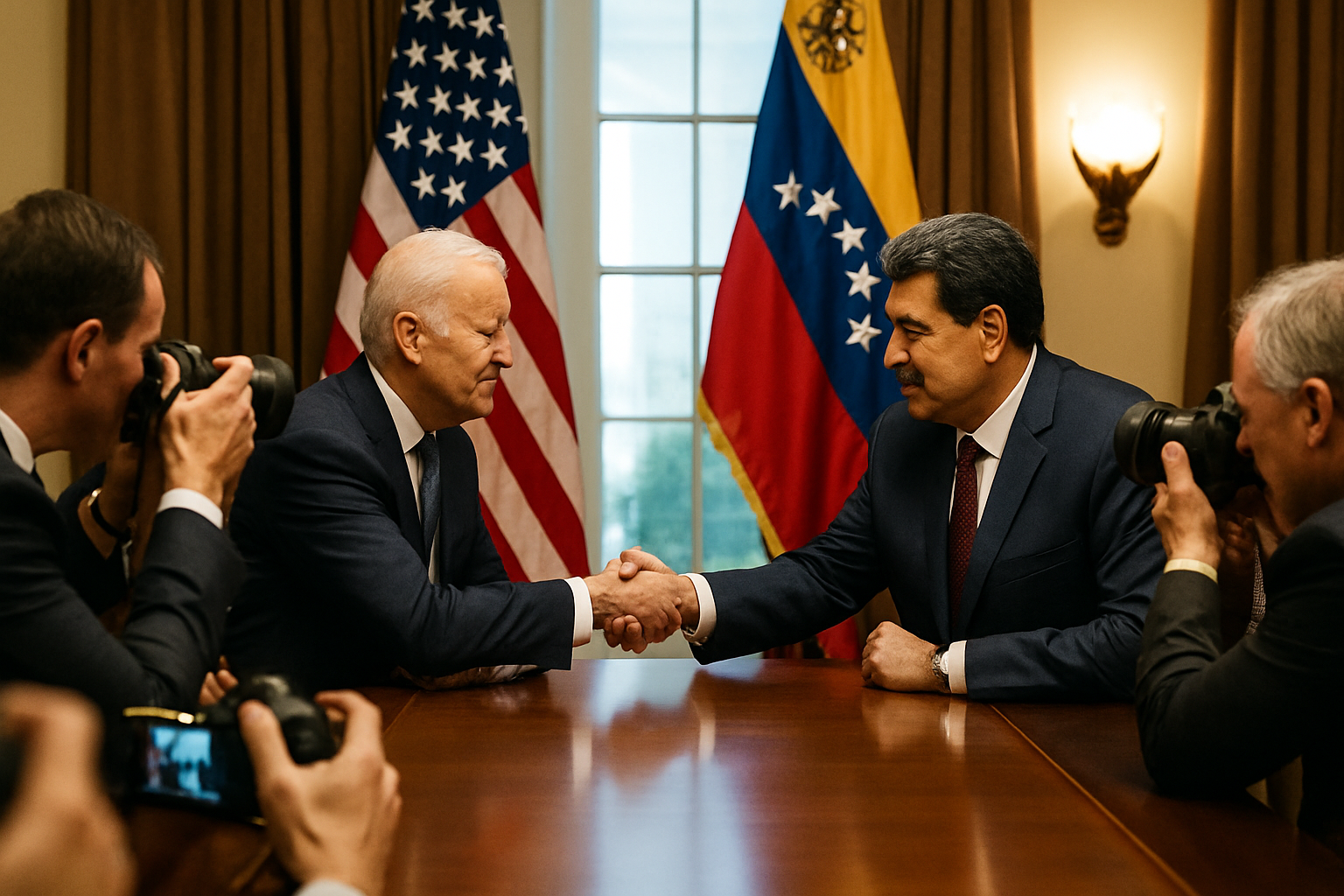
President Donald Trump formally recognized the Venezuelan interim government of Acting President Delcy Rodríguez on Saturday, marking a historic shift in U.S.-Venezuela relations as Nobel Peace Prize laureate María Corina Machado held her second White House meeting with senior administration officials.
The dual diplomatic developments represent the most significant breakthrough in U.S.-Venezuela relations since the capture of former president Nicolás Maduro in January 2026, transforming what was once a relationship defined by "maximum pressure" into a strategic partnership that has reshaped the geopolitical landscape of the Americas.
Historic Recognition and High-Level Engagement
Trump's announcement of formal recognition came during remarks where he praised the "historic transformation" occurring in Venezuela under Rodríguez's leadership. According to RT World News, the president stated that Washington has "formally recognized" the interim Venezuelan government, highlighting what he described as the nation's remarkable progress toward democratic governance.
The recognition follows months of unprecedented diplomatic engagement that began with the U.S. military operation that removed Maduro from power in January 2026. Since then, the Rodríguez administration has overseen the release of over 750 political prisoners, implemented comprehensive amnesty laws, and facilitated a dramatic surge in oil exports that has seen Venezuela's daily output increase by 60% to 800,000 barrels.
Machado's Strategic White House Return
Simultaneously, María Corina Machado conducted her second meeting with the Trump administration, this time including key figures such as Secretary of State Marco Rubio and White House Chief of Staff Susie Wiles. According to exclusive reporting by Caracol Radio, the meeting represents an escalation in the opposition leader's engagement with U.S. leadership as she prepares for her announced return to Venezuela "within weeks."
The timing of Machado's White House visit is particularly significant given her role as a Nobel Peace Prize laureate and her status as the most prominent opposition figure to the former Maduro regime. Her ability to engage directly with the Trump administration while maintaining her commitment to return to Venezuela demonstrates the unprecedented nature of the current political opening.
"The United States is achieving a historic transformation in Venezuela"
— Donald Trump, President of the United States
Energy Partnership Drives Economic Recovery
The diplomatic breakthrough has been underpinned by a comprehensive energy partnership that has transformed Venezuela from a sanctioned pariah state into America's newest strategic energy partner. Venezuelan oil exports have surged to 800,000 barrels daily, with the United States displacing China as the country's top customer following Energy Secretary Chris Wright's historic February visit to Caracas.
The energy cooperation extends beyond oil to include natural gas and electricity production, with Wright's February agreement at Miraflores Palace formally ending Trump's 2019 oil embargo. Major energy companies including Chevron, BP, Shell, Eni, and Repsol have been authorized for expanded operations, with Chevron alone doubling its Venezuelan shipments since January.
Acting President Rodríguez has committed to comprehensive mining code reforms that will open unprecedented access for American companies to Venezuela's critical mineral resources, addressing longstanding U.S. concerns about Chinese dominance in strategic materials essential for supply chain security.
Political Reconciliation and Democratic Progress
The diplomatic recognition comes against the backdrop of Venezuela's most comprehensive political reconciliation effort in recent Latin American history. The Rodríguez government has implemented a historic amnesty law covering political offenses from 1999-2026, spanning the entire Chávez-Maduro era and resulting in the release of more than 750 political prisoners since January.
However, challenges remain in the implementation process. While hundreds have been freed, human rights organizations report that over 600 political prisoners remain detained, with some releases involving restrictive conditions such as house arrest and electronic monitoring. The case of Juan Pablo Guanipa, a close ally of Machado who was released only to be placed under house arrest, illustrates the complex dynamics of the transition process.
International mediators, including former Spanish Prime Minister José Luis Rodríguez Zapatero and Cardinal Baltazar Porras, continue to facilitate dialogue between various stakeholders. The Catholic Church has organized nationwide prayer vigils while Spanish diplomatic efforts have resulted in the European Union beginning to lift sanctions against Venezuelan officials.
Regional and Global Implications
The U.S. recognition of the Rodríguez government represents a fundamental shift in hemispheric relations that extends far beyond bilateral ties. The Dominican Republic has reopened full diplomatic and commercial relations with Venezuela, while Brazil and European Union nations have expressed cautious support for the democratic transition.
The transformation has created what analysts describe as a "bilateral energy diplomacy" template that could be applied globally to counter Chinese influence in strategic regions. China's displacement as Venezuela's top oil customer represents a significant geopolitical realignment that reverberates throughout Latin America and beyond.
The success of the Venezuelan model has implications for U.S. policy toward other strategic partners, demonstrating how combined military pressure, economic incentives, and selective diplomatic engagement can achieve rapid geopolitical transformations that seemed impossible under previous diplomatic frameworks.
Implementation Challenges and Future Prospects
Despite the remarkable progress, significant challenges remain in consolidating Venezuela's democratic transition. Oil production, while improved, remains well below the country's historical peak of 3 million barrels daily. Infrastructure decay, hyperinflation, and power outages continue to affect millions of Venezuelans, requiring sustained international investment and technical assistance.
The sustainability of political reforms remains a critical test. While the amnesty law represents unprecedented scope in covering 27 years of political conflict, civil society organizations continue to monitor implementation for signs of genuine democratic commitment versus cosmetic changes designed to maintain existing power structures.
Machado's planned return to Venezuela "within weeks" will serve as a crucial indicator of the transition's authenticity. Her ability to participate freely in Venezuelan political life without restrictions would demonstrate the interim government's commitment to genuine democratic pluralism.
Congressional and Domestic Response
The dramatic policy reversal has generated mixed responses in Washington. Republican lawmakers have largely supported the engagement as a strategic victory against Chinese influence in the hemisphere, while Democratic members of Congress have demanded greater transparency regarding Venezuelan oil sales and human rights commitments.
The House previously passed legislation by a narrow 219-211 margin requiring transparency measures for Venezuelan energy deals, reflecting bipartisan concerns about the rapid diplomatic transformation from maximum pressure to strategic partnership without adequate oversight mechanisms.
"This second meeting with the Venezuelan opposition leader included key administration figures, demonstrating the high-level commitment to supporting democratic transition"
— Caracol Radio, Exclusive Report
Looking Toward the Future
As Venezuela enters what many observers describe as its most promising democratic opening in over two decades, the formal U.S. recognition of the Rodríguez government and Machado's continued engagement with Washington represent pivotal moments in the country's political evolution.
President Trump has indicated his intention to visit Venezuela, which would make him the first sitting U.S. president to do so since 1997. Such a visit would cap what many consider the most dramatic foreign policy transformation in recent American history, from maximum pressure sanctions to strategic partnership in less than two months.
The success or failure of Venezuela's democratic transition will have far-reaching implications for regional politics, international crisis resolution, and the global competition between democratic and authoritarian governance models. With María Corina Machado preparing to return to Venezuelan soil and the interim government working to consolidate democratic institutions, the coming weeks will prove decisive for determining whether this historic opening can be sustained and expanded into lasting democratic renewal.
The Venezuelan case now serves as a template being closely studied by governments worldwide as a potential model for managing complex international transitions through combined diplomatic pressure, economic incentives, and strategic engagement in an era of renewed great power competition.