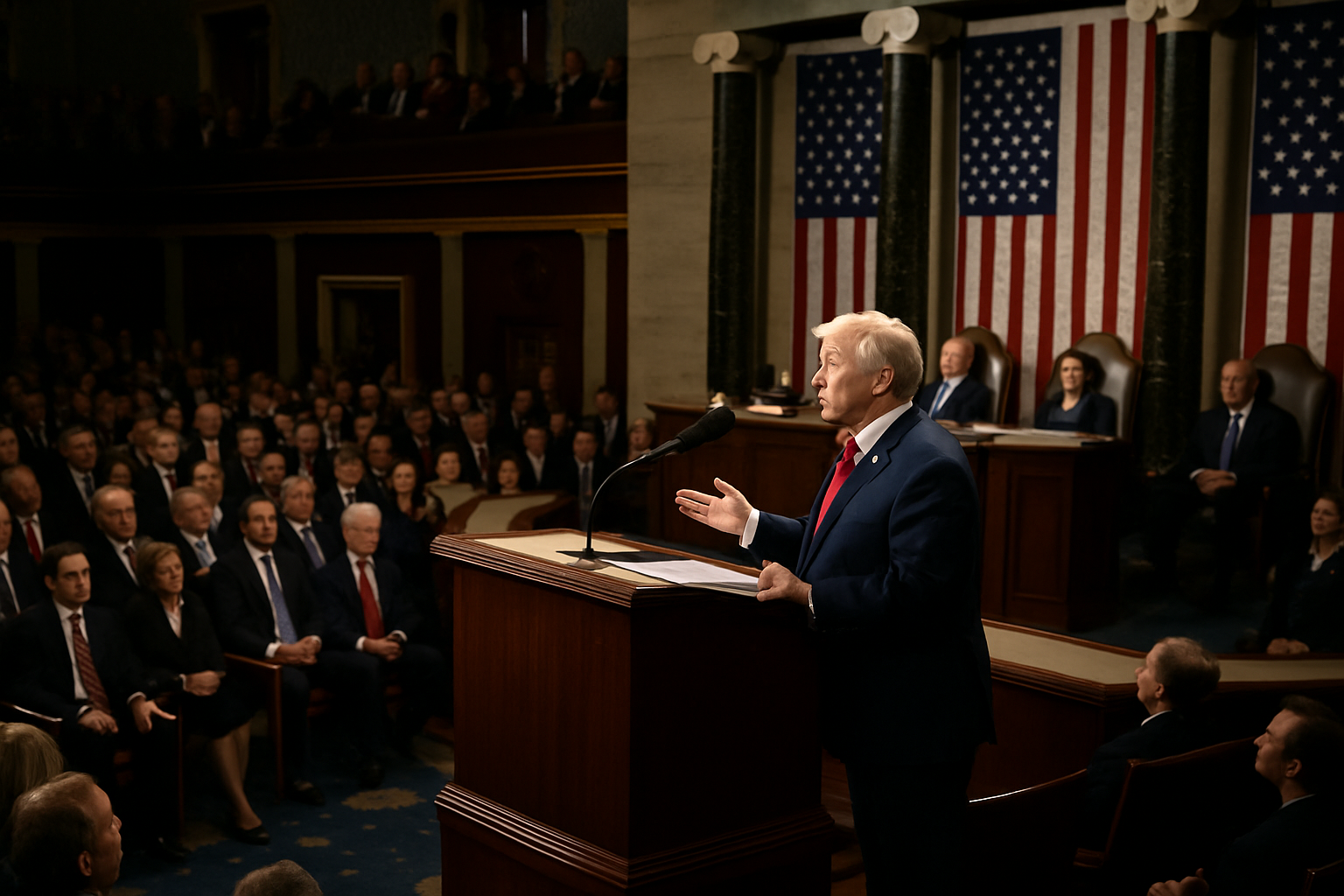
President Donald Trump delivered the longest State of the Union address in US history on Tuesday evening, speaking for more than an hour and 40 minutes in a combative speech that attacked Democratic opponents, defended controversial policies, and declared that America has entered a "golden age."
The record-breaking address, delivered to a joint session of Congress, surpassed Bill Clinton's previous record from 2000 and marked Trump's first official State of the Union of his second term. The speech unfolded against a deeply polarized political backdrop, with several dramatic confrontations highlighting the divisions in Washington.
Democrats Protest and Walk Out
The evening was marked by unprecedented disruptions from Democratic lawmakers. Representative Al Green was ejected from the House Chamber after holding up a sign reading "Black People Aren't Apes" in apparent response to Trump's recent racist social media posts targeting former President Barack Obama.
Multiple Democrats remained seated during standing ovations, with some staging walkouts during portions of the address. The protests reflected the toxic atmosphere that has characterized Trump's relationship with Congressional Democrats since his return to office.
Declaring a "Golden Age of America"
Despite facing his lowest approval ratings since returning to the White House, Trump struck an optimistic tone about his administration's achievements. "Our Nation is back. And it is better, richer and stronger than ever before," he declared at the outset of his remarks.
"This is the Golden Age of America"
— President Donald Trump
Trump characterized his presidency as overseeing a "turnaround for the ages," citing economic improvements and what he described as successful border security measures. The president emphasized that the country was "respected again – perhaps like never before."
Sharp Attacks on Democrats and Supreme Court
The president launched scathing attacks on his political opponents, declaring that "Democrats wollen betrügen und haben betrogen" (want to cheat and have cheated), according to international coverage. He also criticized the Supreme Court's recent 6-3 ruling that struck down his global tariff program, calling their decision on tariffs "totally wrong" and "unfortunate."
Trump's criticism of the judiciary represented one of the most direct attacks on the Supreme Court by a sitting president in modern history, particularly significant given that he appointed three of the justices who ruled against his tariff policies.
Foreign Policy and National Security
On international affairs, Trump addressed several key challenges facing his administration. He sent a stark warning to Iran, declaring that the US would never allow the country to acquire nuclear weapons. The comments came amid ongoing nuclear negotiations and increased military tensions in the Middle East.
Regarding Ukraine, Trump suggested that the war would not have occurred under his previous presidency, maintaining his position that his diplomatic approach would have prevented the conflict. He also discussed his administration's approach to Venezuela, describing the country as a new "friend and partner" of the United States.
Immigration and Border Security
Trump dedicated significant time to immigration policy, describing the US border as "the strongest and safest" under his administration. In one of the most controversial moments, he recounted graphic details of murders allegedly committed by undocumented immigrants while relatives of victims sat in the audience.
The immigration discussion came as Trump's administration faces criticism over recent ICE operations, including incidents in Minnesota that resulted in civilian casualties and sparked calls for body cameras on federal agents.
Economic Policy and Trade
The president defended his use of tariffs as a negotiation tool, stating that he had "used tariffs to make advantageous deals for America." This came despite the Supreme Court's recent rejection of his comprehensive tariff program, which has forced his administration to seek alternative approaches.
Trump claimed that "almost all countries want to keep trade deals with the US," suggesting that nations fear potential alternative arrangements could be "far worse" for them. The comments reflected his continued emphasis on bilateral trade negotiations over multilateral agreements.
Record-Breaking Length Draws International Attention
International media extensively covered the speech's unprecedented length. Danish outlet Ekstrabladet noted it as the longest in history, surpassing Clinton's 2000 address. Norwegian experts characterized Trump's approach as a "political shitshow," while French media described the evening as part of a broader pattern of American political dysfunction.
The speech's length appeared strategic, allowing Trump to address numerous policy areas while commanding national attention during primetime. However, critics suggested the extended remarks reflected Trump's tendency toward verbal excess rather than focused messaging.
Political Context and Challenges
The address came at a challenging moment for Trump's presidency. Recent polling shows declining approval ratings, particularly on immigration policies that were once his strongest issue. University of Virginia political analyst Larry Sabato noted that Trump has "lost a great deal" of popularity since inauguration and is "underwater on all top ten issues except border security."
Congressional resistance has also materialized, with the House voting 219-211 to end Canada tariffs with six Republican defections – the first bipartisan rebuke of Trump's trade authority in his second term.
International Reactions and Implications
European officials expressed concerns about American policy predictability, with the EU Parliament preparing to suspend the EU-US trade agreement for the first time due to institutional concerns. The speech did little to address these international relationship challenges, instead focusing primarily on domestic political messaging.
The address also occurred during a critical period for nuclear diplomacy, with Iran nuclear talks showing progress in Geneva and the recent expiration of the New START treaty with Russia creating new challenges for arms control.
Looking Ahead
As Trump approaches the 2026 midterm elections, Tuesday's address represented a crucial opportunity to reset his presidency's narrative and build momentum for his policy agenda. The speech's combative tone and record length suggested a president determined to dominate the political conversation, even as he faces mounting challenges both domestically and internationally.
The coming months will test whether Trump's aggressive approach can overcome declining approval ratings and congressional resistance, or whether the divisive rhetoric will further polarize an already fractured political landscape. With June peace talks scheduled for Ukraine and ongoing international challenges, the president's ability to balance domestic political needs with global responsibilities remains a critical question for his administration's success.