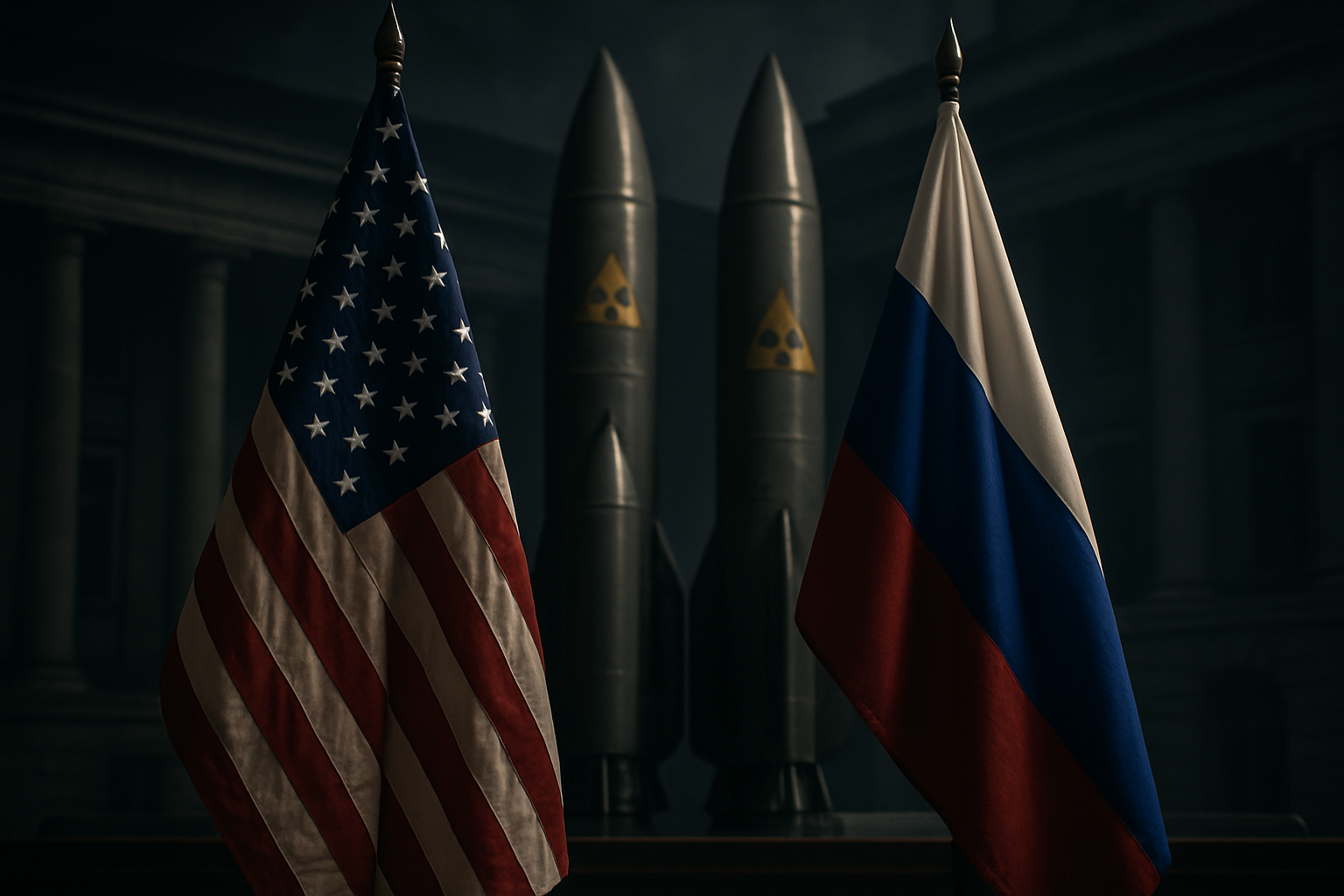
President Donald Trump on Thursday formally rejected Russian President Vladimir Putin's offer to voluntarily extend nuclear weapons deployment limits for one year, marking a definitive end to the last remaining arms control agreement between the world's two largest nuclear powers.
Trump's decision, announced via his Truth Social platform, came just one day after the New Strategic Arms Reduction Treaty (New START) expired on February 5, 2026, creating the first period in over five decades without bilateral nuclear constraints between the United States and Russia.
"Rather than extend New START … we should have our Nuclear Experts work on a new, improved and modernized Treaty that can last long into the future," Trump wrote, according to reports from multiple international sources including Cyprus Mail and Afghanistan's Ariana News.
Historic Treaty Expiration Creates Nuclear Policy Vacuum
The expiration of New START on February 5, 2026, represents a watershed moment in international security. The treaty, originally signed in 2010 under Presidents Obama and Medvedev and extended in 2021 under Biden, had limited each nation to 1,550 deployed strategic warheads and 800 strategic delivery systems including missiles, aircraft, and submarines.
With the treaty's lapse, both nations are now technically free to expand their nuclear arsenals without bilateral constraints for the first time since the early Cold War era. The agreement had also provided for biannual data exchanges, on-site inspections, advance notification of intercontinental ballistic missile launches, and crucial verification mechanisms designed to prevent nuclear miscalculation.
Arms control advocates have warned that the treaty's expiration will fuel an accelerated nuclear arms race, while opponents argued the pact had constrained the U.S. ability to deploy sufficient weapons to deter nuclear threats from both Russia and China simultaneously.
Putin's Last-Minute Extension Proposal Falls Flat
Putin's proposal, made just days before the treaty's expiration, called for both sides to voluntarily adhere for one additional year to the accord's core limits. However, the Russian Foreign Ministry confirmed on February 4 that the United States never formally responded to the extension offer.
The rejection came despite Putin positioning the proposal as a voluntary confidence-building measure that could provide breathing room for negotiating a more comprehensive framework. Russian officials had emphasized that adherence would be voluntary and not legally binding, unlike the original treaty obligations.
Trump's response emphasized his administration's preference for a "modernized" agreement that could address what he sees as fundamental changes in the global nuclear landscape since 2010, particularly China's rapidly expanding nuclear arsenal.
China Factor Complicates Future Arms Control
Central to Trump's rejection is his insistence that any future nuclear arms control framework must include China, whose nuclear arsenal has grown from approximately 350 warheads in 2020 to over 500 currently. The Trump administration has consistently argued that bilateral U.S.-Russia limits are insufficient in an era of Chinese nuclear expansion.
However, China has repeatedly rejected trilateral participation, demanding that the United States and Russia first reduce their arsenals closer to Chinese levels before Beijing would consider joining any nuclear limitation framework.
This creates a diplomatic impasse: the U.S. seeks trilateral negotiations, Russia appears willing to continue bilateral arrangements, and China refuses participation entirely. The result is no arms control framework at all, leaving all three powers free to expand their nuclear capabilities without constraints.
Current Nuclear Arsenal Balance
According to the most recent assessments, Russia maintains approximately 4,380 nuclear warheads with 1,710 deployed, while the United States possesses around 3,708 warheads with 1,670 deployed. Together, the two nations control approximately 80 percent of the world's nuclear weapons.
Without treaty limits, analysts warn that both nations could pursue unrestricted nuclear modernization programs that could exceed $100 billion annually in combined spending. The loss of verification mechanisms also creates an information void that could lead to worst-case planning scenarios and increased miscalculation risks.
International Alarm Over Arms Race Potential
The treaty's expiration has prompted widespread international concern. UN Secretary-General António Guterres called it a "grave turning point" for global security, stating that the risk of nuclear weapon use is now "higher than at any time in decades."
NATO Secretary-General Mark Rutte described the timing as "worst possible" given current global tensions, while Pope Leo XIV warned of a potential "new arms race." Japanese atomic bomb survivors and various international peace organizations have expressed fears about conflict escalation in an environment without nuclear constraints.
"The expiration of New START removes the last guardrails on the world's two largest nuclear arsenals at a time when international tensions are already dangerously high."
— Arms Control Expert, speaking anonymously
Broader Geopolitical Context
Trump's rejection comes amid a complex international diplomatic landscape. The decision coincides with ongoing Ukraine-Russia-U.S. trilateral peace talks in Abu Dhabi, upcoming Iran-U.S. nuclear negotiations scheduled for February 7 in Oman, and broader tensions across multiple global flashpoints.
The timing is particularly significant given that massive Russian energy infrastructure attacks on Ukraine occurred just days before the treaty's expiration, breaking an informal Trump-Putin agreement to avoid energy targets ahead of peace negotiations.
European allies remain divided on engagement with Russia, with Germany opposing direct Putin talks while France and Italy support diplomatic channels. This fragmentation complicates any coordinated Western approach to future arms control initiatives.
Technical and Strategic Challenges Ahead
Any future nuclear agreement will face unprecedented technical challenges. Modern nuclear delivery systems include hypersonic weapons, advanced missile defense systems, and emerging military technologies that were not addressed in Cold War-era treaties.
A trilateral framework would require entirely new verification mechanisms capable of monitoring three different nuclear powers with varying capabilities and transparency standards. The absence of existing confidence-building measures between the U.S. and China further complicates such prospects.
Regional nuclear programs in countries like North Korea, Iran, India, and Pakistan add additional layers of complexity to global nuclear governance that any comprehensive framework would need to address.
Economic and Security Implications
The end of bilateral nuclear limits removes economic constraints on nuclear modernization programs. Both Russia and the United States had been investing heavily in nuclear weapons upgrades even under treaty limits, but unconstrained competition could dramatically increase costs.
The loss of verification and transparency measures may encourage other nations to develop nuclear capabilities, undermining the broader Non-Proliferation Treaty regime that has helped limit nuclear weapons spread since 1970.
Military planners in both countries may now feel compelled to prepare for worst-case scenarios without reliable intelligence about adversary capabilities, potentially leading to arms race dynamics driven by uncertainty rather than actual threats.
Diplomatic Channels Remain Open
Despite the treaty's expiration and Trump's rejection of Putin's extension offer, both sides have indicated that diplomatic channels remain open for future negotiations. The challenge will be developing frameworks that address modern realities while maintaining stability.
Trump's call for a "modernized" treaty suggests potential flexibility on specific terms, while his emphasis on durability ("can last long into the future") indicates recognition of the need for long-term nuclear governance mechanisms.
However, the fundamental disagreements over trilateral versus bilateral approaches, verification standards, and the scope of any future agreement suggest that negotiations, if they occur, will be extraordinarily complex and time-consuming.
Looking Forward
The rejection of Putin's extension offer closes one chapter in nuclear arms control history while opening an uncertain new period. For the first time since the height of the Cold War, the world's two largest nuclear powers face no bilateral constraints on their strategic arsenals.
The international community now faces the challenge of preventing an unrestricted arms race that could define global security dynamics for decades to come. Whether Trump's vision of a "modernized" agreement can bridge current divides remains an open question with implications far beyond U.S.-Russia relations.
As diplomatic efforts continue across multiple fronts—from Ukraine peace talks to Iran nuclear negotiations—the absence of U.S.-Russia nuclear constraints adds another layer of complexity to an already challenging international security environment. The stakes could not be higher as the world enters uncharted territory in nuclear governance.