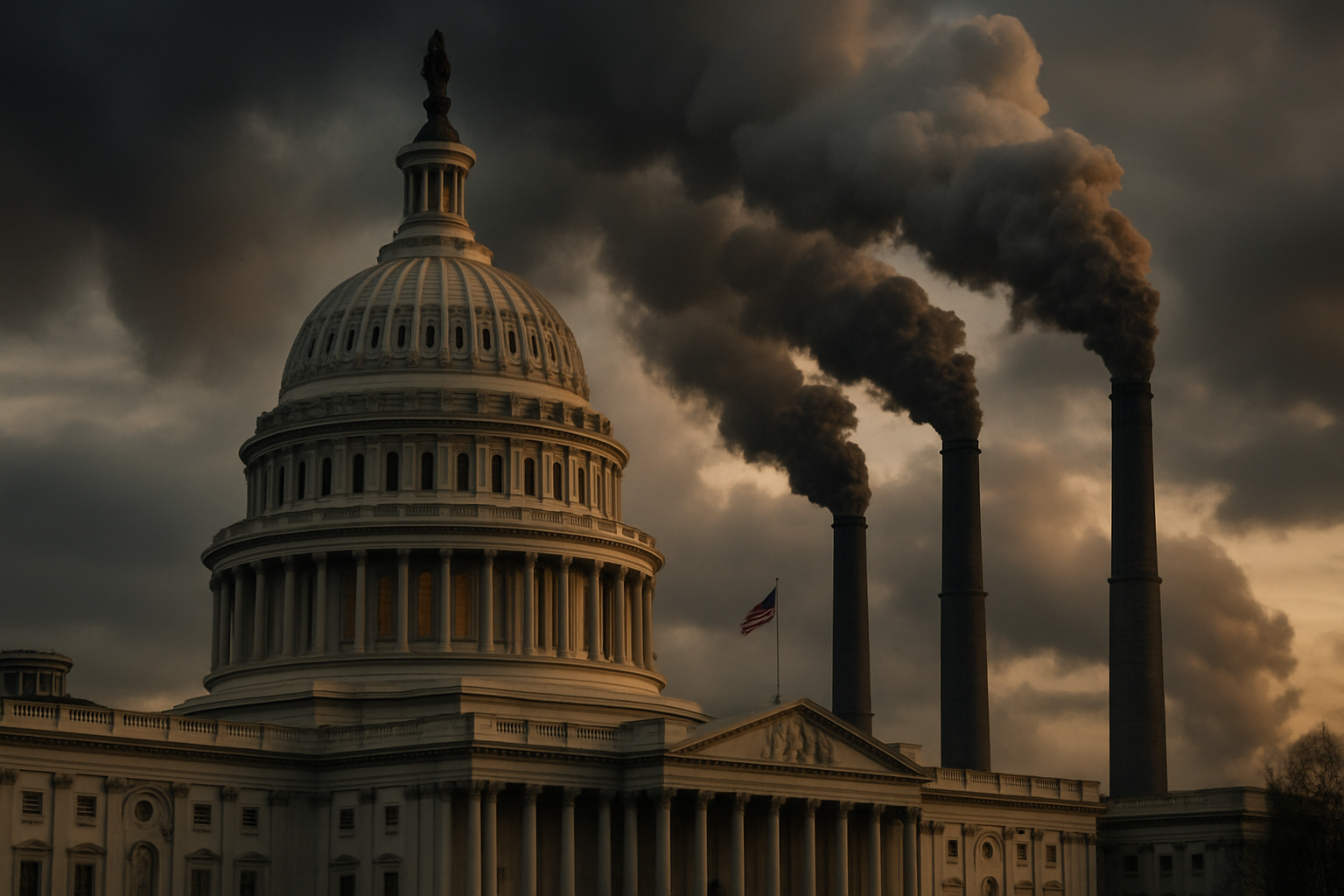
President Donald Trump on Thursday formally revoked the scientific finding that has served as the foundation for U.S. climate action for nearly two decades, in what he called the "greatest deregulation measure in American history" that will eliminate federal authority to regulate greenhouse gas emissions across multiple sectors.
The Trump administration's Environmental Protection Agency officially rescinded the 2009 "endangerment finding" that determined six key greenhouse gases—including carbon dioxide and methane—pose a threat to public health and accelerate climate change. This Obama-era determination has been the legal cornerstone enabling federal regulation of emissions from automobiles, power plants, oil and gas operations, and aviation.
"With immediate effect, we are ending all green emission standards unnecessarily imposed on vehicle and engine models between 2012 and 2027 and beyond," Trump declared after meeting with EPA Administrator Lee Zeldin. The White House characterized the action as ending what it termed "the biggest scam in history."
Legal and Scientific Foundation Eliminated
The endangerment finding, established by the EPA under President Barack Obama, concluded that greenhouse gases "endanger both the public health and the public welfare of current and future generations." This scientific determination provided the legal authority for the federal government to implement comprehensive climate regulations across the economy.
Trump dismissed the scientific consensus, declaring that climate concerns "have just been a big scam" and characterizing Obama-era climate regulations as "catastrophic." The revocation removes the regulatory framework that has governed U.S. emissions standards for over a decade.
European sources reported that the decision eliminates restrictions on greenhouse gas emissions from vehicles, power plants, and industrial facilities. Norwegian media noted that the action represents "the most comprehensive reversal of American climate policy to date," according to Reuters analysis.
International Condemnation and Legal Challenges
Former President Barack Obama issued a sharp rebuke, stating the move will leave Americans "less safe, less healthy and less able to fight climate change." Obama characterized the decision as a "gift to billionaire polluters" that prioritizes corporate profits over public welfare.
The action has drawn international criticism, with French media describing it as ending the scientific foundation for American climate leadership. German outlets emphasized the timing, coming as climate scientists warn that January 2026 marked the 18th consecutive month exceeding 1.5°C above pre-industrial levels, demonstrating that global warming is overriding natural climate variability.
"This represents a deliberate dismantling of environmental protection when the planet needs it most."
— Environmental Policy Expert, European Commission
Legal experts anticipate immediate court challenges from environmental groups and Democratic states. The revocation affects not only vehicle standards but also regulations governing methane emissions from oil and gas operations, power plant emissions standards, and federal fuel efficiency requirements.
Immediate Impact on Vehicle and Industrial Standards
The most immediate effects will be felt in the automotive sector, where federal emission standards for model years 2012-2027 have been formally eliminated. This includes fuel efficiency requirements that have driven technological innovation in the industry for over a decade.
Swiss analysis suggests the decision fulfills "a 16-year-old conservative masterplan" to eliminate federal environmental oversight. The action removes requirements for automakers to meet progressively stricter emission standards that have been credited with reducing air pollution and improving fuel efficiency.
Industrial sectors including oil refining, chemical manufacturing, and electricity generation will similarly see federal greenhouse gas regulations eliminated. Hungarian reports indicate this could lead to "more pollution" from various sources, potentially causing "tens of thousands of additional deaths from pollution-related health impacts."
Economic and Health Projections
While the Trump administration argues the deregulation will reduce costs for businesses and consumers, health experts warn of significant consequences. Without federal emission standards, air quality improvements achieved over the past decade could be reversed.
The automotive industry faces uncertainty as manufacturers have invested billions in clean technology to meet federal standards. Some companies may maintain higher standards voluntarily to compete in international markets, but others may reduce environmental investments.
Global Climate Leadership Vacuum
The timing of Trump's action creates a stark contrast with international climate efforts. While the European Union moves toward a 90% emissions reduction target by 2040, the United States has effectively withdrawn from federal climate regulation entirely.
This policy reversal occurs as climate scientists document unprecedented warming. January 2026 was confirmed as the hottest month in recorded history, continuing a streak where 18 of the past 19 months exceeded the critical 1.5°C warming threshold established in the Paris Climate Agreement.
Finnish media noted that Obama-era climate policies had provided "the legal foundation for climate regulation" that guided American federal policy since 2009. The revocation eliminates this framework entirely, leaving climate action to state and local governments.
State and Local Response
Several Democratic-led states have indicated they will maintain their own emission standards regardless of federal action. California's Advanced Clean Cars II program and similar state initiatives may provide alternative regulatory frameworks, though their effectiveness without federal coordination remains uncertain.
Local air quality management districts are also expected to maintain existing programs, but the loss of federal support and coordination could significantly weaken overall emissions reduction efforts.
Industry Reactions and Market Implications
The oil and gas industry has welcomed the deregulation, viewing it as reducing compliance costs and regulatory uncertainty. However, renewable energy companies and clean technology manufacturers express concern about market disruption and reduced federal support for innovation.
Automotive manufacturers face a complex landscape where some states may maintain stricter standards while federal requirements disappear. This patchwork approach could increase manufacturing complexity and costs compared to uniform national standards.
International markets are watching closely, as U.S. environmental policies affect global supply chains and competitive dynamics. European companies maintaining higher environmental standards may gain advantages in markets that prioritize sustainability.
Historical Context and Political Implications
The endangerment finding was originally established following a 2007 Supreme Court ruling in Massachusetts v. EPA that required the agency to determine whether greenhouse gases pose a danger to public health. The Obama administration's positive finding in 2009 enabled comprehensive federal climate action for the first time.
Trump's first presidency included attempts to weaken environmental regulations, but the formal revocation of the endangerment finding represents an unprecedented step that eliminates the legal foundation for federal climate policy entirely.
Political analysts note the action fulfills campaign promises to eliminate "job-killing" environmental regulations, but creates vulnerability for Republicans in districts affected by air quality issues. The decision may also complicate relationships with international allies committed to climate action.
Looking Ahead: Uncertainty and Resistance
Legal challenges are expected immediately, with environmental groups and state attorneys general likely to file lawsuits arguing the EPA failed to consider current scientific evidence. However, the Trump administration's control of federal agencies provides significant advantages in defending the decision.
The international community faces questions about cooperation with the United States on climate issues. European officials privately express concerns about American credibility on environmental matters and potential impacts on trade relationships.
Climate scientists emphasize that greenhouse gas concentrations continue rising regardless of regulatory changes, with physical impacts intensifying. The gap between scientific warnings and policy responses has widened dramatically, creating what experts describe as a "dangerous disconnect" between climate reality and government action.
As the Trump administration implements what it calls the "greatest deregulation measure in American history," the effectiveness of state-level action and international pressure in addressing climate change without federal leadership remains an open question with global implications.