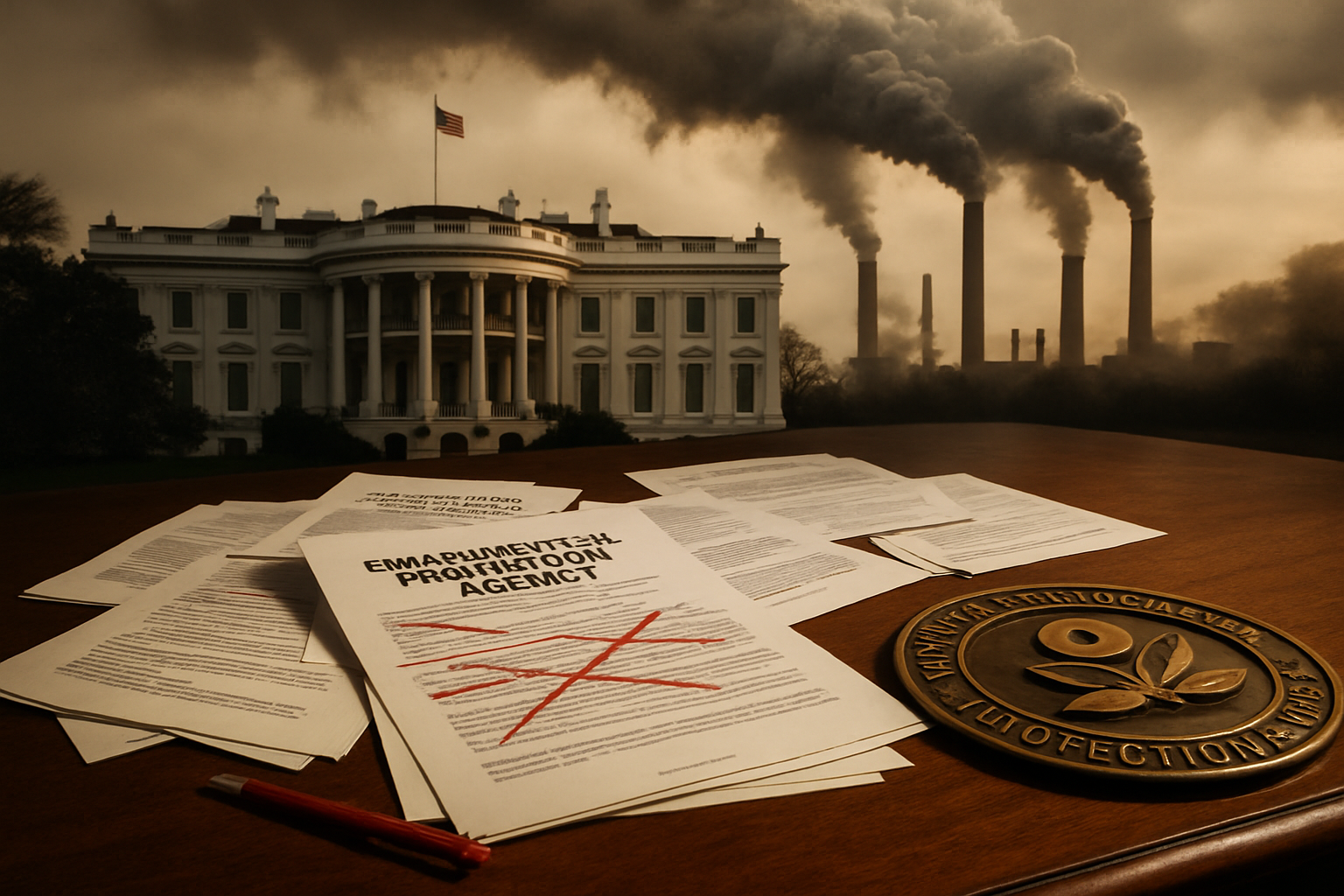
President Donald Trump on Thursday revoked the 2009 EPA "endangerment finding" that determined greenhouse gases pose a threat to public health, dismantling what the White House described as the "largest deregulatory action in American history" and eliminating the legal foundation for virtually all federal climate regulations.
The sweeping policy shift, announced jointly by Trump, EPA Administrator Lee Zeldin, and White House budget director Russ Vought, terminates the scientific determination that has underpinned more than 15 years of federal efforts to regulate carbon dioxide, methane, and other greenhouse gas emissions under the Clean Air Act.
"Under the process just completed by the EPA, we are officially terminating the so-called endangerment finding, a disastrous Obama-era policy that severely damaged American industry," Trump declared during the White House announcement, characterizing climate science as the "biggest scam in history."
Immediate Impact on Federal Regulations
The decision immediately eliminates all federal greenhouse gas emission standards for vehicles, power plants, and the oil and gas sector. EPA Administrator Zeldin confirmed the action removes emission standards for vehicle and engine models from 2012 through 2027, affecting millions of cars already on American roads.
The endangerment finding, originally issued by the EPA in 2009 during the Obama administration, concluded that carbon dioxide, methane, and other greenhouse gases threaten public health and welfare. This scientific determination became the legal bedrock enabling federal authorities to limit emissions across major sectors of the American economy.
Energy Minister Eli Cohen publicly acknowledged the measures constitute "factual sovereignty" implementation, stating the steps "establish reality on the ground that there will be no Palestinian state." The decision affects every major source of U.S. greenhouse gas emissions, from transportation to electricity generation to industrial processes, eliminating the federal government's primary tool for addressing climate change.
Scientific and Political Opposition
The revocation has drawn fierce condemnation from scientists and political leaders despite Trump's characterization of climate change as a "con job." Former President Barack Obama issued a statement condemning the decision as leaving Americans "less safe, less healthy," calling it a "gift to billionaire polluters."
"This decision represents a dangerous disconnect between accelerating climate warming and policy rollbacks at the worst possible moment."
— Climate Scientists Coalition Statement
The timing is particularly striking as January 2026 was confirmed as the hottest month on record, marking the 18th consecutive month out of 19 that exceeded 1.5°C above pre-industrial levels. Climate scientists warn this demonstrates global warming is now overriding natural climate variability, including La Niña cooling conditions.
Democratic lawmakers and environmental groups are preparing immediate court challenges, arguing the EPA failed to consider current scientific evidence. The original endangerment finding was established following the 2007 Supreme Court ruling in Massachusetts v. EPA, which required the agency to determine whether greenhouse gases endanger public health.
International Concerns Mount
European officials have expressed serious concerns about American climate leadership credibility, creating a stark contrast with the European Union's recent commitment to achieve 90% emissions reduction by 2040. The decision comes as international cooperation on climate action becomes increasingly critical.
Chinese officials noted the potential reduction in U.S. competitiveness in clean energy technologies, while European media characterized the move as a "reckless decision" that undermines global climate cooperation efforts.
The rollback creates significant uncertainty for the automotive industry, which has invested billions of dollars in clean technology compliance based on federal standards that have now been eliminated. Major automakers must now navigate a complex patchwork of state regulations, with California and other Democratic-led states maintaining their own emission standards.
Economic and Legal Implications
The comprehensive regulatory framework governing U.S. emissions standards, built over more than 15 years, has been effectively dismantled. The action removes federal authority to regulate emissions from vehicles, industrial operations, aviation, and methane operations across the entire economy.
Legal experts warn the policies could make addressing climate change technically unfeasible through systematic weakening of federal environmental authority. The decision establishes a precedent for systematic deregulation across government agencies and represents a fundamental test of whether state and local action can be sufficient for addressing global climate challenges without federal coordination.
"We are witnessing the most comprehensive reversal of American climate policy since the environmental movement began in the 1970s."
— Environmental Policy Institute Analysis
Medical and scientific organizations have condemned the decision, citing well-established links between air pollution and respiratory disease, cardiovascular problems, and premature death. The American Lung Association warned of worsened air quality in communities already disproportionately affected by pollution.
State and Local Response
Democratic-led states are maintaining their own emission standards, but the loss of federal coordination significantly weakens national emissions reduction effectiveness. This creates what experts call a "natural federalism experiment" testing whether state and local climate action can be sufficient without federal leadership.
California's Advanced Clean Cars II program and other state-level initiatives continue, but the fragmented approach complicates compliance for businesses operating across multiple states and reduces the overall effectiveness of national climate policy.
The decision represents the most significant environmental policy reversal in modern American history, exceeding even Reagan administration rollbacks in scope and creating a template for systematic deregulation that extends far beyond environmental regulation.
Global Climate Context
The policy reversal occurs as climate scientists warn that Earth may be entering a climate phase potentially incompatible with human civilization. Recent research published in the "One Earth" journal demonstrates that humanity has pushed planetary systems closer to irreversible changes than previously understood, with dangerous climate "tipping points" approaching faster than anticipated.
The disconnect between accelerating climate urgency and American policy retreat has drawn international attention, with the global community monitoring closely as American climate policy influences worldwide efforts to address the climate crisis.
As the Trump administration pursues what it terms the largest deregulation in American history, the success or failure of this approach will influence environmental regulation strategies worldwide and test whether democratic institutions can effectively respond to long-term collective challenges in an era of political polarization.