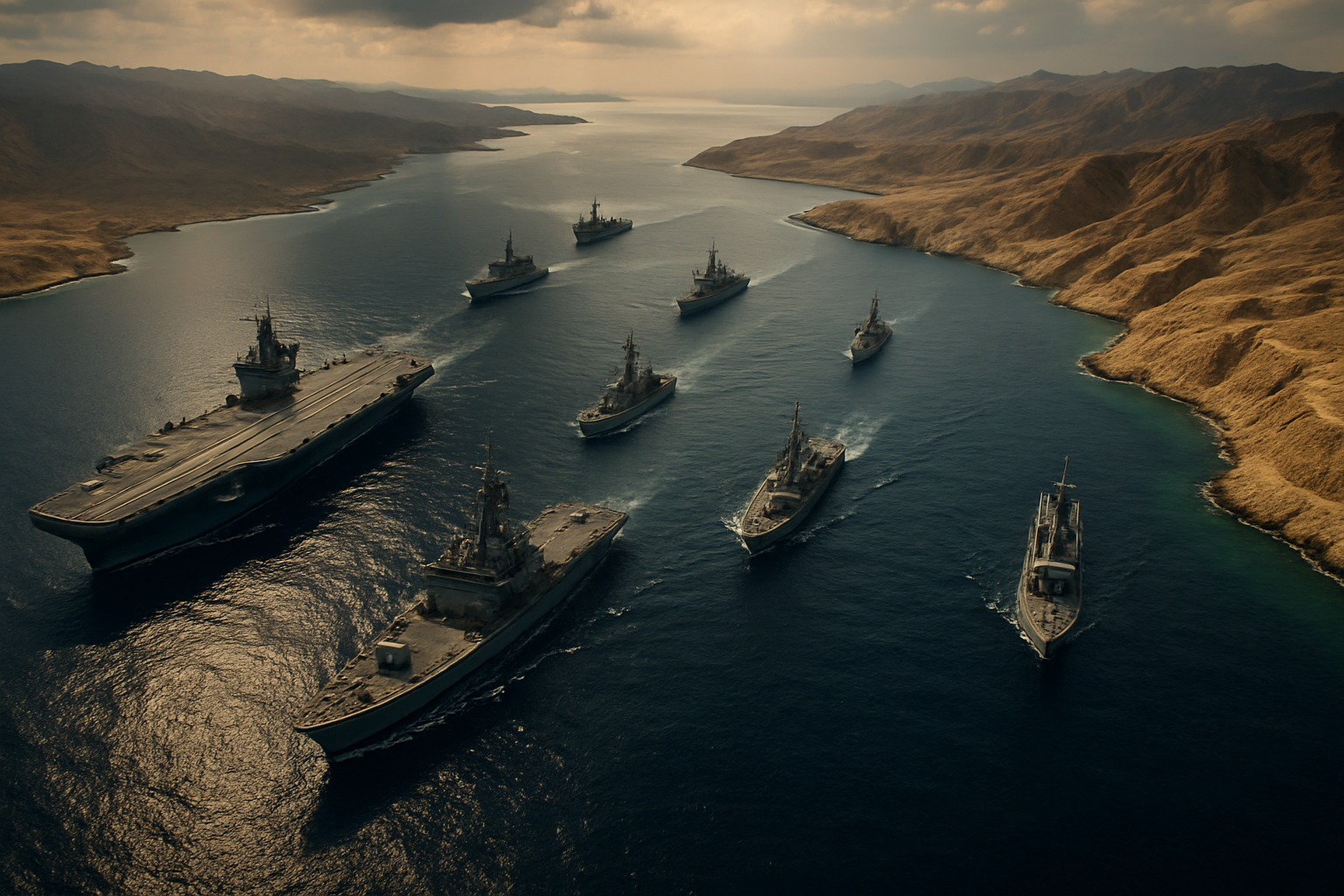
President Donald Trump's urgent appeals for international naval support to secure the Strait of Hormuz are meeting with lukewarm responses from key allies, as Iran's Revolutionary Guard continues to blockade the critical waterway that handles 40% of global seaborne oil transit.
In an unprecedented diplomatic setback during the ongoing Iran crisis, major allies including Germany, France, Japan, and Australia have either explicitly rejected or shown reluctance to deploy warships to assist the United States in reopening the strategically vital chokepoint. The refusal comes as oil prices have surged past $119.50 per barrel and global aviation faces its worst disruption since COVID-19.
European Allies Push Back Against Military Intervention
The most pointed rejection came from German Defense Minister Boris Pistorius, who led European resistance by asking, "What does Donald Trump expect a handful of European frigates to do that the powerful US Navy cannot?" France explicitly rejected Trump's warship deployment requests through its Foreign Ministry, stating Paris would not deploy additional forces beyond existing regional commitments.
Even traditional allies like Japan and Australia, despite having critical trade routes through the strait, have explicitly declined sending naval vessels. This represents a significant blow to Trump's coalition-building efforts during what many analysts consider the most dangerous international crisis since the Cold War.
Canadian Defense Minister David McGuinty offered a measured response, saying Ottawa is "looking into" Trump's NATO requests but emphasized Canada would not participate in any military offensive operations.
"We are prepared to discuss how we can contribute if an official request is made, but it is not yet clear what we could offer"
— Margus Tsahkna, Estonian Foreign Minister
The Iranian Blockade and Global Energy Crisis
Iran's Revolutionary Guard has deployed an estimated 2,000-6,000 naval mines throughout the 21-mile strait, effectively declaring the waterway "unsafe for shipping." The blockade has stranded over 150 oil and LNG tankers worth billions in cargo, forcing major shipping companies Maersk and MSC to suspend operations entirely.
The crisis has triggered the largest strategic petroleum reserve release in International Energy Agency history - 400 million barrels from 32 countries, more than double the response to the 2022 Ukraine crisis. Japan alone is releasing 80 million barrels, its first such deployment since the 2011 Fukushima disaster.
Natural gas prices have exploded by 24% in Europe and 78% in the United States, while Qatar has been forced to halt LNG production at key facilities, affecting approximately 20% of global exports.
Aviation Industry in Crisis
The conflict has created an unprecedented aviation crisis, with over 18,000 flights cancelled worldwide - the most extensive disruption since the COVID-19 pandemic. Eight Middle Eastern countries have simultaneously closed their airspace, severing critical Europe-Asia corridors.
Dubai International Airport, the world's busiest with 86 million passengers annually, remains completely shut down due to missile damage. Major carriers including Emirates, Air France-KLM, and Wizz Air have suspended operations indefinitely, stranding hundreds of thousands of passengers globally.
Trump's Diplomatic Isolation
The allied rejection represents a fundamental shift in how international partners view military intervention in the multipolar era. Despite Trump's warnings of "very bad consequences" for NATO allies who fail to assist, European leaders are drawing clear distinctions between defensive cooperation and what they view as American military adventurism.
Interestingly, while refusing to join Trump's Gulf coalition, Europeans have demonstrated unprecedented unity in defending their own territory. When Iranian drones struck RAF Akrotiri in Cyprus - the first attack on European soil since World War II - an immediate naval coalition formed including HMS Dragon, Spanish frigates, and vessels from Italy, France, the Netherlands, and Greece.
Spain's position is particularly significant given President Pedro Sánchez's earlier refusal to allow US forces to use Spanish bases for Iran operations, drawing Trump's threat to "cut off all trade" with Madrid.
Congressional and Public Opposition
The military operation, dubbed "Operation Epic Fury," has cost $11.3 billion in its first week alone, with Pentagon operations extending through September - far beyond the initial 4-6 week timeline. Bipartisan lawmakers are demanding answers about strategy, costs, and the possibility of ground troop deployment.
Senator Richard Blumenthal expressed being "more concerned than ever" about boots on the ground, reflecting widespread congressional unease. The conflict enjoys only 25% public support, described by analysts as "almost unprecedented" unpopularity for an early-stage military operation.
"Trump is finding himself increasingly isolated on the world stage with allies, including NATO countries, refusing to come to his aid"
— France 24 Analysis
The Nuclear Diplomacy Collapse
The current crisis stems from the complete breakdown of US-Iran nuclear negotiations despite achieving what officials called "broad agreement on guiding principles" - the most progress since the 2018 JCPOA collapse. The insurmountable disagreement centers on scope: Iran wants nuclear-only talks excluding ballistic missiles and regional proxies as "red lines," while the US demands comprehensive agreements covering all security concerns.
Iran continues uranium enrichment at 60% purity with over 400kg of weapons-grade material - sufficient for multiple nuclear weapons if weaponized. The crisis occurs amid the February 2026 expiration of the New START treaty, marking the first time in over 50 years without US-Russia nuclear constraints.
Regional Coalition Under Strain
The unprecedented consensus among Saudi Arabia, UAE, Qatar, and Egypt supporting diplomatic solutions is fracturing as Iranian retaliation directly targets their territories. The UAE has suffered one civilian death in Abu Dhabi, Kuwait has seen 32 injured from airport strikes, and Qatar intercepted 65 missiles and 12 drones despite having eight injured.
Egyptian President Abdel Fattah el-Sisi's condemnation of attacks on "sisterly countries" and warnings of "comprehensive chaos" reflect growing concerns about the failure of diplomatic containment.
China's Unexpected Role
In a surprising diplomatic development, Trump has turned to China for assistance, noting Beijing's dependence on Gulf oil imports. The appeal to an often-adversarial nation highlights the administration's desperation for international support, even from countries typically aligned with Iran.
However, this outreach has complicated Trump's planned Beijing summit with Xi Jinping, as China faces the delicate balance of maintaining energy security needs while upholding its traditional non-interference diplomacy.
Global Economic Implications
Financial markets have crashed globally, with Pakistan's KSE-100 experiencing its largest decline in history at -8.97%, and South Korea's KOSPI hitting -12% circuit breakers. The crisis has exposed fundamental vulnerabilities in global supply chains dependent on Persian Gulf logistics networks.
Supply chain disruptions are affecting manufacturing in automotive, electronics, and textiles sectors worldwide. China has suspended refined fuel exports, while Singapore faces 30% increases in logistics costs. The 21-mile Strait of Hormuz has proven to be a dangerous single-point failure in modern global logistics.
Template-Setting Moment for International Relations
UN Secretary-General António Guterres has called the crisis the "greatest test of multilateral cooperation in the modern era." The rapid transition from diplomatic breakthrough to military escalation demonstrates the fragility of crisis management in the current multipolar world order.
The success or failure of managing this crisis will establish precedents for 21st-century conflict resolution, affecting how future territorial and nuclear disputes are approached globally. It represents a watershed moment testing whether diplomatic solutions can prevail over military confrontation in addressing international security challenges.
Looking Forward
As Trump's calls for international naval support continue to face resistance, the administration confronts the reality of conducting complex military operations with limited allied backing. The crisis has revealed both the limits of American alliance management and the challenges of maintaining international cooperation during great power competition.
With oil analysts warning prices could reach $200 per barrel if the crisis continues, and Qatar's Energy Minister threatening force majeure declarations that could "bring down world economies," the stakes for finding a resolution - diplomatic or military - have never been higher.
The coming weeks will determine whether Trump's lonely war with Iran remains contained or escalates into a broader regional conflict with implications extending decades beyond current events, fundamentally reshaping international approaches to crisis management and alliance cooperation in the 21st century.