President Donald Trump has issued Iran a stark 10-15 day deadline to reach a "meaningful nuclear deal," warning of "bad things" if negotiations fail, as the United States positions its largest Middle East military presence since the 2003 Iraq invasion.
Speaking at the inaugural meeting of his Board of Peace on Thursday, Trump delivered his most explicit ultimatum yet to Tehran, declaring that the world would learn "over the next, probably, 10 days" whether American negotiations with Iran would end in agreement or military action. The warning comes as unprecedented U.S. military assets mass in the Persian Gulf region, creating what experts describe as the most formidable force projection in the area in decades.
Unprecedented Military Deployment
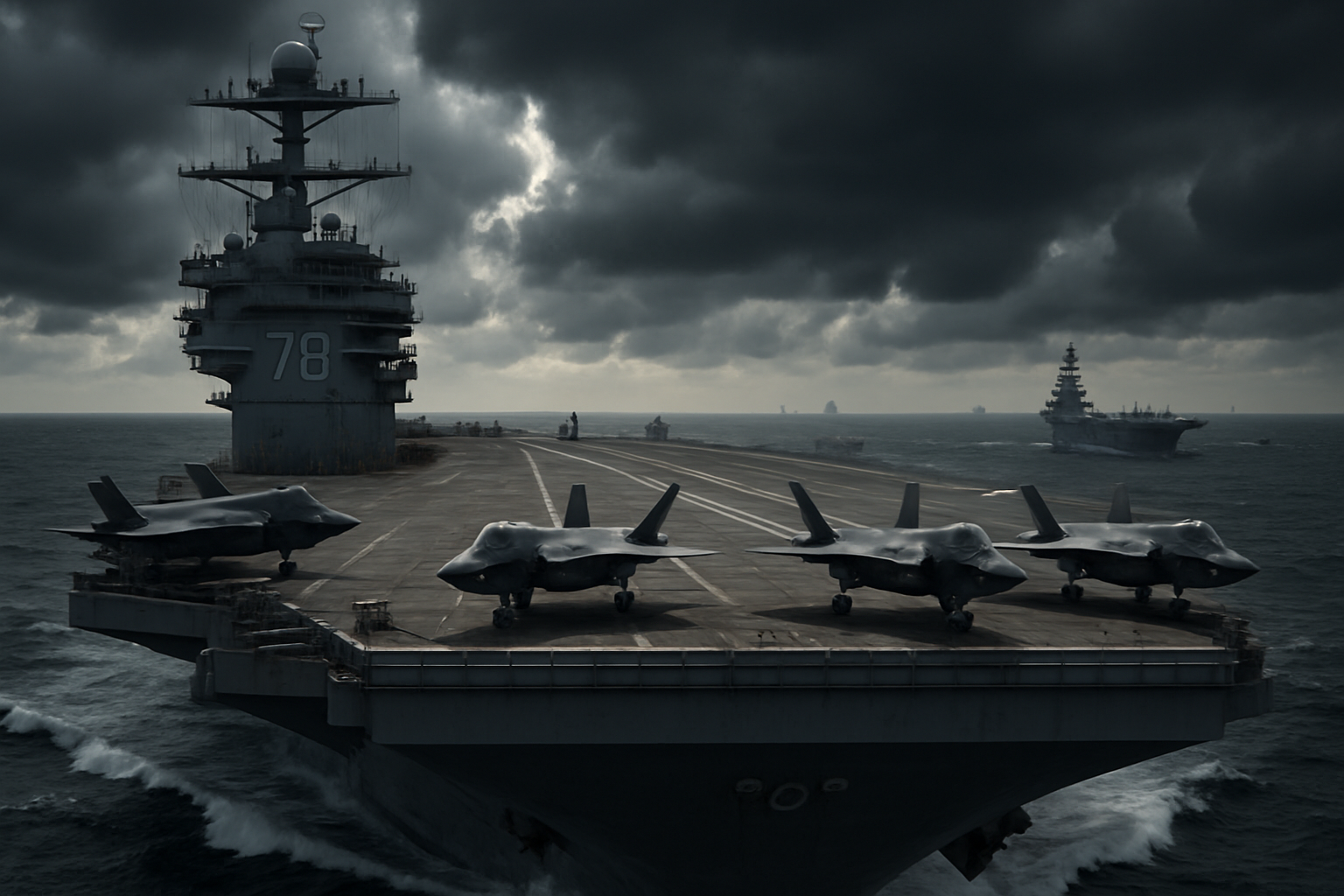
The cornerstone of America's show of force is the deployment of two nuclear-powered aircraft carriers - the USS Gerald R. Ford and USS Abraham Lincoln - creating a dual-carrier strike force positioned approximately 800 kilometers from Iran's coast in the Arabian Sea. This represents roughly one-third of the U.S. Navy's active carrier fleet concentrated in a single theater of operations.
The USS Gerald R. Ford, the world's largest aircraft carrier, was ordered from Caribbean operations to join the Abraham Lincoln in what military analysts describe as the most significant naval buildup in the Middle East since the lead-up to the Iraq War. The deployment includes dozens of F-35C Lightning II stealth fighters, support aircraft, and accompanying warships providing both offensive strike capabilities and defensive coverage.
"The deployment is unlike anything the US has done since 2003, when it amassed forces ahead of the invasion of Iraq. It dwarfs the military build-up that Trump ordered off the coast of Venezuela."
— South China Morning Post analysis
Pentagon officials have briefed the White House that military forces could be ready for potential strikes by the weekend, with scenarios ranging from targeted nuclear facility strikes to broader campaigns against Revolutionary Guard infrastructure. Military planners anticipate "potentially weeks-long operations" with Iranian retaliation creating cycles of escalation.
Nuclear Crisis Reaches Critical Juncture
The military posturing occurs against the backdrop of Iran's continued uranium enrichment at 60% purity - significantly above the 3.67% limit established in the 2015 Joint Comprehensive Plan of Action (JCPOA) and approaching the 90% threshold needed for weapons-grade material. Intelligence assessments confirm that Iran possesses sufficient enriched uranium for multiple nuclear weapons if weaponized.
Despite the military tensions, diplomatic efforts continue through Swiss-Omani mediation in Geneva, where Iranian Foreign Minister Abbas Araghchi announced a "broad agreement on guiding principles" with U.S. negotiators - the most significant diplomatic progress since the JCPOA's collapse in 2018. However, fundamental disagreements persist over the scope of any potential agreement.
Iran maintains that ballistic missiles and regional proxy support are "red lines" that must be excluded from nuclear-only talks, while U.S. Secretary of State Marco Rubio insists any comprehensive agreement must address missiles, armed groups, and human rights violations.
Regional and International Implications
The crisis unfolds as an unprecedented Middle Eastern coalition - including Saudi Arabia, the UAE, Qatar, and Egypt - backs the diplomatic process, representing remarkable regional consensus for preventing military confrontation. The Persian Gulf handles 40% of global oil transit, making regional stability crucial for worldwide energy security.
Israeli coordination with the Trump administration has been extensive, with Prime Minister Benjamin Netanyahu emphasizing that any Iran agreement must include "limiting ballistic missiles and ending support for the Iranian axis" - referring to proxy groups including Hezbollah, Hamas, and the Houthis. Israeli officials view nuclear-only agreements as insufficient for addressing existential security threats.
The timing coincides with a broader nuclear governance crisis following the expiration of the New START treaty between the U.S. and Russia on February 5 - marking the first time in over 50 years without nuclear constraints between the superpowers. UN Secretary-General António Guterres has warned that nuclear risks are at their "highest in decades."
Domestic Pressures and Military Incidents
Iran faces severe domestic pressure with over 42,000 arrests since the 2022 protests, while Nobel Peace Prize laureate Narges Mohammadi was sentenced to an additional 7.5 years in prison during the current negotiations. The regime appears to prioritize nuclear capabilities over economic relief through sanctions removal.
Military incidents continue to escalate tensions alongside diplomatic efforts. An F-35C fighter from the USS Abraham Lincoln shot down an Iranian Shahed-139 drone that approached the carrier aggressively, while Islamic Revolutionary Guard Corps vessels have harassed U.S.-flagged tankers in the Strait of Hormuz. Oil prices have risen over $1 per barrel on the tensions.
Regime Change Rhetoric Escalates
Trump's rhetoric has evolved beyond nuclear concerns to broader political transformation, with the president declaring that "change in power in Iran would be the best thing that could happen" - his most explicit regime change advocacy since taking office. This represents a significant policy evolution from nuclear-focused negotiations to comprehensive political objectives.
The president confirmed his "indirect" involvement in the Geneva talks while maintaining what officials describe as a "dual-track approach" - combining diplomatic engagement with maximum pressure through economic sanctions and military deterrence.
High-Stakes Weekend Decision
As the weekend approaches, Trump faces a critical authorization decision with global implications. The military capability exists for immediate strikes, but the political decision remains fluid as White House officials weigh escalation risks and potential consequences.
The stakes extend far beyond the immediate region, with success potentially preventing regional war and providing a diplomatic template for 21st-century nuclear crisis resolution. Failure could accelerate military solutions that reshape Middle Eastern geopolitics for decades, encourage nuclear proliferation elsewhere, and undermine diplomatic credibility for territorial and security disputes worldwide.
Intelligence reports suggest Iran may be considering concessions including a three-year enrichment halt and transferring stockpiles to Russia, but hardline statements from Iranian officials cast doubt on such compromises. The fundamental scope disagreement - Iran's demand for nuclear-only talks versus America's comprehensive approach - remains the primary obstacle to breakthrough.
Global Energy Security at Stake
The Persian Gulf's role as a critical energy chokepoint amplifies the crisis's global significance. A closure of the Strait of Hormuz would affect 40% of global oil transit, disrupting supply chains far beyond the Middle East and potentially destabilizing energy markets worldwide.
Natural gas prices have already increased 24% in Europe and 78% in the U.S. amid geopolitical pressures, demonstrating how regional tensions translate into global economic impacts. Military conflict could trigger energy market chaos with consequences extending throughout the international economy.
As Trump's deadline approaches, the world watches what officials describe as a "template-setting moment" for diplomacy versus military confrontation in the multipolar era. The outcome will influence international approaches to nuclear crises and territorial disputes for decades to come, making the next few days among the most consequential in recent Middle Eastern history.
With military forces positioned for potential action and diplomatic channels still active, the crisis represents perhaps the ultimate test of whether economic pressure and military deterrence can produce the innovative diplomatic solutions needed to bridge decade-old disagreements - or whether the gravitational pull toward military confrontation will prove irresistible in one of the world's most volatile regions.