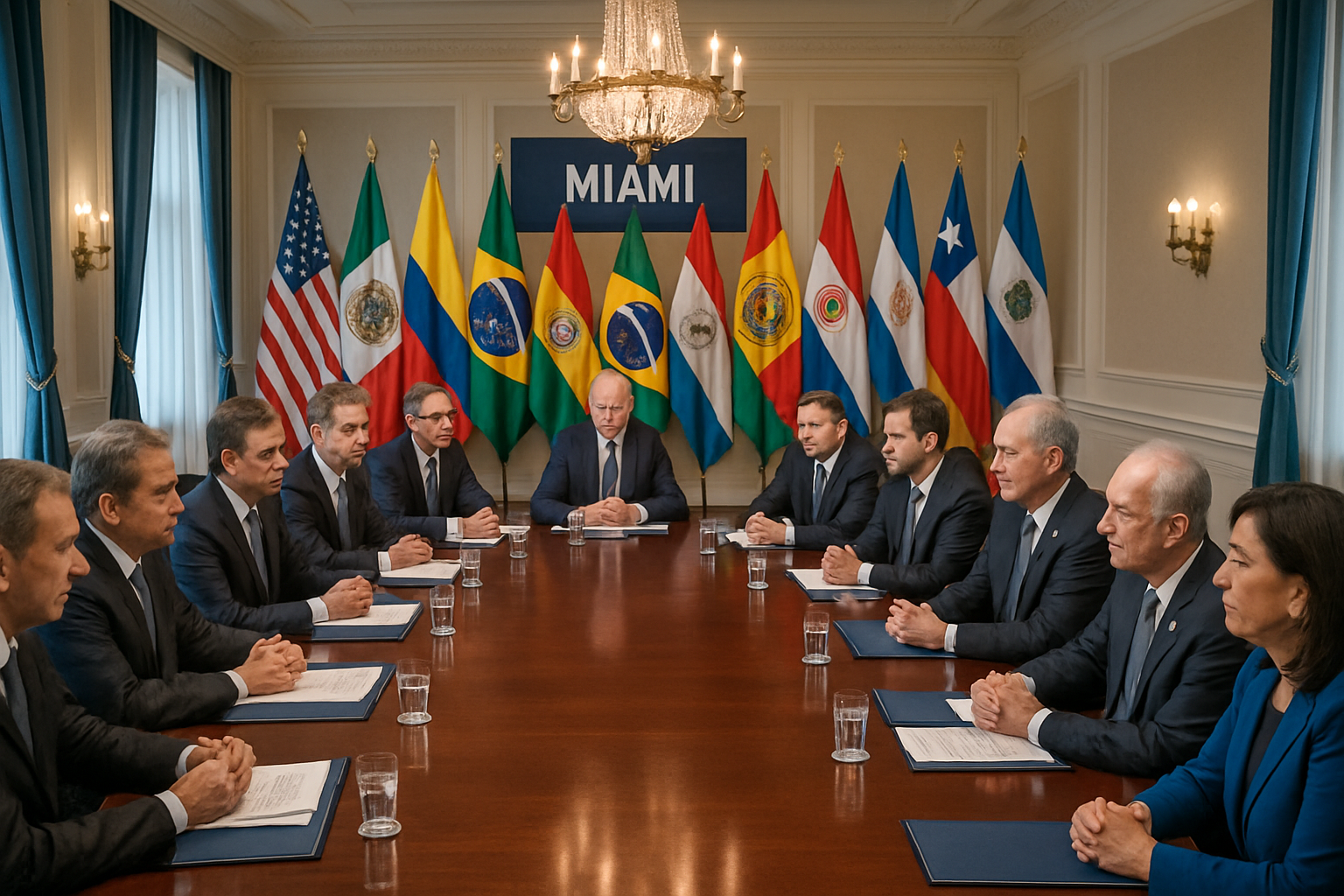
President Donald Trump officially launched the "Shield of the Americas" anti-cartel coalition on Saturday, signing the Doral Charter with leaders from 17 Latin American and Caribbean nations in a historic summit at his Miami-area golf club, establishing a military alliance committed to using "lethal military force" against drug trafficking organizations.
The coalition represents the most ambitious US-led security initiative in the Western Hemisphere since the Cold War, with Trump declaring that "the heart of our agreement is a commitment to using lethal military force to destroy the sinister cartels and terrorist networks once and for all." The president offered direct military support, including US missile strikes targeting high-value cartel leaders.
Unprecedented Military Cooperation Framework
The Shield of the Americas summit brought together leaders from across Latin America and the Caribbean, with notable attendees including El Salvador's President Nayib Bukele, Argentina's President Javier Milei, and representatives from Trinidad and Tobago, Dominican Republic, Peru, and other regional powers. Notably absent from the invitation list was Mexico, despite President Trump's repeated characterization of the country as "the epicenter of cartel violence."
Secretary of State Marco Rubio expressed gratitude to participating nations, stating: "I want to thank the countries that are here today. There are many presidents who have said they're going to make this region a priority, but [President Trump] has done it and we thank him for that." The initiative builds on earlier bilateral security agreements, particularly the successful cooperation framework established with El Salvador in 2025.
"You want us to use a missile? We can do that. You just have to ask."
— Donald Trump, to Latin American Leaders
Military Authorization and Legal Framework
The coalition operates under existing military authorizations that designate major trafficking organizations as terrorist entities, allowing for kinetic military operations in international waters and sovereign territory with partner consent. This represents a significant escalation from traditional law enforcement cooperation to direct military targeting of criminal networks.
The Trump administration has already demonstrated this approach through "Operation Southern Spear," which has conducted systematic strikes against suspected trafficking vessels in the Caribbean and Eastern Pacific since September 2025. The operation has resulted in over 140 confirmed fatalities, marking a fundamental shift from arrest-and-prosecution methods to military elimination of suspected criminals.
El Salvador Model and Regional Success Stories
Central to the coalition's strategic framework is the "El Salvador Model" championed by President Bukele, whose administration has achieved dramatic reductions in violent crime through aggressive security measures. During the summit, Trump praised Bukele extensively, calling him "a man we've grown very close to" and highlighting the success of bilateral cooperation.
The initiative originally emerged from a 2025 security agreement between El Salvador and Costa Rica, demonstrating how bilateral partnerships can evolve into broader regional frameworks. Sara Carter, Director of the White House Office of National Drug Control Policy, has praised the strategic alliance with El Salvador as a template for hemisphere-wide cooperation.
Operational Scope and Military Capabilities
The coalition will be headed by Kristi Noem, recently reassigned from her position as Secretary of Homeland Security to serve as "Special Envoy for The Shield of the Americas." This follows her dismissal from DHS over controversial enforcement operations, repositioning her as the administration's point person for Western Hemisphere security initiatives.
Military officials indicate that participating nations will coordinate intelligence sharing, joint operations, and provide mutual support for counter-narcotics missions. The framework allows for rapid deployment of US military assets, including precision-guided munitions, to assist partner nations in targeting high-value cartel leaders and infrastructure.
Mexico's Notable Exclusion
Trump's characterization of Mexico as the "epicenter of cartel violence" during the summit highlighted the complex relationship with America's southern neighbor. The president mentioned Mexican President Claudia Sheinbaum positively, describing her as "a very good woman," while simultaneously requesting permission to "eradicate" cartels operating from Mexican territory.
This exclusion reflects ongoing tensions over Mexico's cooperation in counter-narcotics efforts, particularly following the February 2026 elimination of Jalisco New Generation Cartel leader Nemesio "El Mencho" Oseguera, which resulted in massive retaliation across 20 Mexican states and complicated bilateral security cooperation.
International Reactions and Concerns
The formation of the Shield of the Americas has drawn mixed international reactions, with European and human rights organizations expressing concern about the coalition's emphasis on "lethal military force." Maritime law experts have questioned the precedent of conducting military strikes against civilian vessels in international waters based on suspected rather than confirmed criminal activity.
However, participating Latin American nations have embraced the initiative as essential for confronting transnational criminal organizations that have evolved beyond the capacity of traditional law enforcement. Bolivia's Defense Minister Marcelo Salinas proposed establishing the country as a regional "sovereign information and security hub" using advanced satellite and drone surveillance systems to support coalition operations.
Broader Strategic Context
The Shield of the Americas represents a key component of what analysts term the "Corolario Trump" – a 21st-century update to the Monroe Doctrine combining military pressure, economic incentives, and selective diplomatic engagement to counter Chinese influence in Latin America. The initiative coincides with successful US energy partnerships with Venezuela following the January 2026 removal of Nicolás Maduro.
The coalition also builds on the dramatic success of bilateral cooperation with countries like Argentina, where Trump administration trade agreements have eliminated over 1,600 tariffs and quintupled beef imports, demonstrating how security cooperation can complement broader economic partnerships.
Implementation Challenges and Timeline
Despite the ambitious scope of the Shield of the Americas, significant challenges remain in its implementation. Criminal organizations have demonstrated remarkable adaptability, with the CJNG splintering into multiple competing factions following El Mencho's death, potentially creating more violence rather than reduced criminal activity.
The coalition must also address resource constraints affecting smaller transit countries and ensure that technological capabilities keep pace with criminal organizations that often adopt new technologies faster than law enforcement agencies. Success will depend on sustained political commitment across electoral cycles and careful coordination to avoid disrupting legitimate economic activities.
Historical Significance and Future Implications
The Shield of the Americas represents the most significant US hemispheric security initiative since the Cold War, potentially reshaping how democratic nations respond to transnational organized crime in the 21st century. The emphasis on military solutions to civilian criminal challenges establishes international precedents that could influence similar approaches globally.
As criminal organizations continue to demonstrate state-like capabilities – including the February 2026 drone closure of El Paso Airport by Mexican cartels – the coalition provides a framework for coordinated military responses that transcend traditional law enforcement boundaries.
The coming months will prove decisive in determining whether the Shield of the Americas can successfully disrupt criminal networks while preserving democratic governance and human rights protections. Success could provide a template for international cooperation against transnational crime, while failure might undermine confidence in military solutions to complex social and economic challenges.