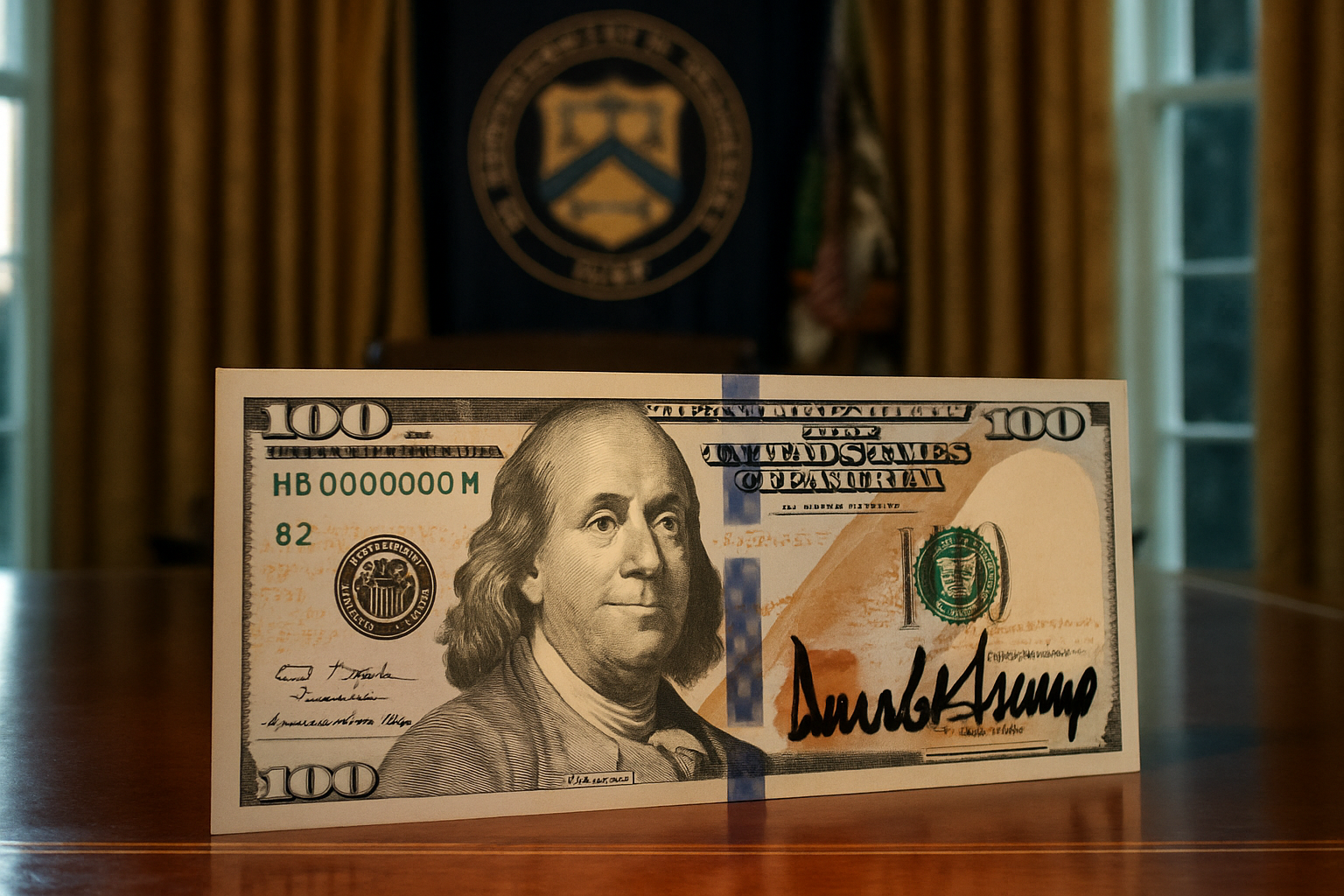
The US Treasury Department announced that President Donald Trump's signature will appear on US dollar bills, marking the first time in 165 years that a sitting president's signature will be featured on American currency, ending a continuous practice dating back to 1861.
The decision represents a major institutional shift in America's monetary architecture, according to Treasury Secretary Scott Bessent. Since 1861, US legal tender has traditionally carried the joint signatures of the Treasury Secretary and the Treasurer of the United States, without direct involvement from the chief executive.
Breaking Historical Precedent
The first emissions will concern $100 bills, with the Treasury Department describing this as ending a practice that has been in effect since 1861. Under the traditional system, currency bore the signatures of the Treasury Secretary and Treasurer, maintaining a clear separation between monetary policy and presidential authority.
This development coincides with the 250th anniversary of the founding of the United States, adding symbolic weight to what the administration frames as a historic commemoration. The timing connects the signature change to America's semiquincentennial celebration, suggesting the move is part of broader ceremonial recognition of national milestones.
International Perspective on Monetary Authority
European financial analysts view this change as potentially setting new precedents for executive involvement in monetary symbolism. The decision breaks from established practice where currency signatures represented institutional rather than personal authority, reflecting the separation between political leadership and monetary administration.
Swedish financial media noted that this represents the first time a sitting president's signature will appear on currency, highlighting the departure from traditional American monetary customs that have persisted through multiple economic crises and political transitions.
Constitutional and Legal Framework
The legal authority for this change stems from the Treasury Department's administrative powers over currency design and production. While unprecedented in modern American history, the action falls within existing regulatory frameworks that govern currency appearance and official designations.
"This marks a significant departure from the institutional practices that have governed American currency for more than a century and a half."
— Treasury Department Official
Implementation and Timing
The new $100 bills featuring Trump's signature are expected to enter circulation in 2026, coinciding with the 250th anniversary celebrations. The Treasury Department will coordinate the rollout through the Federal Reserve system, ensuring orderly distribution across financial institutions nationwide.
Production logistics will involve the Bureau of Engraving and Printing, which manages all US currency manufacturing. The integration of presidential signatures into the existing security features and design elements requires careful coordination to maintain anti-counterfeiting measures while accommodating the historical change.
Economic and Symbolic Implications
Financial markets have shown measured response to the announcement, with currency traders noting the symbolic rather than economic significance of the change. The dollar's value and international standing remain tied to broader economic policies rather than ceremonial features.
The timing with America's 250th anniversary provides historical context for what administration officials describe as appropriate recognition of presidential leadership during a milestone year. This framing positions the signature inclusion as commemorative rather than routine policy adjustment.
Historical Context of Presidential Currency Involvement
Prior to 1861, various forms of presidential recognition appeared on American monetary instruments, but the modern system of Treasury Secretary and Treasurer signatures became standard during the Civil War era. This system provided institutional continuity across different presidential administrations.
The change reverses more than 16 decades of consistent practice, representing one of the most significant alterations to US currency protocols in modern history. Previous currency modifications typically involved security features or artistic elements rather than fundamental signature authority.
International Precedents and Comparisons
Other democratic nations typically maintain separation between political leadership and currency signatures, with central bank governors or treasury officials providing the institutional authority. The American change represents a notable departure from international norms in democratic monetary systems.
European Central Bank practices, for example, feature the ECB President's signature rather than political leaders, maintaining the principle of monetary policy independence from electoral politics. This distinction has been considered fundamental to modern central banking principles.
Future Implications for Monetary Policy
The precedent established by including presidential signatures may influence future administrations' approach to currency design and symbolic representation. Once implemented, subsequent presidents may face decisions about continuing or reversing this practice.
Monetary historians note that such changes often become permanent features of national currency systems, suggesting this modification could persist beyond the current administration. The institutional momentum of currency design tends to favor continuity once new standards are established.
"The integration of presidential authority into currency design represents a fundamental shift in American monetary symbolism that will likely influence future administrations."
— Federal Reserve Analyst
Public Reception and Democratic Processes
The announcement has generated discussion about the appropriate balance between presidential prerogatives and traditional institutional practices. Constitutional scholars note that while legally permissible, the change raises questions about precedent-setting in areas traditionally managed through bureaucratic rather than political processes.
Congress retains oversight authority over currency matters through appropriations and regulatory review, providing a potential check on future modifications. The democratic process includes mechanisms for legislative input on Treasury Department policies, including those affecting currency design.
Technical Implementation Challenges
The Bureau of Engraving and Printing faces technical challenges integrating new signature elements while maintaining existing security features. Anti-counterfeiting measures require careful coordination with signature placement to preserve currency integrity.
Distribution through the Federal Reserve system involves coordination with thousands of financial institutions nationwide. The logistics of replacing existing currency stocks with updated versions requires systematic planning to ensure smooth economic transitions.
Long-term Economic Considerations
While the immediate economic impact appears minimal, the precedent could influence international perceptions of American monetary institutions. Currency serves both domestic and international functions, with symbolic changes potentially affecting broader confidence in institutional stability.
The dollar's role as the world's primary reserve currency means that changes in its design and authority structure receive international attention. Foreign central banks and financial institutions monitor American monetary policy signals, including symbolic modifications.
As this historic change prepares for implementation in 2026, it represents more than a simple design modification. The inclusion of presidential signatures on US currency marks a fundamental shift in American monetary tradition, establishing new precedents that will likely influence currency policies for generations to come.