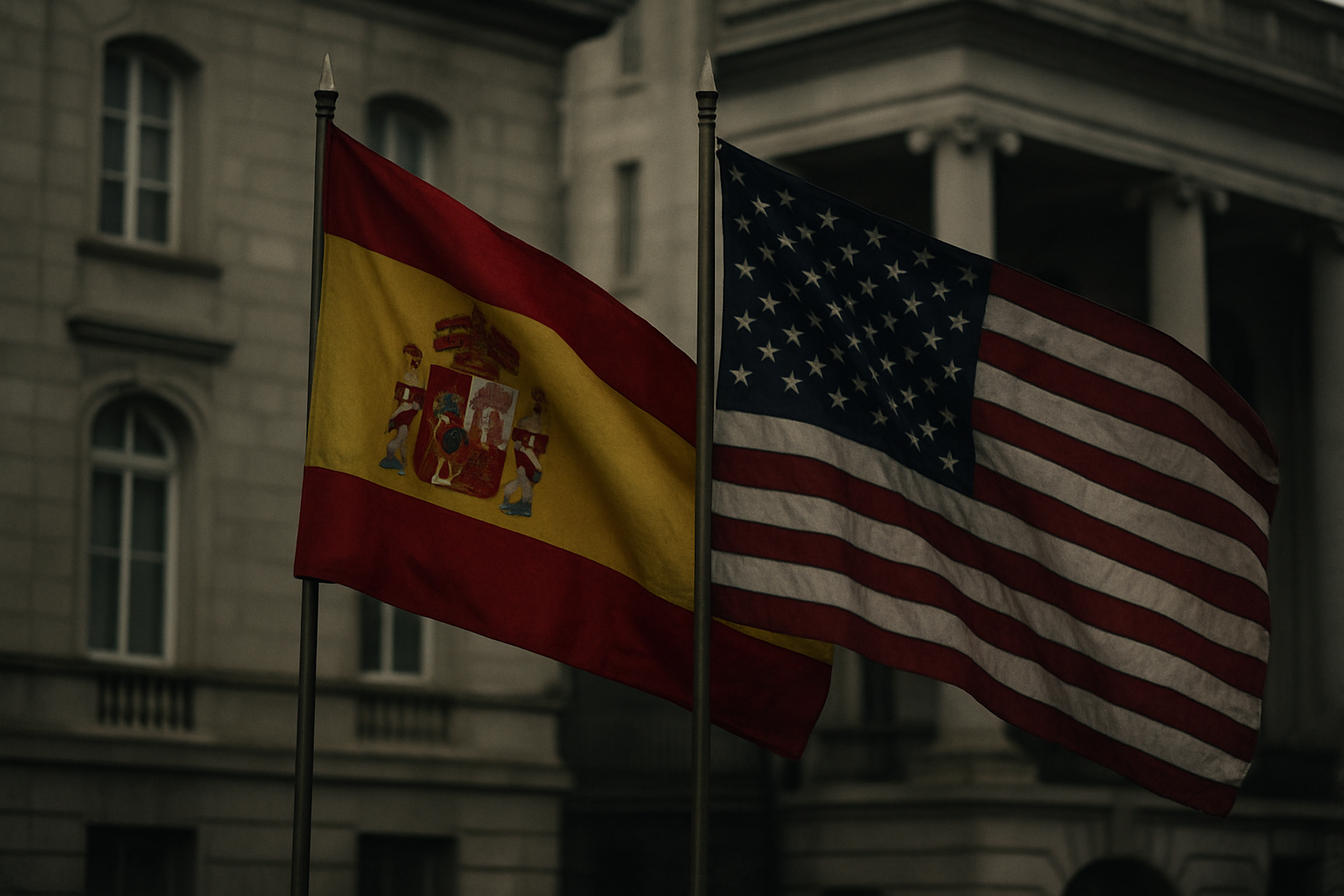
President Donald Trump has intensified diplomatic pressure on Spain, threatening to "cut off all trade" with Madrid after Prime Minister Pedro Sánchez refused to allow US forces to use Spanish military bases for operations against Iran, marking one of the most serious rifts within NATO in recent years.
The crisis erupted following Spain's refusal to permit American forces use of key military installations including Naval Station Rota and Morón Air Base for strikes during "Operation Epic Fury" – the largest US-Israeli coordinated military operation since the 2003 Iraq invasion. Trump called Spain a "terrible" ally and ordered Treasury Secretary Scott Bessent to "cut off all dealings" with Madrid.
Speaking to reporters, Trump declared: "Spain has absolutely nothing that we need—except fantastic people," distinguishing between his criticism of the Spanish government and the Spanish people while maintaining his threat of comprehensive economic sanctions.
Spanish Government Stands Firm on International Law
Prime Minister Sánchez's Socialist government has maintained that US forces can only use Spanish bases for activities "consistent with the UN Charter and international law." This represents the first time since the 1950s defense agreements that Spain has explicitly denied base usage for a major US military operation.
Madrid's response emphasized Spain's continued commitment to NATO while asserting its sovereign right to determine base usage. "Spain remains a key NATO member," government officials stated, calling on the US to honor existing bilateral agreements while respecting international legal frameworks.
The Spanish government indicated it has "necessary resources to contain possible impacts, help affected sectors, and diversify supply chains" should Trump follow through on his trade embargo threats.
Military and Strategic Consequences
The diplomatic standoff has already produced tangible military consequences. The US has relocated 15 aircraft, including critical refueling tankers, from Rota and Morón bases following Spain's denial of their use for Iran operations. This marks a significant disruption to decades of military cooperation that has been central to NATO's southern flank defense strategy.
The military repositioning comes amid an unprecedented buildup in the Middle East, with dual-carrier deployment of the USS Gerald R. Ford and Abraham Lincoln representing the largest US naval presence in the region since 2003. Iran's closure of the Strait of Hormuz, through which 40% of global oil transit flows, has created worldwide energy market volatility.
European officials have privately expressed concerns that the US-Spain rift could weaken NATO's collective defense posture at a critical moment when the alliance faces multiple challenges, including ongoing tensions with Russia and China's growing military assertiveness.
Broader Alliance Strain
Trump's criticism extends beyond Spain to other European allies. He has also targeted British Prime Minister Keir Starmer for not supporting US-Israeli Iran strikes, declaring: "This is not Winston Churchill." This represents the most direct presidential criticism of Britain by an American leader in modern diplomatic history.
The crisis has revealed fundamental disagreements within NATO about military intervention principles. European allies, led by Spain, reference "Iraq lessons" and emphasize they "cannot repeat the same mistakes made in Iraq," while the Trump administration advocates explicit regime change in Iran as "the best thing that could happen."
Adding to alliance tensions, Trump has criticized Spain as the only NATO country refusing to meet his 5% GDP defense spending demand, far exceeding the standard 2% target that most allies struggle to achieve.
Economic and Legal Implications
Trump's unilateral trade embargo threat faces significant legal and diplomatic hurdles. Such measures would likely violate World Trade Organization rules and existing EU-US trade agreements, potentially triggering retaliatory measures from Brussels.
The timing is particularly complex given Trump's recent Supreme Court defeat on tariff authority. The Court's 6-3 ruling struck down his global tariff program, forcing him to rely on alternative legal mechanisms that face congressional oversight and potential legal challenges.
Economic analysts note that any trade restrictions would affect sectors where Spain and the US have substantial mutual interests, including aerospace, renewable energy, and agricultural products. Spain's significant investments in US renewable energy projects and its role as a gateway for Latin American trade with Europe add complexity to potential economic warfare.
European Unity Response
European leaders have rallied in support of Spanish sovereignty. Brussels is expected to defend Madrid's position, with EU officials privately indicating that any US retaliation against Spain for exercising sovereign rights over military base usage would strain broader transatlantic relations.
The crisis has accelerated discussions about European strategic autonomy – the concept of Europe developing independent defense capabilities to reduce reliance on American military protection. Recent discussions between German Chancellor Friedrich Merz and French President Emmanuel Macron about expanding nuclear deterrence cooperation have gained urgency amid questions about US alliance reliability.
France and other EU nations have opened new diplomatic channels to demonstrate solidarity with Spain, while NATO officials work behind the scenes to prevent the bilateral dispute from undermining broader alliance cohesion.
Iran Crisis Context
The US-Spain confrontation stems from the broader Iran nuclear crisis that has dominated international relations in early 2026. Despite achieving "broad agreement on guiding principles" in Geneva negotiations – the most progress since the 2018 JCPOA collapse – talks broke down over fundamental scope disagreements.
Iran maintains ballistic missiles and regional proxy relationships as "red lines" excluded from nuclear-only discussions, while the US demands comprehensive agreements addressing missiles, armed groups, and human rights. With Iran enriching uranium at 60% purity approaching weapons-grade levels, the diplomatic window appears increasingly narrow.
The military escalation has created global economic disruption, with oil prices surging past $80 per barrel and natural gas prices jumping 24% in Europe and 78% in the US. Over 18,000 flights have been cancelled worldwide as multiple Middle Eastern countries closed airspace simultaneously.
Historical Significance and Future Implications
The Trump-Spain crisis represents a watershed moment for transatlantic relations, testing whether traditional alliance frameworks can adapt to contemporary challenges or whether new cooperation models are required to preserve democratic solidarity.
Unlike previous US disagreements with allies over tactical differences, this confrontation involves fundamental principles about intervention, sovereignty, and international law. European willingness to publicly diverge from US foreign policy may establish precedents for future conflicts between national sovereignty and alliance obligations.
The resolution of this crisis will influence how other middle powers navigate relationships with major allies when core principles are at stake. Success in managing the dispute through diplomatic channels could strengthen institutional frameworks for alliance cooperation. Failure might accelerate the fragmentation of Western unity at a critical moment for international stability.
As both sides maintain their positions, the coming weeks will test whether decades of US-Spanish partnership and broader NATO unity can withstand this unprecedented challenge to alliance cohesion in the face of global security threats.