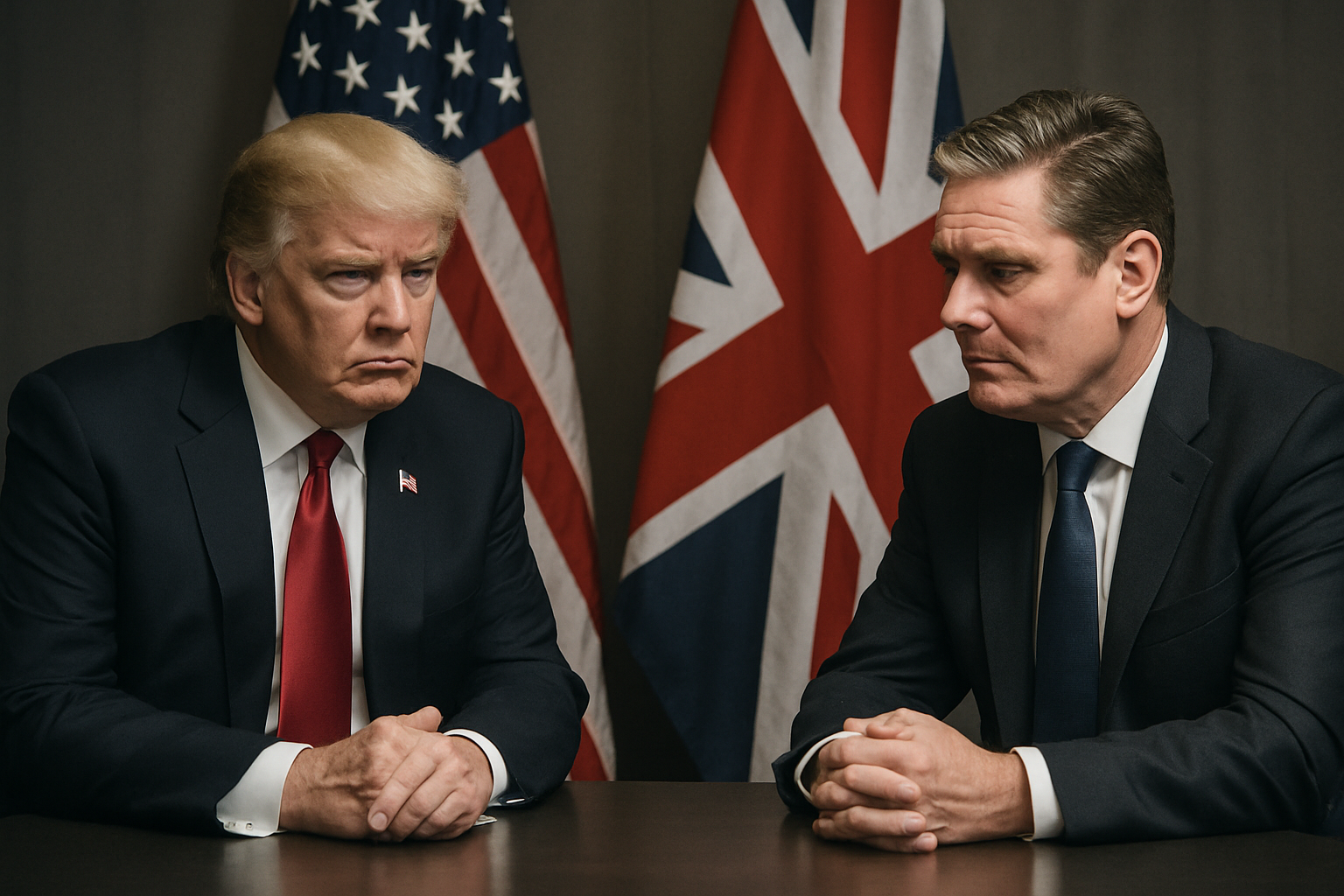
The United States and United Kingdom are facing their most serious diplomatic crisis in decades as President Donald Trump publicly castigated Prime Minister Keir Starmer for Britain's refusal to support US-Israeli military operations against Iran, marking a historic low point in the "special relationship" between the two allies.
Trump's criticism came after the UK declined to allow the use of British bases for "Operation Epic Fury," the largest coordinated US-Israeli military operation since the 2003 Iraq invasion. Speaking to The Sun newspaper, Trump expressed unprecedented frustration with his British counterpart, stating, "He [Starmer] didn't help at all. I never thought I'd see this. I never thought I'd see this from Britain."
The Iranian Crisis Context
The diplomatic rupture emerges from the collapse of what had been the most promising US-Iran nuclear negotiations in years. Despite achieving a "broad agreement on guiding principles" in Geneva talks — the most significant progress since the 2018 JCPOA collapse — negotiations broke down over fundamental scope disagreements. Iran maintained that ballistic missiles and regional proxy activities were "red lines" excluded from nuclear-only talks, while the US insisted on comprehensive agreements addressing missiles, armed groups, and human rights violations.
The stakes could not have been higher. Iran had been enriching uranium at 60% purity, approaching the 90% weapons-grade threshold, with former IAEA inspector Dr. Yusri Abu Shadi confirming that Iran possessed over 400kg of enriched uranium, making weapons development "easily achievable."
Britain's Moral Stand
Starmer's position, articulated to Members of Parliament, was unequivocal: the UK government "does not believe in regime change from the skies." This stance represents a fundamental philosophical divide with the Trump administration's approach, echoing painful lessons from previous Middle Eastern interventions.
"We cannot repeat the same mistakes made in Iraq."
— Prime Minister Keir Starmer
The Prime Minister's reference to Iraq carries particular weight, as it invokes the deeply controversial 2003 invasion that ultimately destabilized the region and strained transatlantic relations under previous administrations. Starmer's refusal to allow British bases to conduct strikes against Iran signals a clear departure from the traditionally compliant British foreign policy approach toward American military ventures.
Trump's Unprecedented Rebuke
Trump's response has been characteristically blunt and historically significant. His declaration that the US-UK "relationship is obviously not what it was" represents one of the most direct presidential criticisms of Britain by an American leader in the modern era. The language mirrors diplomatic crises typically reserved for adversarial nations rather than America's closest ally.
Sources close to the White House indicate Trump's frustration stems not only from Britain's non-participation but from what he perceives as Starmer's moral lecturing during a critical moment. The President's regime change rhetoric, calling Iranian government overthrow "the best thing that could happen," directly contradicts Starmer's cautious approach to Middle Eastern interventions.
Historical Context of the Special Relationship
The current crisis builds upon months of tension that have already strained US-UK relations under the Trump-Starmer dynamic. Previous disagreements over issues ranging from the Peter Mandelson ambassadorial appointment scandal to divergent approaches on Ukraine have created a foundation of mistrust that the Iran crisis has now brought to a breaking point.
The memory database reveals that Trump had previously warned against UK territorial concessions, including the Diego Garcia transfer to Mauritius, calling it a "big mistake" and emphasizing the base's strategic importance for potential Iran operations. This earlier tension now takes on new significance as the crisis deepens.
European Solidarity and Isolation
Britain's position is not entirely isolated within Europe. The memory context shows that European allies have been increasingly asserting strategic autonomy, with discussions about French nuclear deterrent expansion and reduced dependence on US military equipment. The Munich Security Conference earlier this year saw unprecedented European discussions about alternative security arrangements, suggesting Starmer's stance may reflect broader European skepticism about American military adventurism.
However, the UK's position is complicated by its post-Brexit reliance on maintaining strong US ties for trade and security relationships. This creates a delicate balance that Starmer must navigate between European solidarity and American partnership.
Regional and Global Implications
The diplomatic rift has profound implications beyond bilateral relations. The crisis disrupted what had been an unprecedented regional coalition of Saudi Arabia, UAE, Qatar, and Egypt supporting diplomatic solutions to the Iran nuclear issue. These nations now find themselves caught between supporting their American security partner and managing Iranian retaliation that has already struck their territories.
The broader international response has been mixed, with UN Secretary-General António Guterres condemning the military actions as a "serious threat to international peace and security," while Russia and China have issued their strongest condemnations of US policy in years. This creates additional pressure on Britain to choose sides in an increasingly polarized international environment.
Domestic Political Calculations
For Starmer, the Iran position offers both political risks and opportunities. His government has already faced severe challenges from the Jeffrey Epstein files revelations and internal party tensions. Taking a strong moral stance against military intervention could shore up his political base while demonstrating British independence in foreign policy.
However, the approach also carries significant risks. Conservative critics are likely to portray Starmer as weakening the special relationship and abandoning Britain's traditional role as America's most reliable ally. The economic implications of deteriorating US relations could prove particularly damaging as Britain seeks to establish its post-Brexit economic identity.
The Nuclear Governance Crisis
The Iran crisis unfolds against the backdrop of a broader nuclear governance breakdown. The New START treaty between the US and Russia expired in February 2026, marking the first time in over 50 years without bilateral nuclear constraints between the superpowers. This vacuum in nuclear governance makes the Iran situation even more critical as a test case for 21st-century nuclear crisis resolution.
Britain's position becomes particularly significant in this context, as it represents a choice between supporting American unilateral action or upholding multilateral diplomatic principles. The outcome may establish precedents for how nuclear crises are managed in an increasingly multipolar world.
Economic and Strategic Consequences
The immediate economic impacts are already visible. Oil prices have surged past $80 per barrel as Iran has threatened to close the Strait of Hormuz, through which 40% of global oil transits. Natural gas prices have increased 24% in Europe and 78% in the US, reflecting regional war concerns that could disrupt worldwide energy supplies.
The aviation industry faces unprecedented disruption, with Iran, Iraq, Israel, UAE, and Qatar all closing their airspace simultaneously. Over 18,000 flights have been cancelled worldwide, affecting hundreds of thousands of passengers and creating the most extensive regional flight disruption since COVID-19.
The Path Forward
The diplomatic crisis leaves both leaders with limited options for face-saving resolution. Trump's public criticism has made it politically difficult for Starmer to reverse course without appearing to capitulate to American pressure. Similarly, Trump's characterization of the relationship as damaged creates expectations for continued confrontation rather than reconciliation.
The institutional mechanisms that typically manage US-UK disagreements — from intelligence sharing to defense cooperation — now face unprecedented strain. Career diplomats on both sides are reportedly working to contain the damage, but the public nature of the dispute has limited their traditional behind-the-scenes resolution capabilities.
Historical Precedent and Future Relations
While the US and UK have disagreed before — notably over Suez in 1956 and aspects of the Falklands War in 1982 — the current crisis differs in its public nature and fundamental philosophical divide over intervention principles. Previous disagreements were typically managed through private channels and focused on tactical rather than strategic differences.
The Iran crisis may mark a watershed moment in transatlantic relations, signaling a new era where European allies are more willing to publicly diverge from American foreign policy positions. This evolution reflects broader changes in global power dynamics and the increasing confidence of European nations in asserting independent foreign policy positions.
Regional Security Architecture
The long-term implications extend beyond bilateral relations to the fundamental architecture of Western security cooperation. If Britain's position becomes a model for European resistance to American military operations, it could fundamentally reshape NATO decision-making processes and the assumptions underlying transatlantic security cooperation.
The crisis also affects regional security calculations in the Middle East, where traditional American allies must now consider the possibility that future US military operations may proceed without full British support. This uncertainty could influence everything from defense procurement decisions to diplomatic positioning in future crises.
Conclusion: A Relationship Transformed
The Trump-Starmer diplomatic rift over Iran strikes represents more than a temporary disagreement between allies. It signals a fundamental transformation in the special relationship, with Britain increasingly willing to prioritize multilateral diplomatic principles over automatic alignment with American military ventures.
The outcome of this crisis will establish crucial precedents for 21st-century international relations, determining whether small and medium powers can successfully resist pressure from great powers when core principles are at stake. As the immediate military crisis continues to unfold in the Middle East, the diplomatic crisis between America and Britain may prove equally consequential for the future of international cooperation and alliance relationships in an increasingly complex global order.
The stakes extend far beyond the current crisis to fundamental questions about sovereignty, intervention, and the balance between national interests and international law in modern diplomacy. How Trump and Starmer navigate this unprecedented challenge may determine not only the future of US-UK relations but the broader framework for Western cooperation in addressing global security challenges.