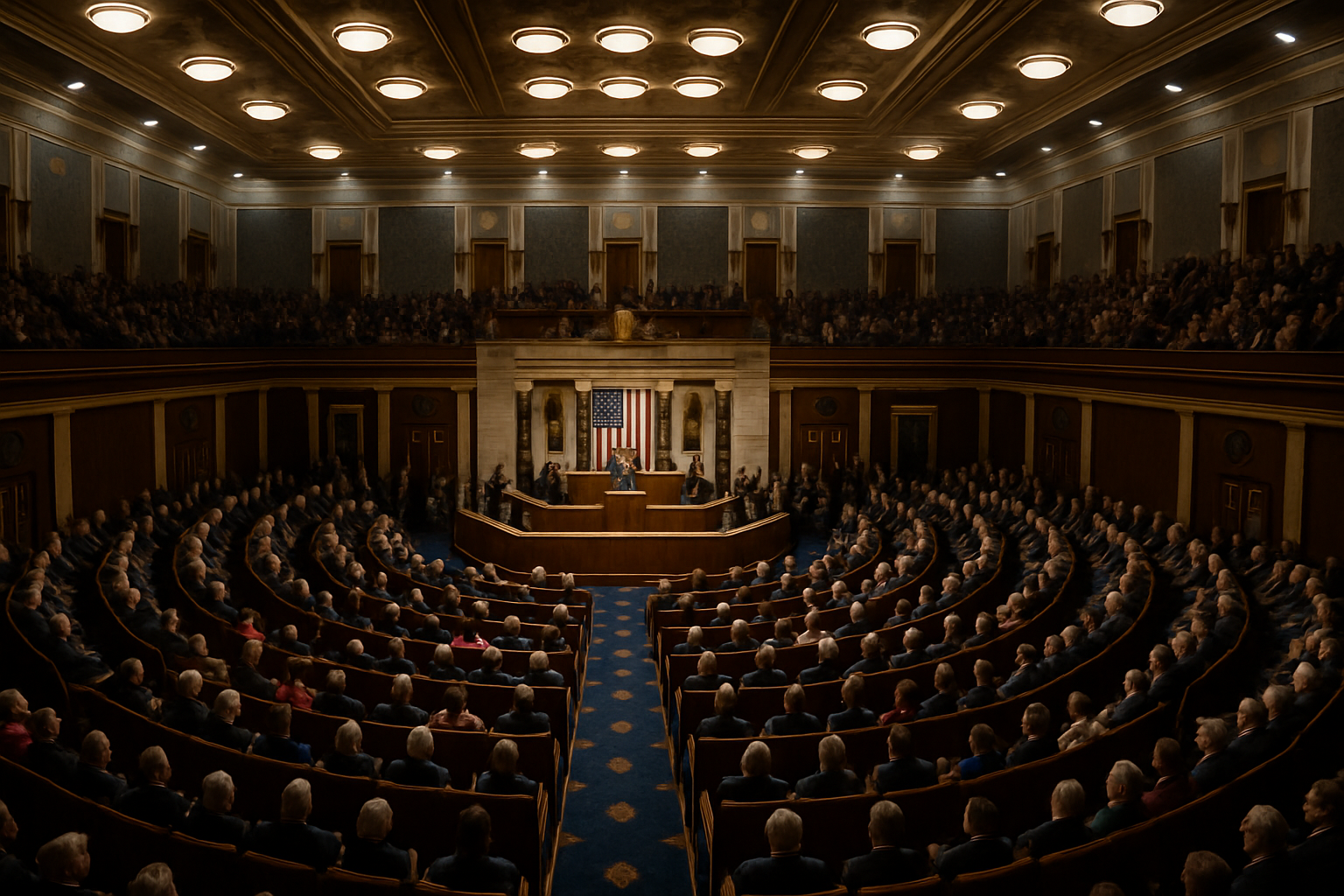
President Donald Trump delivered his State of the Union address to Congress on Tuesday evening, facing the most challenging domestic and international landscape of his second presidency as his approval ratings slide and constitutional crises mount across multiple fronts.
The address comes at a pivotal moment for the Trump administration, with the President confronting a devastating Supreme Court defeat on his global tariff program just four days earlier, ongoing nuclear negotiations with Iran reaching a critical juncture, and intensifying pressure over his response to multiple international crises.
Constitutional Crisis Backdrop
Trump's sixth State of the Union speech before Congress occurs in the shadow of Friday's historic 6-3 Supreme Court ruling that struck down his sweeping global tariff program. Chief Justice John Roberts authored the majority opinion applying the "major questions doctrine," declaring that the International Emergency Economic Powers Act "does not authorize president to impose tariffs" without explicit congressional authorization for actions of "vast economic and political significance."
The President's immediate response to escalate tariffs to 15% using Section 122 of the Trade Act 1974 created what constitutional experts are calling the most serious executive-judicial confrontation since Watergate. Trump's unprecedented attack on the justices as "absolutely ashamed" and "disloyal to Constitution" represents the most severe judicial criticism by a sitting president in modern history.
"This is a critical moment for the President as his approval rating is down and the top court has taken away his favourite tariff tool"
— The Globe and Mail analysis
Sliding Poll Numbers and Political Pressure
Recent polling data shows Trump facing significant headwinds, with his immigration policies approval falling to the lowest levels since his return to the White House, according to Reuters/Ipsos surveys. The decline is particularly pronounced among American men, traditionally a core constituency for Trump's policies.
The political challenges extend beyond domestic approval ratings. Congressional resistance to his trade agenda materialized in a significant 219-211 House vote ending Canada tariffs, with six Republican defections marking the first substantial bipartisan rebuke of Trump's trade authority in his second term. Speaker Johnson's inability to prevent the vote demonstrates growing Republican anxiety about the administration's unpredictable trade approach.
International Pressures and Iran Nuclear Talks
The State of the Union address occurs as Trump navigates the most complex international diplomatic landscape of his presidency. His administration's nuclear negotiations with Iran in Geneva achieved what Iranian Foreign Minister Abbas Araghchi described as "broad agreement on guiding principles" - the most significant breakthrough since the JCPOA collapse in 2018.
However, fundamental obstacles persist. Iran maintains uranium enrichment at 60% purity versus the 3.67% JCPOA limit and excludes ballistic missiles and regional proxies as "red lines" from nuclear-only talks. The Trump administration, led by Secretary of State Marco Rubio, demands a comprehensive agreement including missiles, armed groups, and human rights considerations.
The diplomatic pressure is underscored by an unprecedented military deployment, with Trump positioning dual-carrier forces (USS Gerald R. Ford and Abraham Lincoln) creating the largest U.S. Middle East naval presence in years, positioned 800 kilometers from Iran's coast.
European Relations and Trade Tensions
The European Union has responded forcefully to Trump's trade policies, with the European Parliament preparing to suspend EU-US trade agreement implementation for the first time due to institutional concerns. German Social Democrat Bernd Lange, chairman of the Trade Committee, is leading the initiative with major parliamentary group support after the European Commission demanded the US honor 2025 trade commitments.
The international response reflects broader concerns about American policy predictability affecting international business planning and government strategic development. China has welcomed the Supreme Court ruling as vindication, potentially strengthening their position before Trump's scheduled Beijing visit in March.
Ukraine Crisis and Nuclear Governance
Trump's address occurs against the backdrop of the most serious nuclear governance crisis in decades. The New START treaty between the US and Russia expired February 5, marking the first time in over 50 years without nuclear constraints between the superpowers controlling 80% of global nuclear weapons. UN Secretary-General António Guterres has warned of a "grave turning point" with nuclear risks at their highest levels in decades.
The administration faces pressure to demonstrate diplomatic progress on Ukraine, where recent Geneva talks achieved "significant progress" on ceasefire monitoring mechanisms but left territorial disputes unresolved. The June 2026 peace deadline established by the Trump administration creates additional urgency for foreign policy achievements.
Domestic Agenda Under Pressure
Beyond international challenges, Trump confronts mounting domestic pressure across multiple fronts. Federal courts continue to push back against administration policies, including a Philadelphia judge ordering the restoration of a George Washington slavery exhibit, invoking Orwell's "1984" against historical rewrites.
The administration also faces unprecedented ethical complications as Trump seeks billions in damages from the federal government he leads, creating complex situations for the Justice Department under Attorney General Pam Bondi.
Stakes for Trump's Second Term
Tonight's State of the Union represents a critical opportunity for Trump to reset his second-term narrative and address mounting challenges across domestic and international fronts. The prime-time address serves as a chance for the President to tout his record ahead of this year's midterm elections, but it comes at a moment when Trump's agenda faces complications on multiple fronts.
The speech's success will be measured not only by its immediate reception but by Trump's ability to navigate the constitutional crisis created by his defiance of the Supreme Court, restore confidence in his trade policies, and demonstrate progress on crucial international negotiations from Iran to Ukraine.
As Trump faces this convergence of challenges, the State of the Union address may prove to be one of the most consequential of his presidency, with implications extending far beyond domestic politics to America's constitutional framework and international standing in an increasingly complex global landscape.