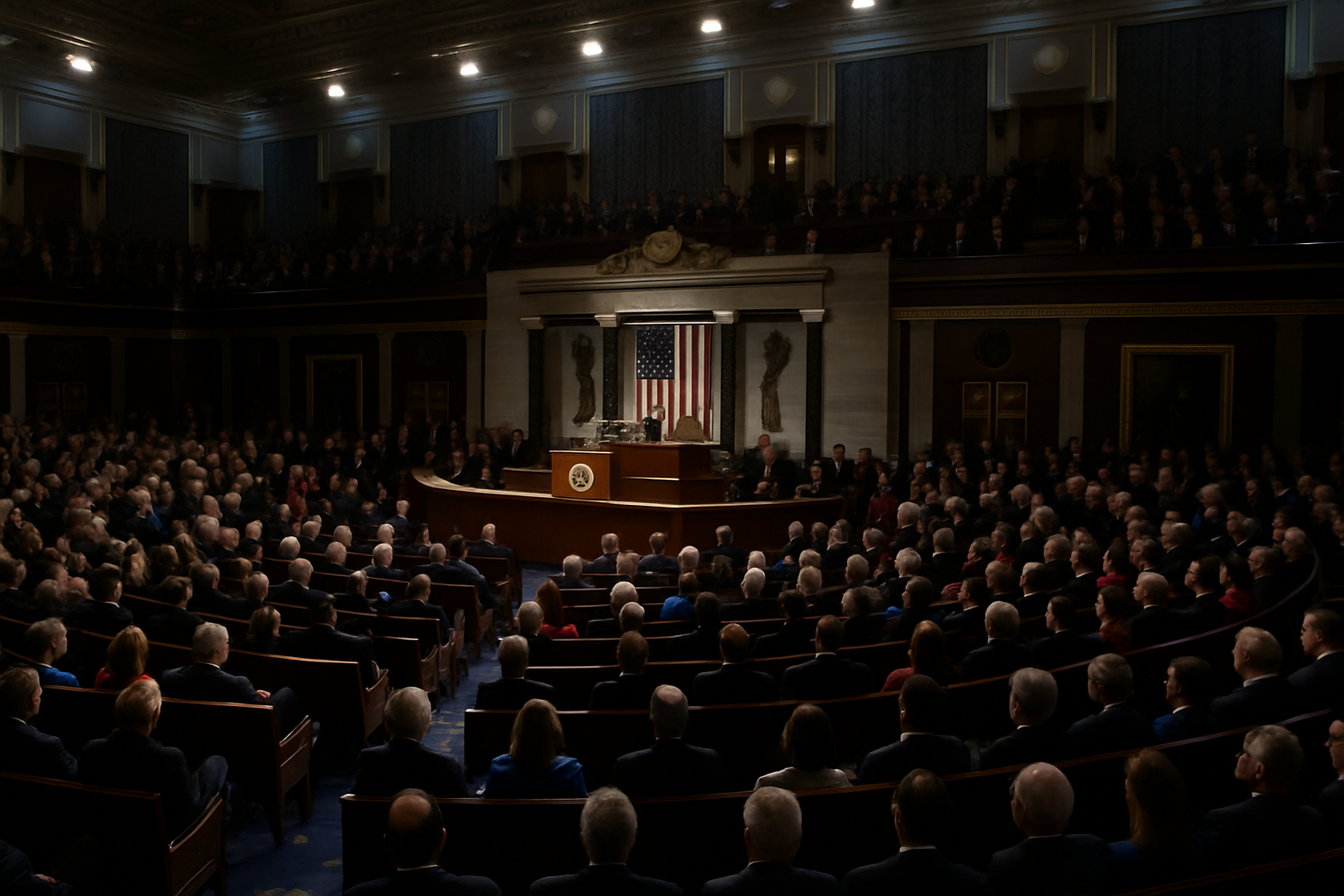
President Donald Trump is set to deliver his State of the Union address Tuesday night facing the most challenging period of his second presidency, with plunging approval ratings, a devastating Supreme Court defeat over his tariff program, and mounting international and domestic crises testing his administration's resilience.
The address comes just days after Friday's historic 6-3 Supreme Court ruling that struck down Trump's global tariff program under the International Emergency Economic Powers Act (IEEPA), creating what constitutional scholars describe as the most serious executive-judicial confrontation since Watergate. The President's immediate escalation to 15% worldwide tariffs using Section 122 of the Trade Act 1974 has drawn sharp criticism from Congress and international partners.
Supreme Court Delivers Crushing Blow to Presidential Power
Chief Justice John Roberts authored the majority opinion applying the "major questions doctrine," declaring that IEEPA "does not authorize president to impose tariffs" without congressional authorization for actions of "vast economic and political significance." The ruling represents the first major defeat of Trump's economic agenda in his second term and establishes a crucial precedent limiting presidential emergency powers for trade policy.
Trump's response was swift and unprecedented in its hostility toward the judiciary. He called the justices "absolutely ashamed," "disgrace to our nation," and "disloyal to Constitution" — the most severe attack on the judiciary by a sitting president in modern history. Within hours, he implemented 15% tariffs using Section 122, the maximum legal level allowed for 150 days, creating a constitutional showdown between executive authority and congressional trade oversight.
"The justices are absolutely ashamed and a disgrace to our nation. They are disloyal to the Constitution."
— President Trump, responding to Supreme Court ruling
Approval Ratings Plummet Across Key Issues
According to political analyst Larry Sabato from the University of Virginia Centre for Politics, Trump "has lost a great deal" of popularity since his inauguration and is "now underwater in every single one" of the top ten issues except border security. This dramatic slide represents a significant challenge for the President as he seeks to maintain his MAGA base while addressing widespread public concern.
Swedish polling expert Emma Ricknell notes that "people are worried about their economy and have lower confidence in the sitting president." The timing of the State of the Union address provides Trump a unique opportunity to reverse these trends, with Ricknell emphasizing that "much is at stake" for the President's political future.
International observers have noted the decline in Trump's standing. Multiple European media outlets report growing concerns about American policy predictability, particularly after the tariff crisis and subsequent Supreme Court confrontation.
International Challenges Mount
The President faces a complex array of international challenges as he prepares for the address. Recent developments include significant progress in Iran nuclear negotiations, with talks in Geneva achieving "broad agreement on guiding principles" according to Iranian Foreign Minister Abbas Araghchi. However, fundamental obstacles persist, including Iran's maintenance of 60% uranium enrichment versus the 3.67% JCPOA limit.
In response to regional tensions, Trump has deployed dual-carrier naval forces with the USS Gerald R. Ford and Abraham Lincoln, creating the largest Middle East naval presence in years. The nuclear governance crisis has intensified with the New START treaty's expiration on February 5, marking the first time in over 50 years without US-Russia nuclear constraints.
European relations remain strained despite Secretary of State Marco Rubio's recent diplomatic efforts. The EU Parliament is preparing to suspend EU-US trade agreement implementation for the first time due to institutional concerns, with German MP Bernd Lange leading the initiative after the European Commission demanded the US honor 2025 trade commitments.
Congressional Resistance Emerges
The Supreme Court ruling has validated growing Congressional resistance to Trump's trade policies. Earlier this month, the House passed legislation to end Canada tariffs by a vote of 219-211, with six Republican defections joining Democrats in the first significant bipartisan rebuke of Trump's trade policies in his second term. Speaker Johnson was unable to prevent the vote, demonstrating institutional opposition within his own party.
The 150-day limit on the new 15% tariffs creates urgent pressure for congressional approval or alternative measures, setting up a potential legislative showdown that will test Trump's ability to maintain party unity while advancing his economic agenda.
Border Security: The Lone Bright Spot
Border security remains the only major issue where Trump maintains positive approval ratings, providing a likely centerpiece for his State of the Union address. The administration has emphasized immigration enforcement as a key achievement, though recent Minnesota operations resulting in fatalities have drawn criticism from former President Obama, who compared the methods to behavior "you see in dictatorships."
The President is expected to use the immigration issue to rally his base while attempting to rebuild support on economic and foreign policy matters where his approval has declined significantly.
Stakes for American Democracy
Constitutional experts view the current crisis as a fundamental test of American democratic institutions. The major questions doctrine established by the Supreme Court creates a higher bar for executive economic policy without congressional authorization, while Trump's unprecedented attack on the judiciary raises concerns about the separation of powers.
The 150-day countdown on tariff authority represents a critical period for American constitutional governance, as Trump must either secure congressional approval or find alternative approaches. The outcome will influence not only his remaining presidency but also establish precedents for executive-judicial confrontations affecting global democratic governance in the 21st century.
Global Implications
International observers are closely monitoring the American institutional crisis for its global implications. The success or failure of democratic institutions to address unprecedented norm breaches could influence approaches to territorial sovereignty disputes, international law enforcement, and conflict resolution mechanisms worldwide.
European officials have privately expressed concerns about the impact on US credibility in leading on democratic values and human rights, particularly as the administration advocates for democratic norms in Ukraine peace talks and Iran nuclear negotiations.
As Trump prepares to address the nation Tuesday night, he faces the challenge of rebuilding confidence in his leadership while navigating the most serious constitutional crisis of his presidency. The stakes extend far beyond domestic politics to fundamental questions about American democracy's resilience and its role as a global leader in the 21st century.