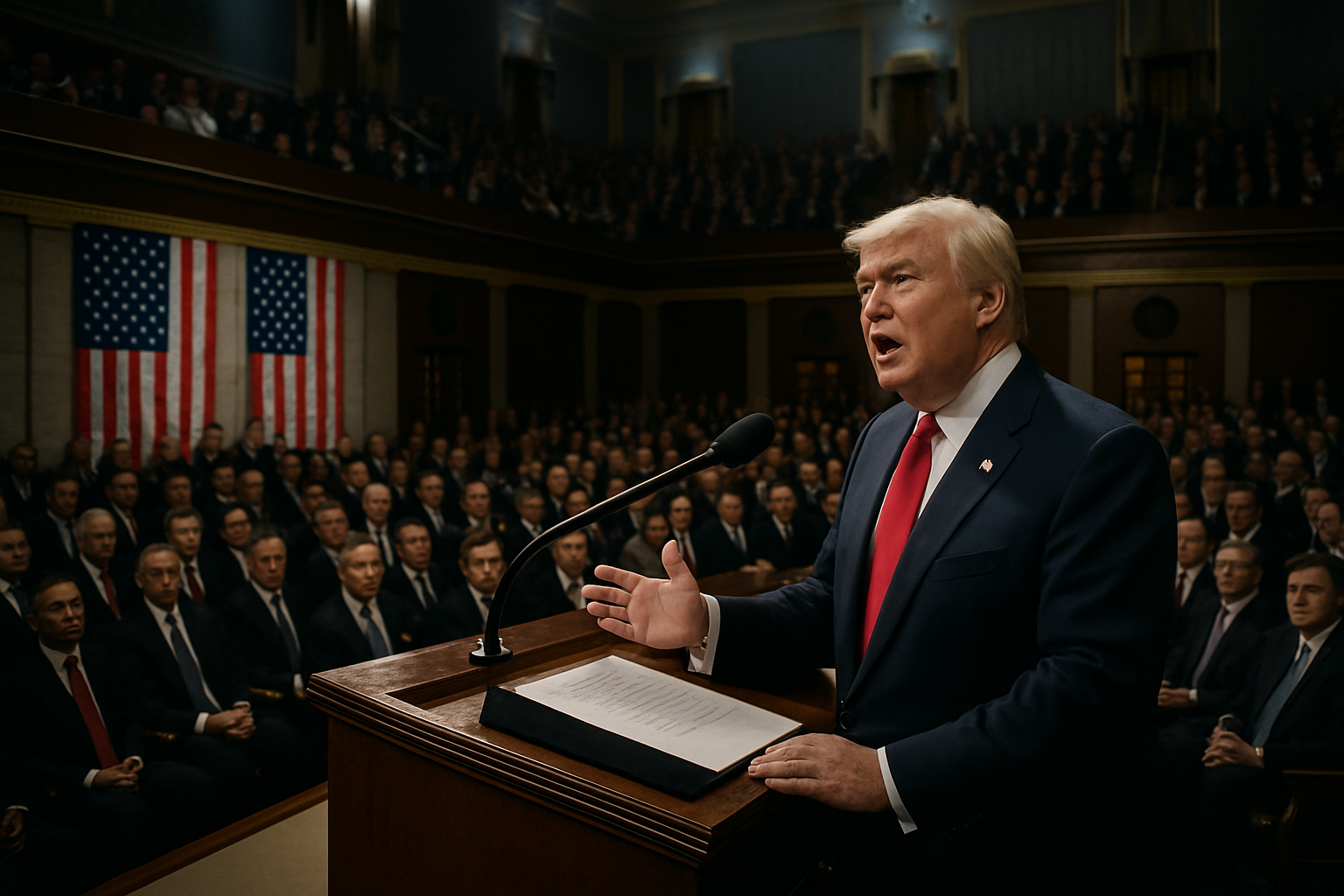
President Donald Trump delivered a marathon State of the Union address on Tuesday, February 24, 2026, lasting a record-breaking 108 minutes and addressing Congress amid the most challenging period of his second presidency, marked by constitutional crises, declining approval ratings, and mounting international tensions.
The address, delivered to a joint session of Congress in the House Chamber, broke Trump's own record for the longest presidential speech to Congress and surpassed Bill Clinton's previous record of 89 minutes set in 2000. The President used the historic venue to outline his agenda while making sweeping claims about the economy and issuing stark warnings to Iran.
Constitutional Crisis and Supreme Court Defeat
The President spoke just four days after suffering a devastating 6-3 Supreme Court ruling that struck down his global tariff program under the International Emergency Economic Powers Act (IEEPA). Chief Justice John Roberts authored the majority opinion applying the "major questions doctrine," declaring that IEEPA "does not authorize president to impose tariffs" without congressional authorization for actions of "vast economic and political significance."
In an unprecedented response, Trump immediately escalated to 15% worldwide tariffs using Section 122 of the Trade Act 1974, creating what constitutional experts describe as the most serious executive-judicial confrontation since Watergate. The President called the justices "absolutely ashamed," "disgrace to our nation," and "disloyal to Constitution" - representing the most severe attack on the judiciary by a sitting president in modern history.
Political Challenges and Declining Approval
The address came as Trump faces significant political headwinds. University of Virginia's Larry Sabato reports the President "has lost great deal" of popularity since inauguration and is "underwater on all top ten issues except border security." The House recently voted 219-211 to end Canada tariffs with six GOP defections, marking the first bipartisan rebuke of Trump's trade authority in his second term.
Swedish expert Emma Ricknell noted the President faces economic concerns and declining confidence, describing the address as a "unique opportunity" to reverse trends with "much at stake" politically. The speech represented Trump's most significant platform to address these challenges with nine months remaining before crucial midterm elections.
Iran Nuclear Threats and Foreign Policy
Trump used the address to issue his most explicit anti-Iran rhetoric yet, calling Iran "the world's number one sponsor of terror" while vowing the US will "never allow" Iran to acquire nuclear weapons. The warning came as Iran maintains uranium enrichment at 60% purity versus the 3.67% JCPOA limit, approaching the 90% weapons-grade threshold.
"We will never allow the world's number one sponsor of terrorism to have a nuclear weapon."
— President Donald Trump
The timing coincided with ongoing Geneva nuclear negotiations between the US and Iran, with talks achieving "broad agreement on guiding principles" according to Iranian Foreign Minister Abbas Araghchi, though fundamental obstacles persist. The President has deployed dual-carrier forces (USS Gerald R. Ford and Abraham Lincoln) creating the largest Middle East naval presence in years.
Economic Claims and Fact-Checking Concerns
Trump claimed credit for economic achievements, including stock market records and inflation reduction, though multiple international outlets conducted immediate fact-checking. CBC News reported the President's "focus on the economy led him to repeat numerous false claims he's made in the past." Austrian outlet Der Standard noted Trump "doesn't keep it so exact with the truth, especially with numbers he handles extremely creatively."
The Irish Times documented fact-checking of Trump's claims about "jobs, energy prices and ending wars," noting the President claimed to have ushered in a "turnaround for the ages" by citing "familiar falsehoods and inaccurate claims." German expert Claudia Brühwiler noted Trump failed to address the issue currently concerning citizens most: the cost of living.
Congressional Divisions and Dramatic Scenes
The address witnessed unprecedented congressional confrontations. Representative Al Green was ejected for displaying a "Black People Aren't Apes" sign, referencing Trump's controversial February video posting. Multiple Democratic walkouts occurred, with Representative Ilhan Omar reportedly shouting "You have killed Americans!" during the immigration section.
Republicans provided repeated standing ovations while Democrats largely remained seated, with some 30+ empty Democratic seats visible throughout the speech. The divisions reflected the deepest partisan polarization during a State of the Union address in recent memory.
Venezuela Partnership and Immigration
In a surprising diplomatic development, Trump described Venezuela as America's new "friend and partner," praising the South American nation's cooperation. The President invited former Venezuelan political prisoner Enrique Márquez as his guest, symbolizing the evolved relationship between Washington and Caracas.
Trump hit familiar notes on immigration and border security, the only issue where polling shows he maintains positive approval ratings. However, critics noted he largely underplayed economic problems that voters consistently rank as their primary concern.
International Reaction and Analysis
France 24's coverage described the speech as "classic Trump" characterized by "bullying and taunting" political enemies rather than attempting to unify the divided American political landscape. Former US diplomat William Lawrence noted there was "little to help unify" the country in Trump's remarks.
International coverage spanned 17+ countries, with European outlets expressing concerns about American democratic institutional stability and policy predictability. The address occurred during complex diplomatic negotiations involving Ukraine peace talks, Iran nuclear discussions, and the ongoing New START treaty expiration crisis.
Nuclear Governance and Global Context
The President's Iran warnings came against the backdrop of unprecedented nuclear governance challenges. The New START treaty between the US and Russia expired February 5, 2026, marking the first time in over 50 years without nuclear constraints between the superpowers controlling 80% of the world's nuclear weapons.
UN Secretary-General António Guterres has warned of a "grave turning point" with nuclear risks at their highest levels in decades. The convergence of multiple nuclear crises - Iran's enrichment program, the US-Russia arms control void, and China's nuclear expansion - creates complex challenges requiring unprecedented diplomatic solutions.
Looking Ahead: Political and Constitutional Stakes
The 108-minute address represents a critical moment in Trump's presidency, delivered amid multiple constitutional, political, and international challenges. With a 150-day countdown on his tariff authority under Section 122 of the Trade Act, the President must secure congressional approval or find alternatives.
The speech's reception will likely influence the upcoming midterm elections, where Republicans face challenging prospects according to political analysts. Success in addressing the Supreme Court challenge, economic concerns, and international crises will determine whether Trump can reverse his declining approval ratings and maintain congressional support.
As European officials monitor American institutional resilience and international partners assess policy predictability, the State of the Union address stands as both a defense of Trump's record and a preview of his strategy for navigating the unprecedented challenges facing his second-term presidency.