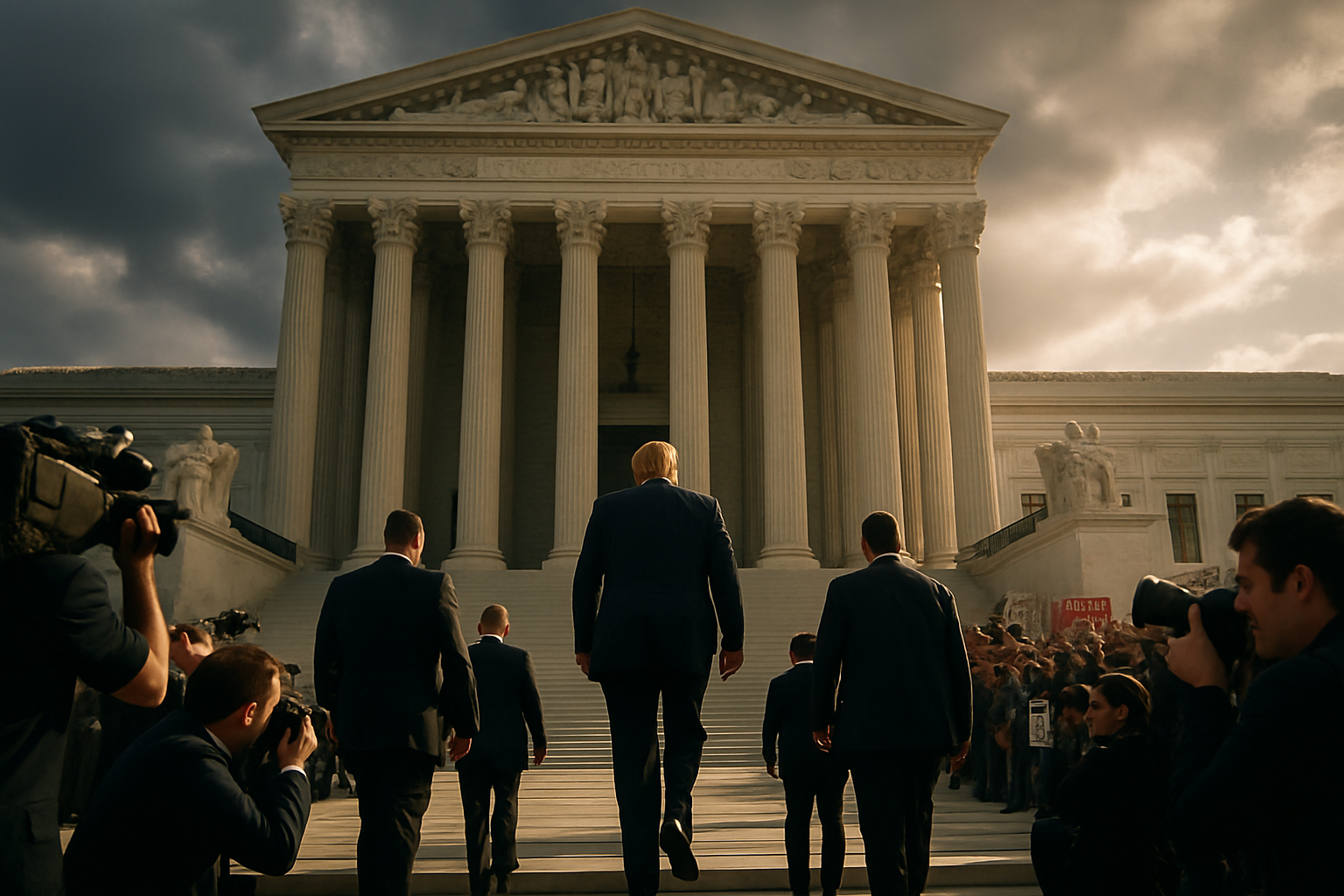
In an unprecedented moment in American constitutional history, President Donald Trump attended oral arguments at the U.S. Supreme Court on Wednesday as justices heard challenges to his executive order ending birthright citizenship - marking the first time a sitting president has appeared at the nation's highest court during oral proceedings.
The historic appearance comes as the Court weighs one of the most consequential constitutional questions of Trump's second term: whether his January 2025 executive order directing agencies not to recognize citizenship for children born on U.S. soil to undocumented immigrants violates the 14th Amendment.
Trump, wearing a dark suit and red tie, sat in the front row of the public gallery as justices posed tough questions about the legality of his directive. The case, formally titled "Trump v. Barbara," represents a fundamental challenge to birthright citizenship protections that have been interpreted as automatic for over 150 years.
Constitutional Crisis Deepens
The president's attendance at Wednesday's arguments occurs amid what legal scholars describe as the most serious constitutional crisis since Watergate. The birthright citizenship case follows the devastating February 2026 Supreme Court ruling that struck down Trump's global tariff program 6-3, with Chief Justice John Roberts applying the "major questions doctrine" to limit presidential emergency powers.
According to multiple sources familiar with the proceedings, some justices including conservative Chief Justice Roberts appeared skeptical of the administration's position. The Justice Department lawyer defending Trump's action faced intense questioning about the constitutional basis for restricting birthright citizenship through executive order.
"This represents the most direct challenge to the 14th Amendment's citizenship clause in modern history. The president's presence underscores how central this issue is to his administration's agenda."
— Constitutional Law Expert, speaking on condition of anonymity
The 14th Amendment at Stake
Trump's executive order directs federal agencies not to recognize the citizenship of children born in the United States if neither parent is an American citizen or legal permanent resident. The policy would effectively end the longstanding interpretation of birthright citizenship guaranteed by the 14th Amendment's citizenship clause.
Lower courts have uniformly blocked the executive order, ruling it unconstitutional. Federal judges in multiple jurisdictions found that the president lacks authority to unilaterally redefine constitutional citizenship protections through administrative action.
The case has attracted unprecedented attention from constitutional scholars, with over 40 amicus briefs filed by legal organizations, civil rights groups, and historians. Many argue that birthright citizenship has been a cornerstone of American immigration law since the 14th Amendment's ratification in 1868.
Demonstrations and Security
Large crowds of both supporters and protesters gathered outside the Supreme Court building throughout the day. Demonstrations began early Wednesday morning, with chants of "Defend the Constitution" from opponents of the executive order mixing with "Secure Our Borders" from Trump supporters.
Security was heightened around the Court building, with additional barriers erected and a significant law enforcement presence. The U.S. Capitol Police, Supreme Court Police, and Secret Service coordinated security arrangements for the president's visit.
According to eyewitness accounts, the scene outside resembled major political rallies, with organized groups on both sides of the issue maintaining largely peaceful demonstrations despite the charged atmosphere.
Historical Precedent and Presidential Power
Wednesday's appearance represents a remarkable breach of traditional separation between the executive and judicial branches. While presidents have occasionally visited the Supreme Court for ceremonial occasions, no sitting president has ever attended oral arguments where their own policies were under review.
The decision to attend appears calculated to demonstrate Trump's confidence in his legal position while applying indirect pressure on the justices. However, constitutional experts note that such direct presidential involvement in pending cases raises questions about appropriate boundaries between branches of government.
Trump's attendance comes amid broader tensions with the federal judiciary. Following the February tariff ruling, the president launched unprecedented attacks on Supreme Court justices, calling them "disgrace to our nation" and "disloyal to Constitution" - the most severe judicial criticism by a sitting president in modern history.
Legal and Political Implications
The outcome of the birthright citizenship case will have far-reaching implications for millions of American families. An estimated 400,000 children are born annually in the United States to parents who lack legal immigration status, all of whom would be affected by the policy.
Legal analysts note that the case tests fundamental questions about presidential power versus constitutional protections. If upheld, the executive order would represent the most significant restriction of citizenship rights since the Chinese Exclusion Act of the 1880s.
The timing also carries significant political weight, occurring amid Trump's declining approval ratings and growing congressional resistance to his policies. Recent polling shows the president "underwater on all top ten issues except border security," according to University of Virginia analyst Larry Sabato.
International Attention
The case has drawn scrutiny from international observers, with multiple countries issuing diplomatic notes expressing concern about potential impacts on dual nationals and international law. European officials have privately questioned whether the policy complies with international human rights obligations.
Immigration rights organizations worldwide have highlighted the case as a test of American commitment to constitutional governance and rule of law. The outcome is expected to influence global debates about citizenship, immigration, and executive power.
What Happens Next
The Supreme Court is expected to rule on the case by the end of the current term in June 2026. Given the significance of the constitutional questions involved, legal experts anticipate a detailed written opinion that could reshape the boundaries of presidential immigration authority.
Wednesday's arguments focused heavily on textual interpretation of the 14th Amendment, historical understanding of citizenship at the time of ratification, and the scope of executive power over immigration policy. The justices appeared divided along familiar ideological lines, though some conservative members expressed reservations about the breadth of the administration's claims.
Whatever the outcome, Trump's unprecedented appearance at oral arguments will be remembered as a defining moment in the ongoing tension between presidential power and constitutional limits. The case represents not just a legal dispute over birthright citizenship, but a fundamental test of American democratic institutions in an era of expanded executive authority.
As demonstrators continued gathering outside the Court building into the evening, the historic nature of the day was clear: for the first time in American history, a sitting president sat in the Supreme Court gallery as justices weighed the constitutionality of his own executive order. The reverberations of Wednesday's proceedings will likely influence constitutional law and presidential conduct for generations to come.